
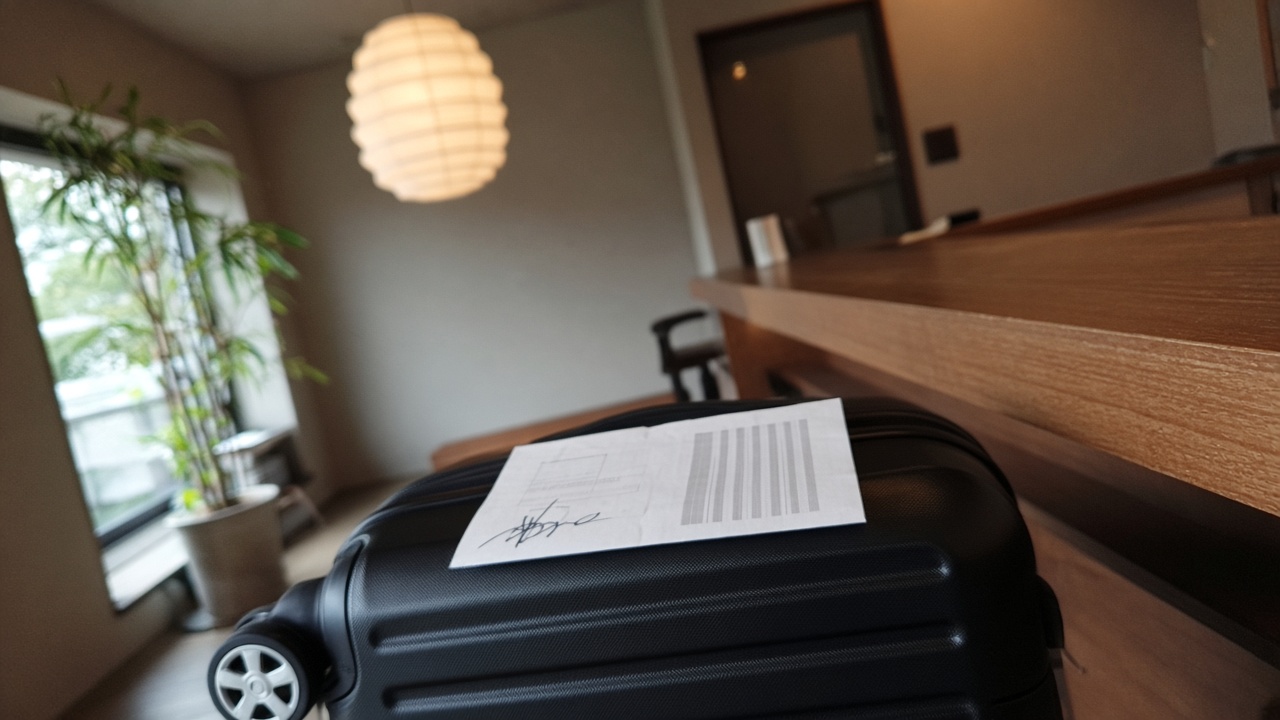
Short answer
Yes. You can send luggage from one hotel to another in Japan when the sending hotel works with a delivery company and the next hotel will hold the bag at the front desk. For tourists the default carrier is Yamato Transport (Kuroneko, service name TA-Q-BIN / takkyubin). Sagawa Express and Japan Post Yu-Pack do the same job at some desks.
Yamato's hotel-to-hotel FAQ says the bag must arrive at least one day before the stay. Their accommodation note says to hand it in before the cutoff at least two days before check-in, and three days where the trip itself takes two delivery days. Those two lines are the same rule: delivery is one day or two, so you send early enough to land the day before. You cannot pick a delivery hour for a hotel address, and cash-on-delivery to a guest is not allowed.
Yamato, Sagawa, and Japan Post
Ask the desk which slip they use. If they are a Yamato partner, they fill in the waybill. Do not assume every property is. A ryokan may use the same carrier but only during reception hours — see the Kyoto ryokan guide before you assume a late drop-off is fine.
Book a stay with a real front desk, not a lockbox. Compare hotels in central Tokyo, Kyoto, and Osaka and write in the request: “Please confirm you can receive Yamato luggage before check-in.” An eSIM or Yesim helps when you need to call the next hotel or open the tracking page.
What to do at the front desk
- The day before, ask the cutoff for the hotel pickup. Miss it and you lose a day.
- Bring the next reservation: hotel name, address, phone, check-in date, and the guest name in romaji, matching the booking.
- The clerk writes the waybill. You pay per piece, usually cash or card.
- Keep the tracking copy. Do not peel it off and “tidy” the suitcase.
- Travel with a daypack. At the next hotel, ask reception — bags are often behind the desk, not in the room.
Pack the shipped case the way you would for a hold: see the long-trip suitcase guide. The bag you keep should still pass as a carry-on on the Shinkansen, where oversized luggage can need a reserved seat.
Deadlines: do not ship on the morning you need the bag
Yamato says delivery takes one day or two, depending on the destination. Use their date search with the two postcodes. Do not treat Tokyo–Kyoto and Tokyo–Sapporo as the same clock. Same-day delivery exists only for some same-area drop-offs at a sales office, not for a hotel-to-hotel hop across regions. Typhoons and peak holidays (Golden Week, Obon, New Year) can add a day on top.
Pattern that matches the Yamato hotel FAQ: if you check into Kyoto on Thursday, the suitcase should already be there on Wednesday. On a one-day lane that means sending it from Tokyo on Tuesday. Where delivery takes two days, send on Monday. You live out of the daypack for a night. Some hotels charge a storage fee if the bag arrives early — ask before you build that buffer.
Dropping the bag on checkout morning and hoping it arrives that evening does not meet the “day before the stay” rule. If the bag is late, travel insurance does not replace a change of clothes. Yamato’s own liability cap is ¥300,000 per piece. Keep one outfit in the daypack.
Size and price: Tokyo to Kyoto
The cash price is the sum of three sides in centimetres, then the weight cap for that size — whichever is larger wins. Figures below are Kanto to Kansai (Tokyo to Kyoto or Osaka) on the Yamato cash fare list in force since 1 October 2025, tax included. Over 30 kg is refused. One side longer than 170 cm is refused. A same-prefecture rate (Tokyo hotel to another Tokyo hotel: size 140 is ¥2,090, size 160 is ¥2,410) applies only to pickup, a sales office, a locker, or a convenience store with a smartphone waybill — a handwritten hotel slip may not get it. Osaka to Kyoto is not that rate: both cities are Kansai, but different prefectures, so size 140 is ¥2,630 and size 160 is ¥3,020.
| Size | Tokyo–Kyoto | Note |
|---|---|---|
| 100 | ¥1,650 | Up to 100 cm and 10 kg. A small bag, not a full suitcase. |
| 120 | ¥2,170 | Up to 120 cm and 15 kg. Many cabin cases, if they stay under 15 kg. |
| 140 | ¥2,780 | Up to 140 cm and 20 kg. A mid-size case. |
| 160 | ¥3,160 | Up to 160 cm and 25 kg. A 70–75 cm suitcase usually lands here. |
A second piece to the same address is ¥100 less on prepaid regular TA-Q-BIN. That multi-piece discount does not apply to suitcases of size 160 or larger, or to Airport TA-Q-BIN. Drop-off at a convenience store, agency, or sales office is ¥100 less per piece than the table above. The digital-waybill discount is ¥60 and does not stack with a convenience-store drop-off. A hotel desk often charges the full cash rate. None of this is worth missing the cutoff.
What not to put in the shipped suitcase
Leave with you: passport, cash, cards, house keys, medicines you might need that night, and anything you cannot replace. Yamato’s liability cap is ¥300,000 per piece. A duffel or Boston bag must have a cover; a suitcase does not, but it can get scratched. Anything over 30 kg is refused, and some convenience stores will not take size 180 or larger. Name the contents on the waybill. Spare lithium batteries and aerosols are restricted — do not assume a power bank can ride in the case, especially if any leg moves by air.
Write your name on the case itself. The waybill can tear. A photo of the tracking number in your phone is the backup if the paper slip stays in the taxi.
If the hotel has no shipping desk
Yamato will not collect from a typical Airbnb or a monthly apartment with no partnership. Carry the bag to a 7-Eleven or FamilyMart that displays the Yamato mark, or to a Yamato office. Staff may not speak English; a screenshot of the next hotel address in Japanese (from the booking email) solves most of it.
Choose the next stay with that in mind. Central desks that already handle groups are listed in the central Tokyo hotels and central Osaka hotels guides. For the flight in, compare flights into Haneda, Narita, or Kansai, then use the airport baggage counter — it is not always a Yamato-branded desk.
Airports: into the first hotel and out to the flight
JAL ABC runs the airport baggage counters at Narita terminals 1 and 2, Haneda terminal 3, and Kansai terminal 1. At Chubu Centrair that same service sits at the Yamato counter. Airport to hotel still has to arrive at least one day before you need the bag, so a 21:00 landing does not put the suitcase in the room that night. Hotel to airport: ship the day before the flight, then collect with time before check-in. Counter hours differ by terminal — Haneda’s JAL ABC desk is not a reason to assume Narita is open at the same hour.
ANA’s domestic Express Home Delivery (快速宅空便) takes a checked bag from an ANA domestic flight to a hotel or home. It is for ticketed ANA passengers, not a walk-up substitute for hotel-to-hotel TA-Q-BIN in the middle of a trip.
A Tokyo–Kyoto–Osaka hop without the suitcase
Sketch the nights first, then the shipping days. A common shape is four nights in Tokyo, three in Kyoto, two in Osaka. Send the Tokyo bag so it is already in Kyoto the day before you board the Shinkansen. Kyoto to Osaka is cheaper (Kansai-to-Kansai, not same-prefecture) but not faster: still land the bag the day before, and still watch a ryokan desk that closes.
While the case is in transit, walk. Kyoto temple geography is in the Fushimi Inari, Kinkaku-ji, and Kiyomizu guide. A hands-free city day pairs well with the Japan bike rental guide. Longer jumps — Matsumoto, Takayama, the Japanese Alps — need the three-day send window, not the Tokyo–Kyoto one.
Ready-made scaffolds: Tokyo 7 days for a couple, Kyoto 3 days for a weekend, and Osaka 3 days for a couple. How to chain cities in one vacation is in the multi-city route guide.
Put the hotel changes on a day-by-day plan so each suitcase leaves a day early.
Build the routeReady-made routes
Routes for your destination
Day-by-day plans you can adapt to your dates right away.
FAQ
Can I send a suitcase from one hotel to another in Japan?
Yes, if the sending hotel partners with a carrier such as Yamato Transport and the next hotel accepts bags at the front desk. Confirm both points before you rely on it. Airbnb-style stays usually cannot ship from reception.
When should I send the bag?
The hotel-to-hotel rule is that the bag must arrive at least one day before the stay. The accommodation note says to hand it in before the cutoff at least two days before check-in, and three days where delivery takes longer. Delivery itself is one day or two, depending on the destination. Some hotels charge storage if the bag arrives early. If it will land after you do, travel with a daypack.
How much does Tokyo to Kyoto luggage delivery cost?
On the Yamato cash tariff in force since 1 October 2025, Tokyo to Kyoto is ¥1,650 for size 100, ¥2,170 for size 120, ¥2,780 for size 140, or ¥3,160 for size 160, tax included. If the bag is heavier than that size cap, you pay the next size. A convenience-store or sales-office drop-off is ¥100 less per piece. A hotel desk may not give that discount. Confirm the figure on the waybill.
What should stay in my day bag?
Passport, cash, cards, medicines, chargers, one change of clothes, and toiletries. Do not ship valuables you cannot replace. Yamato liability is capped at ¥300,000 per piece. Cash-on-delivery addressed to a hotel guest is not allowed.
What if the hotel cannot ship my luggage?
Take the bag to a 7-Eleven or FamilyMart that shows the Yamato mark, or to a Yamato sales office. You still need the next hotel name, address, phone, and the guest name exactly as on the reservation.