
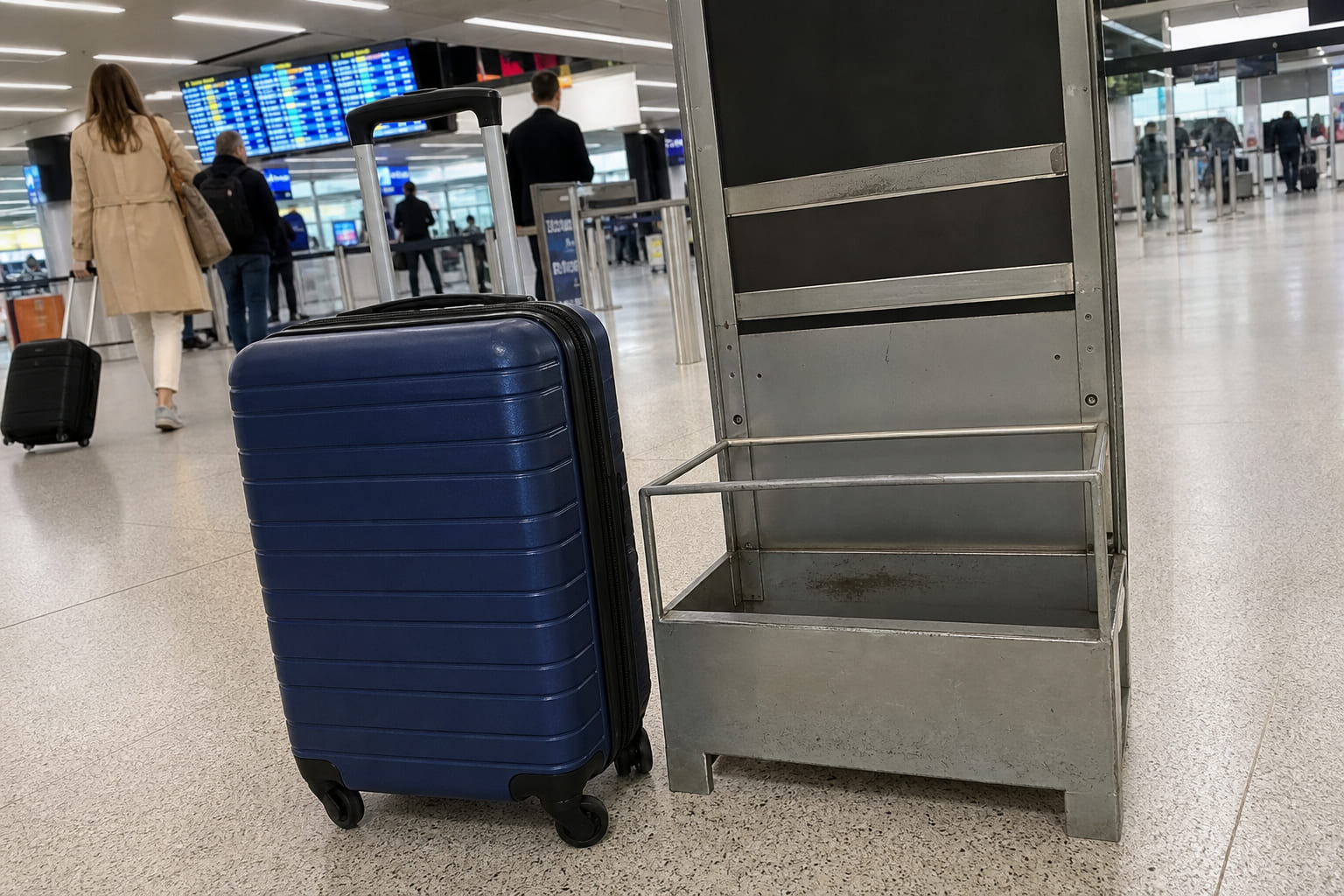
The right suitcase cuts budget airline baggage fees and speeds up connections — with one carry-on only self-transfers save 30–60 minutes, as explained in our airport layover guide.
3 non-negotiable rules when buying cabin luggage
- Real outer dimensions. The international sweet spot is 55×40×20 cm (depth sometimes up to 23–25 cm). Always account for wheels and handles — that is why bags fail the sizer at the desk even when the label says “cabin size.”
- Shell material. Skip cheap ABS — it shatters on drops. Choose polypropylene or polycarbonate: lighter, shock-absorbing, and fine in the hold if you are gate-checked.
- Hardware and maneuverability. Four double spinner wheels damp vibration and let you roll sideways down a narrow aisle. The telescopic handle should lock in at least two heights with minimal wobble.
Premium tier ($1000+)
Aviation-grade aluminum, patented materials, lifetime warranty — worth it if you fly 15–20+ times a year.
RIMOWA Essential Cabin
Polycarbonate classic — benchmark lightness and reliability. Flawless double-wheel roll and an internal compression system.
TUMI 19 Degree Aluminum Carry-On
Aviation aluminum with ribbed design. Extremely tough shell and TSA locks integrated into the metal frame. Around $1295.
Briggs & Riley Baseline Essential Carry-On
Known for CX expansion tech: adds ~25% volume, then compresses back to carry-on dimensions while squeezing clothes.
Mid-range ($150–$400)
Durable polypropylene or ballistic nylon without paying for luxury branding — the sweet spot for most travelers.
Samsonite Freeform Carry-On Spinner
Light polypropylene shell with expansion and built-in TSA lock. A workhorse for frequent trips.
Travelpro Platinum Elite Carry-On Spinner
Crew favorite. PrecisionGlide magnetic wheels for smooth roll and a built-in USB port for your power bank. About $390.
Delsey Paris Hardside Expandable
French design with patented SECURITECH zipper — claimed 3× stronger than standard and harder to tamper with.
Budget (up to $100)
Budget bags can work if you insist on polypropylene, not ABS. Money saved on checked bags belongs in the trip budget calculator and our travel savings guide.
American Tourister Soundbox 55cm
100% polypropylene from Samsonite’s value line. Fits most cabin rules, expands, and rolls on dependable wheels.
Xiaomi 90 Points (Ninetygo) Cabin Luggage
Popular three-layer Makrolon polycarbonate. Light, quiet wheels, minimalist look.
Robinzon RS5743-M Montreal
Affordable polypropylene that matches strict low-cost limits (55×40×20) at low empty weight.
Suitcase covers for airport protection
A good cover pays back in 2–3 flights versus plastic wrap, shields hard shells from scratches, and keeps fabric dry. If gate-check is likely, add travel insurance for conveyor damage.
What to look for
- Material: neoprene or dense spandex. Neoprene (wetsuit-grade) absorbs bumps and resists moisture; spandex is thinner but stretches to fit odd shapes.
- Bottom attachment: wide elastic strap with a sturdy buckle, plus zipper or Velcro under the wheels.
- Handle access: hidden slits on zippers for top and side grab handles.
Top cover brands
Routemark
Russian leader in quality covers. Flagship lines use SP240 spandex (240 g/m²) that hugs corners without fraying. Sublimation prints resist sun fade.
Fancy Armor
Elastic fabric with water-repellent finish, double bottom fixation (strap + buckle), often includes a storage pouch. Huge print catalog.
Samsonite Travel Accessories
OEM-fit polyester covers — conservative designs but patterns matched to Samsonite shells without wrinkles.
Plan a route around your carry-on
Bag chosen — now build the trip. AlpacaBag assembles a detailed itinerary in minutes: duration, budget, and transport — from a Paris weekend to a week in Italy with one cabin suitcase.
Ready-made routes
Routes for your destination
Day-by-day plans you can adapt to your dates right away.


FAQ
What size carry-on suitcase fits airline requirements?
The gold standard is 55×40×20 cm (sometimes depth up to 23–25 cm). Count protruding wheels and handles — the sizer at check-in measures the full outer dimensions. Budget airlines often enforce stricter limits (40×30×20 cm for a backpack).
Polypropylene, polycarbonate, or ABS — which is best?
ABS is cheap but cracks on impact — skip it for frequent flyers. Polypropylene and polycarbonate are lighter, flex on bumps, and handle temperature swings in the hold if you are forced to gate-check.
How much should an empty carry-on suitcase weigh?
Aim for 2.5–3.5 kg for a 55 cm hardside. With an 8–10 kg airline limit, every gram of shell weight eats into your packing capacity. Lightweight picks like American Tourister Soundbox or Xiaomi 90 Points are sensible compromises.
Do I need a suitcase cover at the airport?
Not mandatory, but it pays for itself in 2–3 flights compared to wrap fees. Neoprene or dense spandex protects hard shells from conveyor scratches; fabric shells from moisture and grime.
Is Rimowa or TUMI worth the premium?
If you fly 20+ times a year and value lifetime warranty and wheel performance — yes. For 2–4 trips annually, Samsonite Freeform or Travelpro Platinum Elite deliver ~80% of the function at ~20% of the price.