
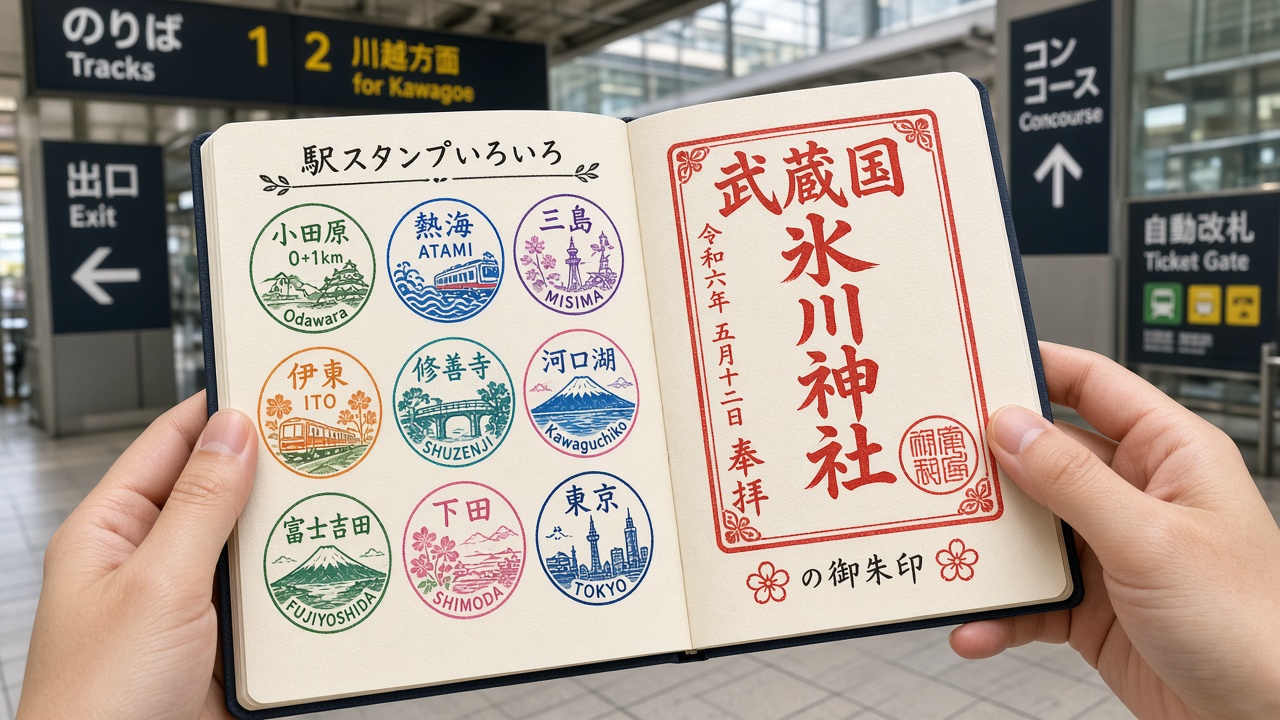
What tourists collect: eki stamps vs goshuin vs attraction stamps
Three overlapping hobbies get lumped under “Japan stamps.” Knowing which desk you want saves awkward moments at temples and stations.
- Eki stamps (駅スタンプ) — free self-service ink stamps at many railway stations. Cartoon maps, local mascots, seasonal art. Usually one design per station (sometimes rotating).
- Goshuin (御朱印) — temple or shrine calligraphy plus red seal, written into a dedicated book (御朱印帳) by staff for a small cash fee. Not a free souvenir pad.
- Attraction / museum stamps — castles, observation decks, theme parks and museums often keep a free ink pad near the exit or info desk.
Personal name seals (hanko) are a different shopping item—see our Tokyo souvenir shops guide if you want a carved name stamp, not a travel journal.
Flying in soon? Compare flights into Tokyo or Osaka before you lock a stamp-hunting loop between cities.
Where to buy a stamp book
Look for スタンプ帳 (general stamp books) or 御朱印帳 (goshuin books). Prices vary by cover quality and shrine/temple branding—budget notebooks exist alongside artisan covers; check the shelf tag rather than assuming one national price.
- Major JR stations and tourist information desks often sell simple stamp books.
- Loft, Tokyu Hands / Hands, and large bookstores stock blank stamp journals.
- Temple and shrine gift shops sell site-specific 御朱印帳—useful if goshuin is your focus.
- Convenience stores rarely carry good books; save the stop for ink or cash.
Keep a working Japan eSIM so you can map the next stamp desk without relying on station Wi‑Fi alone.
Etiquette and rules
- Do not press stamps on walls, poles, or other people’s books.
- Queue politely; let locals finish tickets before you ask for the stamp corner.
- For goshuin, wait quietly, open the book to a blank page, and thank staff afterward.
- Cash is still common for goshuin offerings—carry coins and small bills.
- Skip stamp desks during platform emergencies or when staff are managing crowds.
Temple circuits pair well with our Kyoto temples guide and the Sensō-ji Tokyo guide—confirm each site’s 御朱印所 hours before you queue.
Tokyo examples
Tokyo Station is the classic first eki stamp for many visitors—ask for the current スタンプ location near tourist services, because renovations move desks. Combine with a short walk toward the Marunouchi side after you stamp.
Other reliable Tokyo hunts: major JR hubs on the Yamanote loop (designs differ by station) and tourist-heavy spots like Asakusa around Sensō-ji, where shrine/temple goshuin and nearby attraction stamps often sit on the same half-day walk.
Slot stamps into a Tokyo 3-day budget route or an off-the-beaten-path Tokyo plan so you are not zigzagging across the city for one ink pad.
Kyoto and Osaka examples
In Kyoto, temple goshuin is the headline hobby: Fushimi Inari, Kinkaku-ji area shrines, and Kiyomizu-dera neighbourhoods all have well-known 御朱印 desks—hours and fees are local. JR Kyoto Station also keeps eki-stamp culture alive for rail travellers.
In Osaka, mix station stamps at big JR/Metro hubs with castle and waterfront attraction pads. Dotonbori evenings are for food; stamp desks are quieter mid-morning.
Ready-made loops: Kyoto 3 days budget and Osaka 3 days budget. Stay near a rail hub with an Osaka or Kyoto hotel if you plan early stamp runs.
Wow outside the core: Kamakura and Hiroshima
Kamakura rewards a day trip from Tokyo: shrine and temple goshuin plus station stamps on the JR/Enoden corridor. Pack patience on weekends—paths clog near the Great Buddha.
Hiroshima pairs Peace Park context with castle/attraction stamps and JR station ink if you continue west. Use the JR Pass calculator guide before buying rail passes for a Tokyo–Kyoto–Osaka–Hiroshima arc.
English SEO hubs cover Tokyo, Kyoto and Osaka first—build Kamakura/Hiroshima as day or overnight add-ons inside the itinerary wizard.
How to fit stamp hunting into a multi-city trip
Treat stamps as five-minute stops, not day goals. Park the book in an outer pocket, stamp while waiting for a timed entry, then move on. A realistic loop is Tokyo → Kyoto → Osaka with optional Kamakura or Hiroshima wings.
Build the route around your stamps
Drop Tokyo, Kyoto and Osaka days into one itinerary so stamp desks sit next to temples and transfers—not as a separate scavenger hunt.
Ready-made routes
Routes for your destination
Day-by-day plans you can adapt to your dates right away.
Frequently asked questions
Are eki stamps free in Japan?
Yes. Station eki stamps (駅スタンプ) are free promotional stamps at many JR and private-railway stations. Bring your own book or paper—ink pads stay at the desk. Designs and desk locations change; ask station staff if you cannot find the stamp stand.
Do I need a special stamp book?
A dedicated stamp book (スタンプ帳) or goshuincho (御朱印帳) keeps pages flat and looks nicer, but many travellers start with a notebook. Temple offices prefer a goshuincho for 御朱印; station stamps accept almost any blank page.
How much does a typical goshuin cost?
Expect a modest cash offering in the hundreds of yen at many temples and shrines—amounts vary by site and season. Confirm the posted fee at the 御朱印所 desk; do not invent a fixed national price.
Can I stamp in a plain notebook?
For eki and attraction stamps, yes. For goshuin, staff usually want a proper 御朱印帳 so calligraphy sits on dedicated pages. Avoid sticking goshuin on random receipts or phone cases.
Where do I find the stamp desk at big stations?
Look near tourist information, ticket offices, or clearly marked “stamp” corners inside the paid or free area—signage often says Stamp or スタンプ. At Tokyo Station and other hubs, desks can move for renovations; ask “スタンプはどこですか?”