
Food travel in Asia is not just photo spots — it is knowing what is worth the calories and yen/won, and what is sold to tourists at a markup. We sorted the headline dishes into three buckets — must try, overrated, and acquired taste — so you can plug them into a multi-city vacation plan without disappointment.
Before you fly, model food spending in the travel budget calculator and read the budget food in Asia guide for konbini, CU, and cheap snacks. For a European comparison, see the Romania food guide.
Must try: Korean and Japanese essentials
Korean BBQ (Samgyeopsal / Bulgogi)
Must tryBest region: Seoul (Hongdae & Gangnam) and Busan
In South Korea, grilling meat is a social ritual. Restaurants put a built-in grill in the table center; guests cook thin slices of marinated beef (bulgogi) or pork belly (samgyeopsal). Wrap meat in lettuce with garlic, gochujang, and kimchi for the full flavor balance.
Best entry point into Korean food: about ₩9,000–15,000 per portion or all-you-can-eat formats. Book stays in Hongdae or Gangnam to walk to BBQ spots at night. A ready-made capital plan: 3-day budget Seoul route.
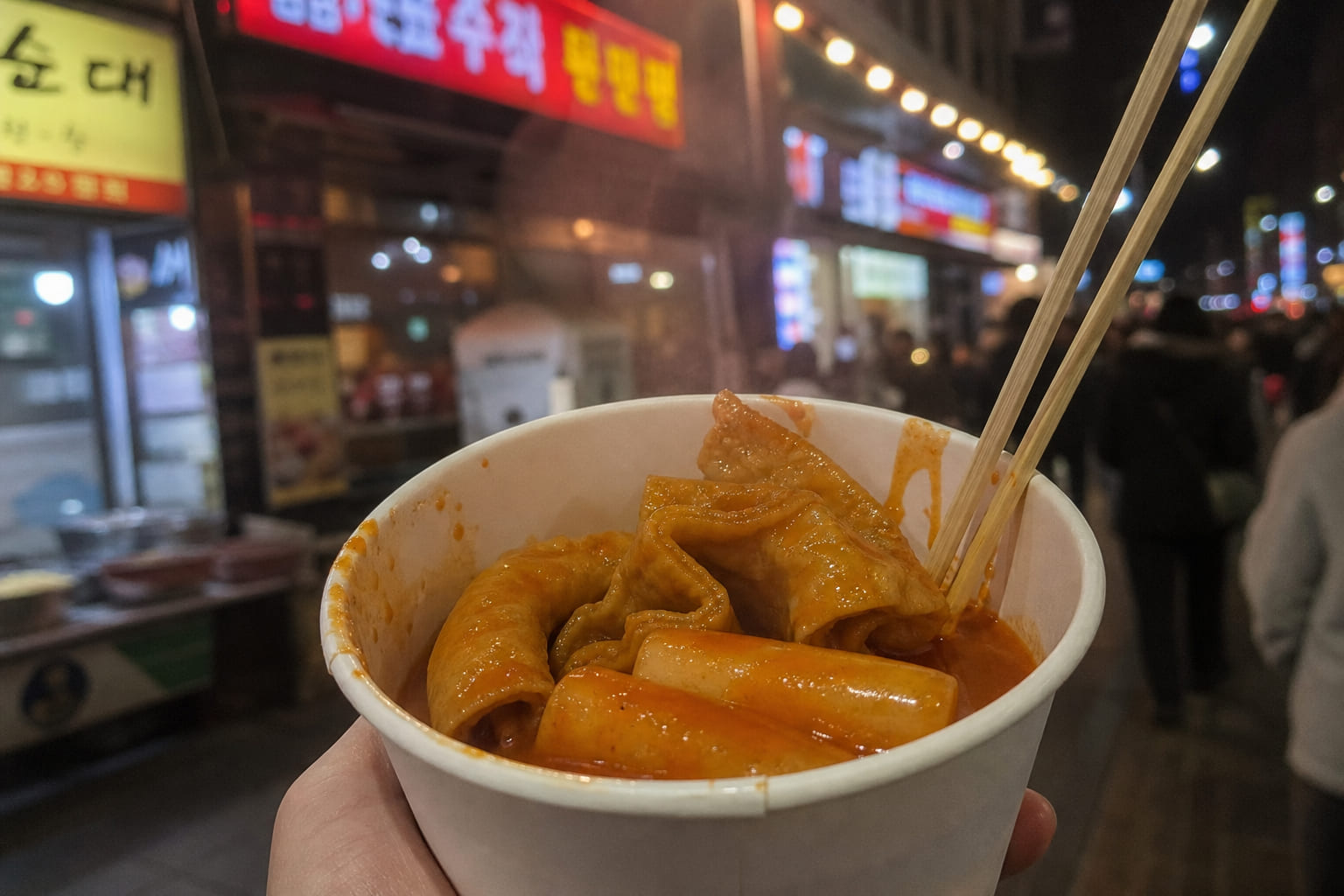
Tteokbokki
Must tryBest region: Korean street markets (Gwangjang Market, Seoul)
Iconic street food: cylindrical rice cakes simmered in thick sweet-spicy gochujang sauce. Chewy texture, often served with fish cakes (odeng). A filling snack around ₩3,000 that warms you up at a night market.
Near Gwangjang Market, grab kimbap too — Korean rice rolls sold at kiosks across Seoul. A fast lunch between sights.
Overrated: tourist traps
Sushi at tourist markets (Tsukiji & Nishiki)
OverratedBest region: Avoid tourist markets in Tokyo and Kyoto
Tourism and a weak yen created “inbound-don” — seafood bowls priced for foreigners. At Tsukiji in Tokyo or Nishiki in Kyoto, a kaisendon bowl can hit ¥7,000 (about $45), roughly five times local norms.
Better sushi hides in neighborhood shops or conveyor-belt spots away from tourist zones. For capital planning see the 3-day Tokyo food tour route; for traditional flavors try the budget Kyoto route.
Street crab snacks in Japan
OverratedBest region: Avoid tourist zones in Hokkaido and Osaka
Japan is famous for seafood, but street fast food often disappoints. At Hokkaido ski resorts (Niseko) a basic crab ramen can cost ¥3,800 (about $24) — triple Sapporo prices. Same for dried squid or fish packs at $15–20.
In Osaka, hunt takoyaki and okonomiyaki in residential blocks, not main tourist strips. Example route: 3 budget days in Osaka.
Acquired taste: bold experiments
Traditional Japanese breakfast (Natto)
Acquired tasteBest region: Ryokan inns across Japan
A classic Japanese breakfast often includes natto — fermented soybeans with a strong smell and sticky, stringy texture. Locals eat it with rice, raw quail egg, and soy sauce for health benefits; for many Western palates it is a serious challenge.
Spicy Korean seafood & seaweed soups
Acquired tasteBest region: Coastal cities and Korean islands
Korea serves soups packed with seaweed and niche seafood (including sea snails), plus brutally spicy cold noodle soups (naengmyeon). If you dislike iodine-heavy smells or extreme gochugaru heat, choose milder tteokmanduguk (rice cake and dumpling soup) instead.
Before island hops to Jeju or coastal towns, get travel insurance and an eSIM for Japan and Korea — navigation and menu translation matter off the main strips.
Build a food route across Japan and Korea
In AlpacaBag, set interests, dates, and budget — the planner suggests cities, logistics, and spots for BBQ, tteokbokki, and local Japanese food without juggling dozens of tabs.
How to slot food into a day-by-day plan
A solid 10–12 day loop: Tokyo (3 days, local ramen and sushi) → Kyoto (2–3 days, kaiseki and tea) → Osaka (1–2 days, street food) → fly to Seoul (3–4 days, BBQ and Gwangjang Market). Compare Tokyo–Seoul flights early — routing via Osaka is sometimes cheaper.
Tipping is not expected in Japan — details in the tipping guide by country. To avoid overspending on stays and flights, see how to save money while traveling. Pick timing with the best season guide for top destinations, and for downtime between meals — free things to do in any city.
Want deeper local food context? Book a food tour with a local guide in Tokyo or Seoul to find authentic spots off tourist streets.
Ready-made routes
Routes for your destination
Day-by-day plans you can adapt to your dates right away.
FAQ
What food must you try in Japan and South Korea?
In Korea: Korean BBQ (samgyeopsal or bulgogi) and street tteokbokki at a market. In Japan: skip tourist-market sushi and go to local sushi bars and ramen shops. Kimbap is a handy snack in Seoul between sights.
How much does Korean BBQ cost in Seoul?
A portion of samgyeopsal or bulgogi usually runs 9,000–15,000 won (about $7–12) per person. All-you-can-eat formats start around 15,000–25,000 won. Hongdae and Gangnam cost more; outer districts are cheaper.
Why is sushi at Tsukiji and Nishiki markets overrated?
Tourism and a weak yen created “inbound-don”: seafood bowls priced for foreigners — up to ¥7,000 ($45) per bowl, roughly five times what locals pay. Better sushi hides in neighborhood shops or conveyor-belt restaurants away from tourist zones.
How do I fit food into a Japan–Korea itinerary?
A classic loop: Tokyo (3–4 days) → Kyoto or Osaka → fly to Seoul for 3–4 days. In AlpacaBag you can build a day-by-day route with markets, BBQ spots, and local cafés.