
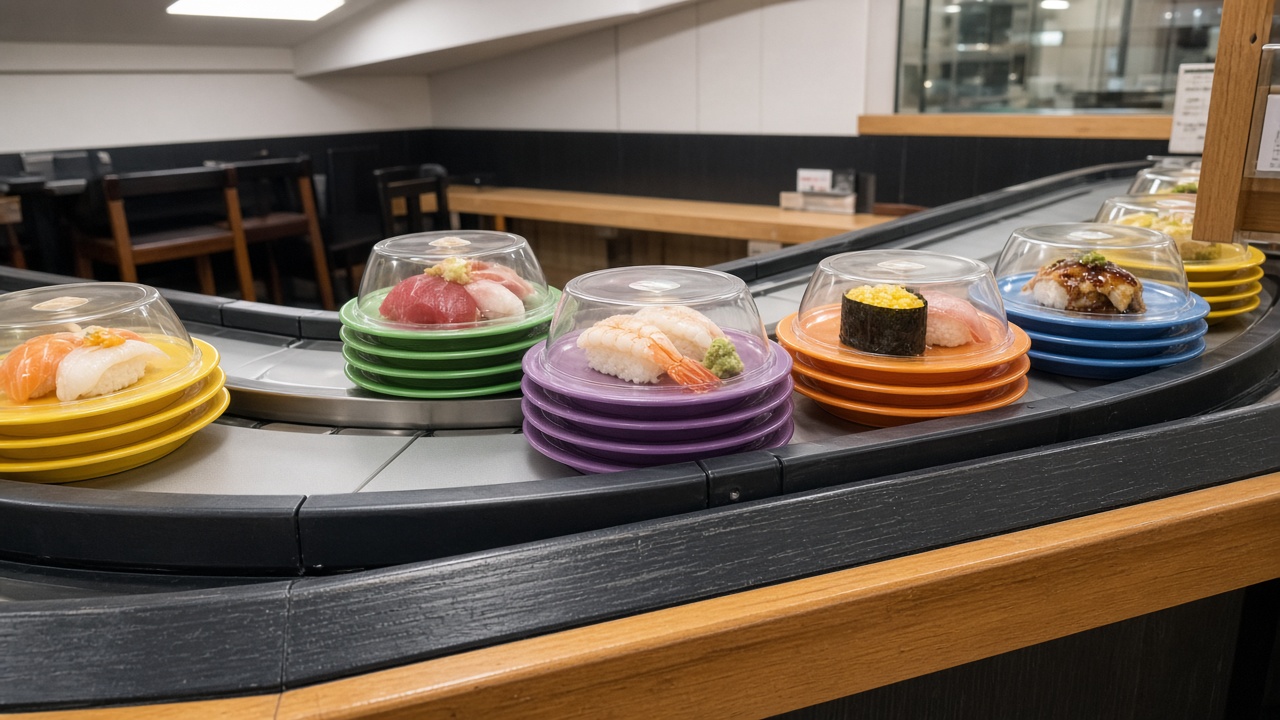
Why kaiten is the tourist default in 2026
This is not omakase and not a two-hour counter seat. Conveyor-belt sushi lets you control pace and spend: grab a plate, order from the tablet, pour your own tea, leave in 30–45 minutes. Between temples and transfers it beats hunting a “secret” restaurant with no reservation.
By 2026 most busy branches pair the classic belt with express lanes or tablet delivery—so the good stuff is less likely to sail past while you decide. For street snacks and market traps, see the Japan & Korea food guide and budget food across Asia.
How to read the belt in one minute
- Plate colour ≈ price band. Cheaper bands are often yellow/white; pricier ones red, black or gold. The legend is at the entrance or on the tablet.
- Belt vs tablet. Belt = ready now; tablet = freshly made or missing items. Never put a plate back on the belt.
- Tea. Usually self-serve: hot water + powder—pour your own.
- Wasabi and soy. Many nigiri already include wasabi; dip fish, not rice, if you want the local move.
1. Sushiro — the safe default almost everywhere
Japan’s largest kaiten footprint: stations, suburbs and malls from Hokkaido to Kyushu. Predictable quality, broad menu, English tablet at most busy shops. Standard plate bands often start around ¥100+ depending on region and campaigns.
Best for: first visit, families, lunch between trains. Unsure what to pick? Start here.
2. Kura Sushi — games, booths and kids
Kura (くら寿司) is the one with bikkura-pon-style plate games, mirrored booths and a strong family vibe. Menus are large; many tablets add allergen/vegan filters—still double-check the dish card.
Best for: travelling with kids or when you want a slightly more “attraction” lunch without losing kaiten speed.
3. Hama Sushi — often the cheapest bands
Hama frequently wins on price: simpler rooms, less theatre, more branches near residential strips and big-box retail. Tourists find it on Maps just outside ultra-central stations—handy after a suburban day.
Best for: tight budgets, big appetites, lunch without a neon queue. Honest chain quality, not a food theatre.
4. Kappa Sushi — value, but check the branch
Kappa has been renovating hard: price-led positioning and refreshed dining rooms. Branch variance is higher than Sushiro—skim recent Maps reviews for the location near your hotel before you commit.
Best for: when Sushiro/Hama are far and Kappa is next door. Treat it as a solid Plan B, not the only stop of the day.
5. Uobei — express rails and Greater Tokyo
Uobei leans into the wow factor: orders often shoot along dedicated rails to your table. Coverage is denser in Kantō than nationwide—Osaka/Kyoto travellers will more often land on Sushiro, Kura or Hama.
Best for: a first Tokyo evening when you want a quick show and a clear bill. Look near major stations and shopping complexes.
Etiquette and payment
- Do not return plates to the belt or hover over someone else’s food.
- The bill is usually by plate stack or auto-counter—watch the on-screen total.
- Cards and IC (Suica/Pasmo and friends) are increasingly common, but smaller branches may still prefer cash—keep some yen.
- Peak dinner near stations queues up: aim for late lunch or take a number in the chain app.
For Maps, chain apps and offline pins, grab a Japan eSIM—mall Wi‑Fi rarely helps while you wait outside.
Fit kaiten into Tokyo, Osaka and Kyoto
Treat conveyor sushi as a lunch insert, not the day’s goal. In Tokyo it slots after Asakusa morning or before a Shibuya evening; in Osaka before or after Dotombori; in Kyoto between temple loops when you do not want a two-hour café. For “wow coffee” between sushi stops, see unusual Tokyo cafés.
- Tokyo · 3-day food tour
- Tokyo · 3 days budget-friendly
- Osaka · 3 days budget-friendly
- Kyoto · 3 days budget-friendly
Stay near a rail hub so dinner is not a cross-city trek: hotels by stations in Tokyo, Osaka or Kyoto. Still choosing an arrival city? Compare flights into Tokyo or Osaka.
Build a trip around the lunches
Drop Tokyo, Osaka and Kyoto into one plan so kaiten sits next to transfers—not as a separate quest. Sorting trip cover? Set up travel insurance while you assemble the days.
Ready-made routes
Routes for your destination
Day-by-day plans you can adapt to your dates right away.
FAQ
Do kaiten chains have English menus?
Often yes at big brands: Sushiro, Kura, Hama, Kappa and Uobei tablets usually offer photos plus EN/CN/KR toggles. Language packs vary by branch—if options are thin, follow pictures and plate colours.
How much does one person usually spend?
As of November 2026, a relaxed lunch often lands around ¥1,000–2,000 per person on standard plate bands without large share sets. Promotions and premium plates push the bill up—watch the plate counter on screen.
Which chain should I try first?
Sushiro is the safest default: dense coverage and predictable quality. Travelling with kids—Kura. Tightest budget—often Hama. In Greater Tokyo for the “wow” rails, try Uobei.
Is it good with kids or food allergies?
Yes: fast service and clear portions. Kura often adds plate games kids love. For allergens, read the tablet cards and ask staff—filters differ by brand and change over time.
Lunch or dinner for shorter queues?
Late weekday lunch (after 13:30) is usually calmer. Friday–Sunday dinner near stations and tourist strips often queues—grab a ticket in the chain app when the branch supports it.