
Where English actually works
Treat English as a bonus, not a plan. International airports, airline desks, and the front desk of a large hotel usually have someone who can help. Beijing and Shanghai metro stations print English names under the characters. A night-market stall, a neighbourhood clinic, and most of Chengdu’s side streets do not.
If you are still choosing a base, the which China city to choose guide is the place to start. A ready Beijing plan or Shanghai plan keeps the first days inside places with bilingual signs. The same language tricks work in Chengdu — you just use the screenshot more often.
Hong Kong and Macau are a different writing system and an easier English environment. This guide is for the mainland. Save mainland addresses in simplified characters, not the traditional forms you will see across the border.
Book the flight into China first, then a hotel whose confirmation shows the address in characters. That Chinese line is what you will show every driver.
Apps to install before you fly
Do this on your home wifi, then turn the phone to airplane mode and check that the tools still open. Large offline packs are painful to fetch after you land, and Google Play often does not open on a mainland connection.
- Pleco — a Chinese–English dictionary, not a sentence translator. Camera lookup and handwriting work when a sign is one word you need to understand. The core dictionary is offline.
- Baidu Translate — the everyday camera, voice, and text tool. It runs on Chinese networks, so it is the one to open in a restaurant.
- Apple Translate or Microsoft Translator — download the Simplified Chinese offline pack. A solid second voice when Baidu mishears a noisy street.
- Google Translate — offline text only, if you downloaded the pack at home. Do not count on camera or conversation mode after you land.
- Alipay and WeChat — payments, and a translator inside the app you already have open. In WeChat, long-press a Chinese message and choose Translate.
- DiDi for mainland China — not the overseas DiDi Rider app, which does not hail cars inside the mainland. The store listing should be the China ride-hailing app, with an English interface.
- Amap (Gaode) on Android, or Apple Maps on iPhone. Inside China, Apple Maps uses local map data and stays in English. Google Maps is a poor backup: it is often blocked or out of date.
A China eSIM gives you data for maps, DiDi, and Baidu from the jetway. It does not replace the offline packs: install those at home anyway. The same pre-trip phone setup is in our smartphone travel checklist.
Characters, not pinyin
Pinyin is how you pronounce a word. Drivers, station staff, and map search want characters. “Wangfujing” in Latin letters is a guess. 王府井 on the screen is an address.
Before each day out, save three screenshots into a Photos album named China:
- Hotel name and street address in simplified characters, copied from the booking.
- The day’s sights the same way — the Chinese name, not only the English one.
- Any restaurant you already chose, so you are not translating under a queue.
Amap sometimes finds a place from pinyin. Characters still fail less often, especially when two hotels share a similar romanisation. If a sign will not photograph cleanly, Pleco’s handwriting box lets you draw the character with a finger.
Mainland signs use simplified characters (简体). Traditional characters are the Hong Kong and Macau default. Mixing them up is the mistake that sends a driver to the wrong building.
Taxis and maps
Set the destination before you need the car. In DiDi, type the Chinese name or drop a pin on the map. The driver follows GPS. The awkward moment is the phone call: many drivers ring to confirm the pickup, and the call is in Chinese. Decline the conversation and use the in-app chat. Preset lines such as “I am at the pickup point” are translated for the driver. If the pin is ambiguous, send the address screenshot as a picture.
If DiDi has no cars, Amap’s ride tab is the usual backup in mid-size cities. Show a street taxi the same screenshot and the phrase 我要去这里 — “I need to go here.” Keep the hotel card for the ride home, when your battery is the thing that fails.
Walk the first evening inside one district. Our ready Beijing 3-day plan, Shanghai 3-day plan, and Chengdu 3-day plan keep sights close together so you are not negotiating a new address every hour.
Ordering food from a photo
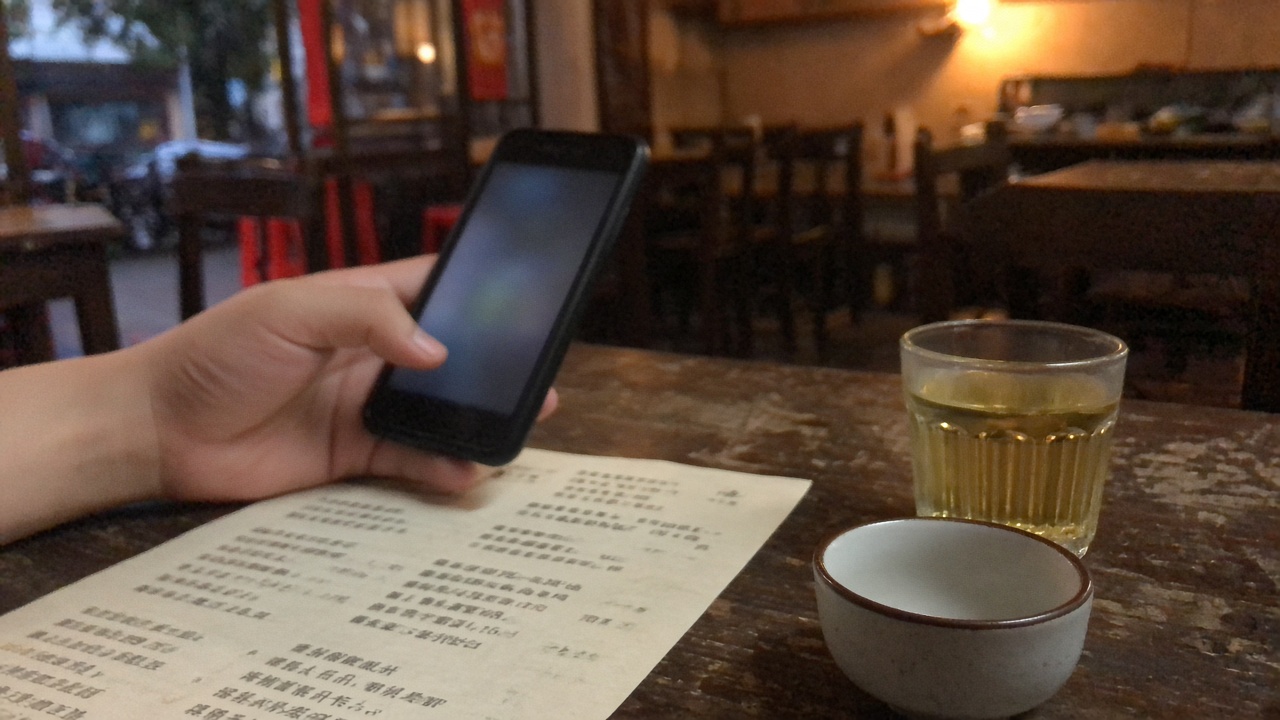
Photograph the menu, open Baidu Translate’s camera, and point at the dish. Then say or show 这个 — “this one” — and tap the picture. Staff are used to it. If the camera mangles a regional name, order from the photo on the menu instead of the English guess. Wrong poetry is fine. Wrong chilli level is not: show 不要辣 if you do not want it hot.
What is worth ordering once you can read the menu is in the Peking duck guide and the regional food guide. Tipping is a separate question — most local restaurants do not expect it. The China tipping guide covers the few places that do.
For a first night when you would rather have a person than a camera, book a food walk with a guide. One evening with someone who orders for you is enough to learn the pointing habit.
Trains and the metro
Beijing, Shanghai, and Guangzhou metros label stations in English as well as characters, and many ticket machines have an English button. Smaller cities often do not. Save the station name in characters next to the hotel screenshot, and match the Chinese name on the wall, not a similar English spelling.
High-speed tickets are a passport problem more than a language problem. 12306 has an English mode, and it still rejects some foreign passports until the name is verified. Register before the trip if you expect several trains. When that flow stalls, a reseller that shows the train number and the exact stations is the practical backup. Station names, baggage, and timing are in the China high-speed train guide. At the gate, the original passport matters more than anything you can translate.
Paying without a conversation
QR codes are the default, cash is the backup, and a conversation is optional. Link a foreign Visa or Mastercard in Alipay and in WeChat Pay while you still have reliable wifi. Some cards fail the check — try a second card, and keep a small amount of cash for a stall that only scans a local wallet. Any fee appears on the confirmation screen before you pay. Do not memorise a percentage from a blog.
Alipay’s built-in translator also covers a lot of mini-program screens that are otherwise Chinese-only. If a museum or a restaurant booking lives inside WeChat, open it once at the hotel, translate the buttons, and screenshot the result.
A pocket phrase card
You will not hold a conversation with nine lines. You will survive the moments when the phone is wet, the queue is moving, or someone needs a word instead of a photo. Show the characters. Pinyin is for you.
| Characters | Pinyin | Use it for |
|---|---|---|
| 你好 | nǐ hǎo | Hello |
| 谢谢 | xièxie | Thank you |
| 我不会说中文 | wǒ bú huì shuō Zhōngwén | I don’t speak Chinese |
| 请写下来 | qǐng xiě xiàlái | Please write it down |
| 我要去这里 | wǒ yào qù zhèlǐ | I need to go here (show the screen) |
| 这个 | zhège | This one (point at the dish) |
| 多少钱 | duōshǎo qián | How much is it? |
| 厕所在哪里 | cèsuǒ zài nǎlǐ | Where is the toilet? |
| 不要辣 | bú yào là | Not spicy |
When an app is not enough
A translator is the wrong tool for a clinic, a police desk, or an argument about a bill. Show your passport, the hotel’s Chinese address, and — if you need a hospital — the line 我需要去医院, “I need a hospital.” Then let the hotel call. Do not diagnose yourself through a camera app.
Carry travel insurance that includes a number you can call or message. The insurer’s desk and the hotel front desk both speak more English than a random pharmacy counter.
- Keep passport, hotel card, and offline screenshots available without unlocking ten apps.
- If someone rushes you to scan a personal QR you do not understand, stop and walk to the hotel desk.
- Write numbers on the phone calculator. Prices do not need a sentence.
Build the trip, then save the addresses
Put Beijing, Shanghai, or Chengdu into one itinerary, then copy each hotel and sight into a Chinese screenshot album before you leave the room. Ready city plans are linked above if you want the days already sequenced. A wider starting point is the China trip page.
Ready-made routes
Routes for your destination
Day-by-day plans you can adapt to your dates right away.



Common questions
Can I travel in mainland China without speaking Chinese?
Yes, if you prepare the phone before you fly. English shows up at international airports, many hotel desks, and on Beijing and Shanghai metro signs. Street food, taxis, and smaller cities are Chinese-first. Screenshots of addresses in characters, an offline dictionary, and Alipay or WeChat cover most ordinary days.
Does Google Translate work in China?
Download the Simplified Chinese offline pack at home and you can translate typed text without a connection. Camera and voice modes usually need Google’s servers, which often do not open on a mainland network. Use Baidu Translate, Microsoft Translator, or the translator inside Alipay for live camera and voice.
Pleco or Baidu Translate — which one should I use?
Both. Baidu Translate is the daily camera and conversation tool and works on Chinese networks. Pleco is a dictionary: it looks up single characters, handwriting, and tones, and the core dictionary works offline. They solve different moments.
How do I tell a taxi or DiDi driver where to go?
Show the destination in simplified characters, or drop a pin. DiDi’s mainland app can translate preset chat messages for the driver. A phone call from the driver will probably be in Chinese — answer in the in-app chat with the address screenshot instead of trying to speak.
Do I need both WeChat and Alipay?
Install both before the trip and link a foreign Visa or Mastercard in each if the app accepts the card. Shops and ticket windows often show one QR style. Cash and the hotel’s card terminal are the backup when a card fails verification. The fee, if any, is shown on the payment screen.
What is the difference between simplified and traditional characters?
Mainland China uses simplified characters (简体). Hong Kong and Macau mostly use traditional characters, and English is easier to find there. A screenshot saved in traditional script can confuse a Beijing taxi driver. Save mainland addresses in simplified characters.
How does AlpacaBag help if I do not speak Chinese?
Build a China itinerary in the planner so each day has a realistic city and a hotel stop. Ready Beijing, Shanghai, and Chengdu plans already include the sights; you still save each stop’s Chinese address on your phone before you go out.