
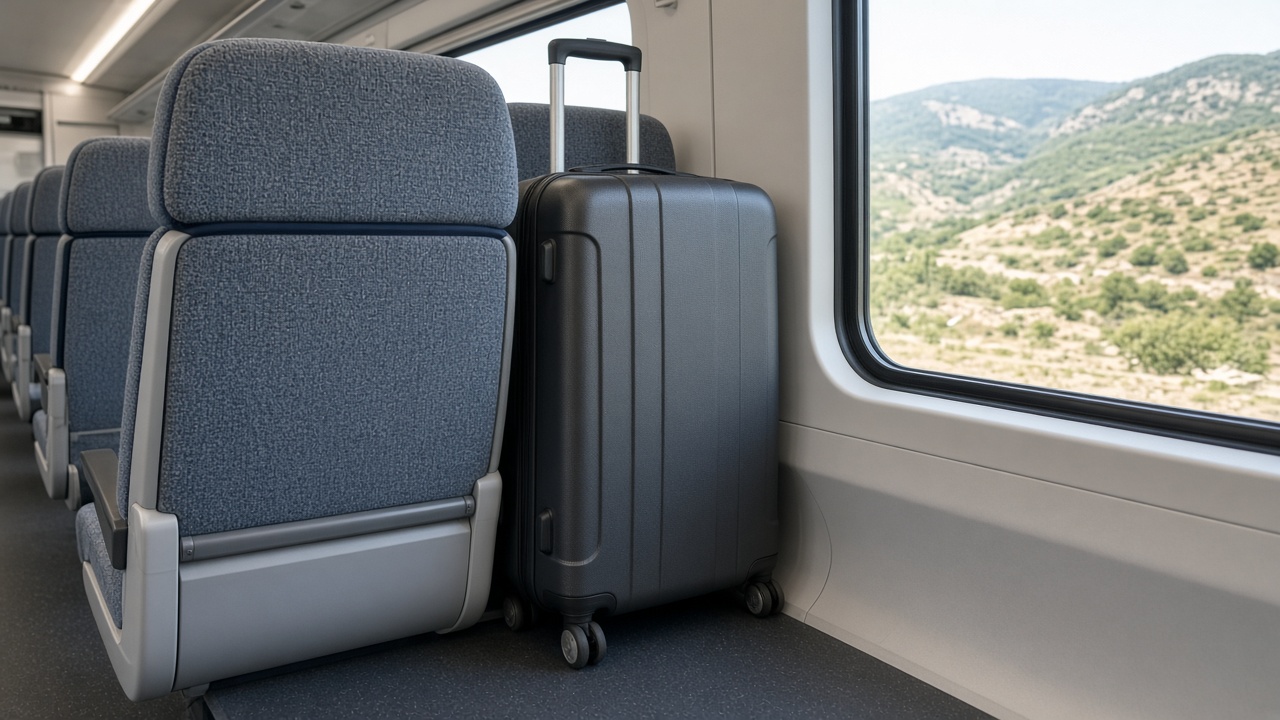
What counts as oversized
Add the three outside sides: height, width, and depth, measured on the bag as it will stand on the train. Checked against JR Central, JR West, and SmartEX on 17 November 2026. Operators still word the exact 160 cm line slightly differently, so the table below follows JR Central’s summary, which is the clearest set of numbers.
| Three sides (A+B+C) | On Tokaido, Sanyo, Kyushu, Nishi Kyushu |
|---|---|
| Up to 160 cm | Overhead rack, at your feet, or deck storage. No reservation. |
| 161–250 cm | Reserved seat with an oversized baggage area, booked before you board. The seat is the normal reserved fare. |
| Over 250 cm | Cannot be brought on board. |
JR Central’s prose also says “between 160 and 250 cm” and “more than 160 cm”. JR West’s table says “up to 160 cm” is allowed and lists “160 to 250 cm” as the reserved size. English SmartEX says “160 cm or more and 250 cm or less”. Japanese SmartEX says over 160 cm up to 250 cm. Use more than 160 cm as the line that needs the seat. At a tape reading of exactly 160 cm, JR Central and JR West still class the bag as ordinary carry-on. Reserve if you cannot remeasure.
Their own examples: 30 × 50 × 80 cm is 160 cm and is the size they say fits the overhead rack. On the N700 sets used for Nozomi, Hikari, and Sakura, that rack is about 42 cm deep, so the long side lies along the rack. 25 × 40 × 55 cm is 120 cm, their example for the footwell in an ordinary car. Green seats have a footrest, so that bag goes on the rack. A common large spinner at 80 × 55 × 35 cm is 170 cm. That one is oversized on these four Shinkansen.
You may carry two pieces, each 30 kg or less, each 250 cm or less, with no side longer than 200 cm. An umbrella, a cane, and a handbag do not count toward the two pieces. JR East publishes the same piece, weight, and size ceiling on its own trains.
Which Shinkansen use the reserved seat
The reserved baggage seat applies on the Tokaido, Sanyo, Kyushu, and Nishi Kyushu Shinkansen: Tokyo, Shin-Osaka, Hakata, Kagoshima-Chuo, and the Nishi Kyushu line. JR Central says the same advance reservation is not required on conventional trains.
JR East uses a different system on the Hokkaido, Tohoku, Akita, Yamagata, Joetsu, and Hokuriku Shinkansen. There is no designated oversized-luggage seat to reserve. Carry-on is free. The limit is 250 cm total, up to 2 m long, 30 kg per item, and two pieces. Luggage space is first-come on trains that have it, and some trains have none. For Tokaido, Sanyo, Kyushu, and West Kyushu, JR East tells you to follow the other company’s page.
A large suitcase from Tokyo to Kyoto or Shin-Osaka is the Tokaido rule. The same suitcase from Tokyo to Sendai, Nagano, or Niigata is the JR East rule. Hokuriku Shinkansen seats are in the JR East “no reserved baggage seat” list, even though JR West runs the western part of that line. The 1,000 yen fee in the next sections is the Tokaido / Sanyo / Kyushu / Nishi Kyushu fee, published by both JR Central and JR West. It is not a JR East Shinkansen fee.
How to reserve the seat
Choose “Seat with Oversized Baggage Area” in SmartEX, JR-WEST ONLINE TRAIN RESERVATION, or JR-Kyushu Train Reservation, or say that at a reserved-seat machine or a ticket counter. You pay the Ordinary reserved fare or the Green reserved fare. JR Central and JR West both say the baggage area and the compartment add no extra charge.
SmartEX, as published on 17 November 2026, adds a few traps that cost people the seat:
- The train screen shows seats for the whole train. Baggage seats can be gone while that screen still looks open. Open the seat map for the baggage seat.
- Sales start one month before departure, with other reserved seats. After-hours and pre-sale requests cannot book this seat.
- On a connection, every Shinkansen that carries the oversized bag needs the baggage seat. A non-reserved seat cannot take it.
- One booking covers up to 5 people in an ordinary car, or 4 in Green, in the same car. Some trains cap it lower. A mix of baggage seats and ordinary seats is split into separate bookings.
- Japanese SmartEX says S Work, S Work P, and the limited-period family car have no oversized-baggage seats, so an oversized bag cannot ride in those cars.
The area behind the seat is the last row of some reserved cars. JR Central describes it as shared by the five passengers who booked those last-row seats. The seat may not recline fully once a large bag is there. People without that reservation do not use that space.
The compartment is a locked cupboard on the deck, and only on some 16-car Tokaido and Sanyo trains (Nozomi, Hikari, Kodama). JR West: the upper shelf is 80 × 60 × 50 cm and goes with an aisle seat; the lower shelf is 80 × 60 × 40 cm and goes with a window seat. The lock needs a contactless transit IC card, and some cards and phones fail. JR Central’s FAQ states one piece up to 80 × 60 × 40 cm in a compartment. If the suitcase is larger than the box you are offered, book the area behind the seat. That area allows the full 161–250 cm total.
From 1 July 2025, JR Central and JR West say some deck compartments are on trial as storage you can use without a reservation. A bag over 160 cm still needs the reserved seat with the oversized baggage area. The trial does not waive that seat.
On a 16-car Tokaido set, JR Central publishes these counts. Nozomi: 57 seats with a baggage area (12 Green, 45 ordinary) and 10 compartment seats. Hikari: 42 and 8. Kodama: 17 and 2. Ordinary area seats are in cars 3–6 and 12–16, five per car. Green area seats are in cars 8–10, four per car. Ordinary compartment seats are in cars 4, 6, 13, and 15. JR Central’s Kodama ordinary count assumes reserved ordinary cars exist. Some Kodama runs in commuting hours have only non-reserved ordinary cars, and those cars cannot take an oversized bag. Use Green on that train, or another departure that still has ordinary baggage seats. Sanyo, Kyushu, and Nishi Kyushu publish their own car lists. Do not reuse the Tokaido car numbers on an 8-car set.
JR Central also says the Tokaido Supreme Class cabins can carry a bag in the 160–250 cm range. The cupboard beside the two-person cabin is smaller than the open baggage area (under 80 × 60 × 40 cm), and the single cabin has no dedicated cupboard outside the room. JR Central points you to the tablet in the cabin for how that cupboard locks.
A rail pass does not attach the baggage seat by itself. At a JR ticket office, tell the clerk you need a seat with an oversized baggage area. JR Central also points pass holders to the JR Pass reservation service. Whether the pass pays for itself is a separate question, covered in the JR Pass calculator. This page does not sell Shinkansen tickets.
Station Wi-Fi drops often enough that a working phone line matters when you reopen the seat map. An eSIM for Japan is the practical fix at Tokyo or Kyoto if the ticket machine’s English stalls.
What happens if you board without a reservation
On the Tokaido, Sanyo, Kyushu, and Nishi Kyushu Shinkansen, JR Central and JR West both publish a baggage fee of 1,000 yen including tax when you bring an oversized bag aboard without the reservation. The conductor assigns the storage spot. Japanese SmartEX uses the same 1,000 yen figure for a bag over 160 cm and up to 250 cm.
JR Central’s FAQ is stricter than “pay and sit down”. If the train is full, you can be asked to reserve another departure so the bag does not block everyone else. The fee is not a ticket to keep a non-reserved seat with that suitcase. Oversized baggage is refused in non-reserved cars and in reserved cars that have no baggage seat.
Miss the train and the rules split. Depending on the ticket, you may ride a non-reserved seat on a later train. You may not take the oversized bag onto that non-reserved seat. Buy a new reserved baggage seat for the later train. If the plan changes before departure, change the reservation before you board. A ticket that is not a baggage seat does not allow the bag on the train.
Strollers, sports equipment, and musical instruments stay outside the oversized reservation rule, inside the 250 cm, 30 kg, and two-piece limits. The last-row space is still reserved for people who booked it. Reserve the seat if that is where the stroller has to go. A bicycle comes aboard folded or dismantled inside a bag, on the sports-equipment rule. An assembled bike is refused.
Tokyo, Kyoto, and Osaka with a large suitcase
Tokyo to Shin-Osaka is the Tokaido Shinkansen, so the 160 cm rule applies to the whole of that ride, including a stop at Kyoto. Kyoto is on many Hikari and Kodama trains. Do not assume the Nozomi you want stops at Kyoto. The booking screen lists the stops. Book the baggage seat only on a train that calls at your station.
Shin-Osaka is the Shinkansen station for Osaka. Osaka, Umeda, and Namba are another local ride after you get off. The 1,000 yen figure is the Shinkansen fee. This guide does not invent a size limit for the subway.
Continuing west of Shin-Osaka on the Sanyo Shinkansen, toward Okayama, Hiroshima, or Hakata, stays inside the same reserved-baggage system. On a connection, reserve the baggage seat for each Shinkansen that carries the bag. Check the baggage-seat map before you pay. Ordinary seats can still be open after the baggage seats are gone.
Those seats open one month out, with the rest of the reserved inventory, and they go first on holiday trains. JR Central’s instruction when they are sold out is to take another departure. Build the Tokyo and Kyoto days so a two-hour slide still works: 3 days in Tokyo on a budget and 3 days in Kyoto on a budget. Once the bag is at the hotel, what to see in Tokyo besides Shibuya Crossing is the walking day, not another suitcase day.
A baggage seat that only exists two hours later can miss a flight out of Kansai. That is a missed-connection problem. A travel insurance policy is for that miss. It does not pay the 1,000 yen, and it does not hold the seat.
Want the Shinkansen day set between the hotels, with the big bag moving the day before you ride?
Build an itineraryCoin lockers or forwarding
Coin lockers at Tokyo, Kyoto, and Shin-Osaka keep the bag for the hours you are out of the station. The door prints the size and the price. Both vary by station and by the locker company, so there is no single yen figure worth memorising. Large doors are the ones that disappear at Tokyo Station and Kyoto Station when trains are full. A locker is the right tool for a day on foot. It is the wrong tool if the suitcase still has to board a Tokaido train that afternoon. You would take it out and still need the baggage seat.
Forwarding is how you ride with a bag at or under 160 cm. Drop the large suitcase for the next hotel and keep a rack-sized bag with you. The steps, counters, and timing are in the hotel-to-hotel luggage guide. JR Central describes a paid hands-free delivery to the destination hotel and says same-day delivery can be arranged. In their summary table that service is listed up to 200 cm total. The cutoff is the courier’s, not a national clock. A bag handed over on the morning you leave Tokyo is a poor bet for a morning train to Kyoto.
Rules on this page were read from JR Central, JR West, JR East, and SmartEX on 17 November 2026. Seat maps and the July 2025 deck-compartment trial can change by train. Recheck the operator page if your date is later, and measure the bag again if you are within a centimetre of 160.
Ready-made routes
Routes for your destination
Day-by-day plans you can adapt to your dates right away.
FAQ
Is the cutoff 160 cm or 161 cm?
Treat a bag as oversized when height + width + depth is more than 160 cm and at most 250 cm. JR Central’s summary table starts the reserved-seat rule at 161 cm, and the Japanese SmartEX page says “over 160 cm”. JR Central and JR West still list a bag of up to 160 cm as ordinary carry-on. The English SmartEX page says “160 cm or more”. If your tape reads exactly 160 cm, reserve the baggage seat rather than arguing the centimetre at the door. Over 250 cm is refused on board.
Does the oversized-baggage seat cost extra?
The reservation itself is the normal Ordinary or Green reserved-seat fare. JR Central and JR West both say there is no surcharge for the baggage area or the compartment. The 1,000 yen fee (tax included) is only for boarding Tokaido, Sanyo, Kyushu, or Nishi Kyushu Shinkansen with an oversized bag and without that reservation.
What happens if I board without the reservation?
On those four Shinkansen families the published fee is 1,000 yen including tax, and you store the bag where the conductor tells you. JR Central also says that if the train is full you can be asked to reserve a different departure. A non-reserved seat cannot take the oversized bag. If you miss the train, a later non-reserved seat may still be valid on your ticket, but the big bag needs a new reserved baggage seat.
Does JR East use the same reserved baggage seat?
On Hokkaido, Tohoku, Akita, Yamagata, Joetsu, and Hokuriku Shinkansen, JR East does not sell a designated oversized-luggage seat. Carry-on is free inside their limit: 250 cm total, up to 2 m on the longest side, 30 kg per item, two pieces. Storage is first-come on trains that have a luggage area. JR East points Tokaido, Sanyo, Kyushu, and West Kyushu passengers to the other operators’ rules, including the reserved seat.
Can a coin locker replace the baggage seat?
A locker holds the bag while you are away from the station. Sizes and prices are printed on the door and differ by station, so this guide does not quote a yen price. It does not replace a baggage seat if that suitcase still rides the Shinkansen later the same day. To travel with a bag at or under 160 cm, send the large one to the next hotel. Same-morning drop-off is a poor plan for a morning Tokaido train.
Do strollers, skis, and instruments need the seat?
JR Central and JR West say the oversized-baggage reservation rule does not apply to strollers, sports equipment, and musical instruments, within the overall 250 cm / 30 kg / two-piece limits. The space behind the last row is still for passengers who reserved the baggage seat. Reserve that seat if you want the space. Folded bicycles in a bag follow the sports-equipment rule; an assembled bike is a different restriction.