
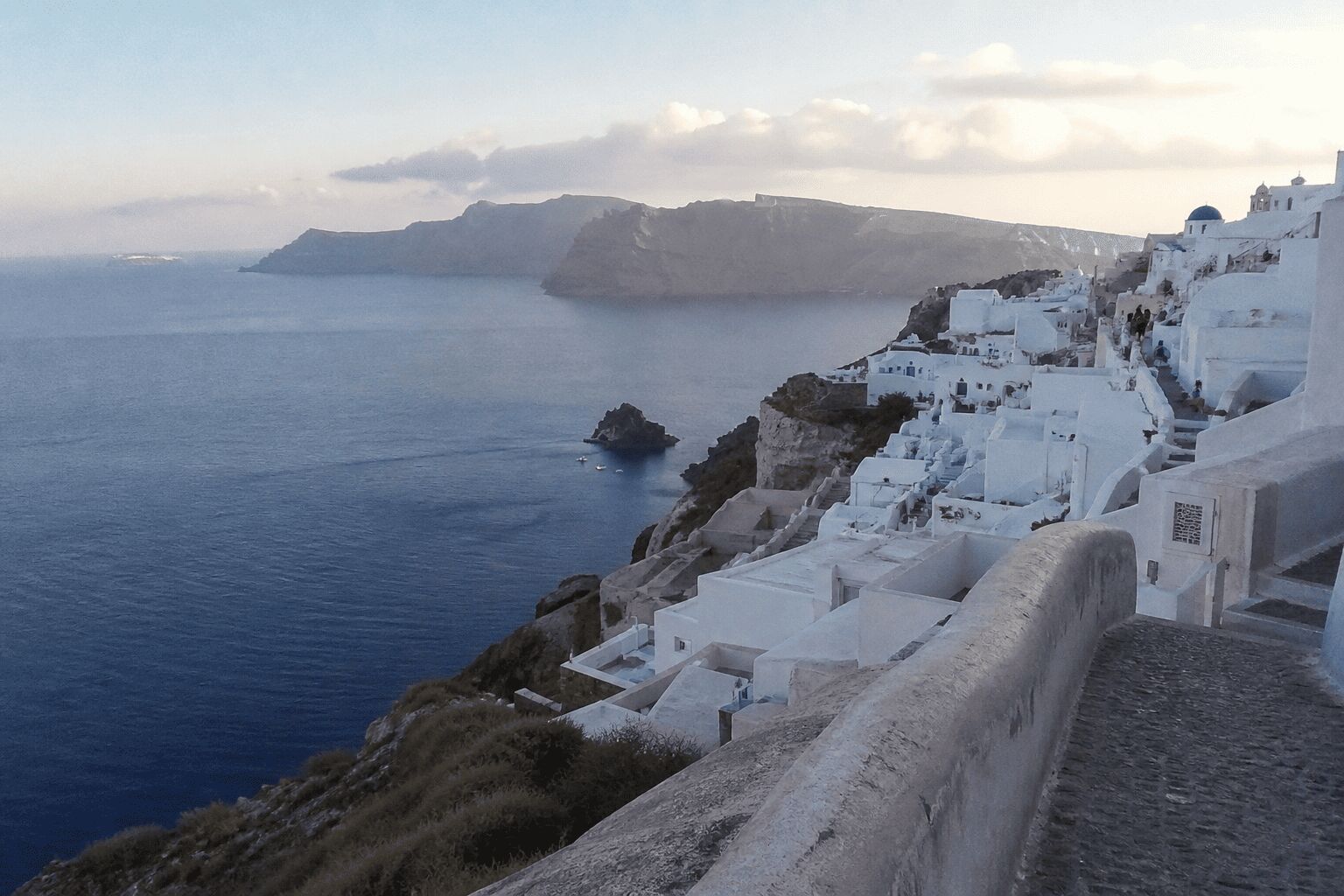
Oia, Fira, Imerovigli: three different islands on one cliff
Santorini reads wrong if you treat it as one town with a view. Three settlements sit along the western rim of the caldera and each does a different job: Oia is the photograph, Fira is the infrastructure, Imerovigli is the altitude and the quiet. Itineraries fall apart precisely when people try to do all three in a single evening.
Oia: sunsets and blue domes
Oia is the postcard: whitewashed houses, blue church domes, staircases dropping toward the water. The domes are shot from narrow lanes in the northern half of the village, and in high season that is exactly where the tripod jam forms. Sunset officially belongs to the Venetian castle ruins — which is why watching it from there is a competitive sport rather than a holiday.
The practical takeaway is simple. Come to Oia in the morning, when the village is nearly empty and the light falls from the east, or arrive an hour and a half before sundown. And do not bolt the second the sun disappears: twenty minutes later there are fewer people and the sky is still doing something.
Fira: the capital and all the practicalities
Fira is the administrative and transport hub: KTEL buses radiate from here, and so do banks, pharmacies, rental desks, and the Museum of Prehistoric Thera with the frescoes lifted from Akrotiri. The cable car runs down to the old port where cruise tenders dock — the roughly 580 steps beside it remain a free but deeply unpleasant alternative.
Imerovigli and Skaros Rock
Imerovigli sits higher than its neighbours — the highest point on the caldera rim, which is why locals call it the balcony. A short trail drops from the village to Skaros: a rock spur that carried a medieval fortress guarding the island against pirates. Only fragments survive, but the near-270-degree panorama is the best free viewpoint on Santorini.
Akrotiri, Atlantis, and Ancient Thera
Santorini is not a pretty cliff; it is the wall of a crater. Somewhere in the 17th–16th century BCE the volcano erupted hard enough to drop the centre of the island into the sea, and a Bronze Age town in the south was sealed under a layer of ash.
Akrotiri: the “Greek Pompeii”
The Akrotiri excavation earned the Greek Pompeii nickname, and the comparison holds up literally: two- and three-storey houses, streets, plumbing, and pottery survived under the ash. One difference matters — almost no human remains were found, so the residents apparently got out in time. The dig now sits under a roof with shade and flat boardwalks, making it a rare piece of antiquity you can comfortably visit at midday.
The Atlantis link is attractive but should be held loosely: the idea that Plato’s account of a vanished sea power grew out of the memory of the Minoan catastrophe is a popular scholarly hypothesis, not a settled fact. As a framing device for the visit it works beautifully — you are standing in a town that disappeared in one disaster and came back three and a half thousand years later.
Ancient Thera: a different layer entirely
Ancient Thera belongs to another era: a Hellenistic and Roman city along the ridge of Mesa Vouno, between Kamari and Perissa. There is an agora, a theatre, remains of residential quarters, and a view onto two coastlines at once. The climb is fully exposed with almost no shade, so go first thing in the morning or late in the afternoon.
Most Akrotiri frescoes live not at the dig but in the Museum of Prehistoric Thera and in Athens, which makes it sensible to pair the island with a couple of city days — the Athens weekend plan covers the essentials. If the archaeology hooks you, the Minoan thread continues on Crete: Knossos and the Crete itinerary are a separate multi-day trip, not a day trip from Santorini.
Beaches: Red Beach, Perissa, and black sand
Santorini’s beaches are volcanic: dark sand and pebbles, water that drops off fast, and a surface that turns into a griddle by noon. Water shoes are not a fashion choice here.
Red Beach
Red Beach below Akrotiri is the most recognisable: rust-coloured cliffs falling straight into the sea. The caveat is rockfall — access to the cove itself is restricted from time to time and the rules shift during the season. Plan it as a viewpoint from the trail; if it is open and unsigned on the day you turn up, treat the swim as a bonus.
Perissa and Kamari
Perissa in the southeast is a long black-sand beach with loungers, tavernas, and a legible promenade. It works as a base for anyone who wants the caldera for two evenings rather than the whole trip: prices drop, parking becomes real, and a trail runs up to Ancient Thera from here. Kamari, on the other side of the same ridge, is laid out similarly and feels slightly more resort-like.
Plans for 1, 2, and 3 days
Three ready scenarios follow. One day is the island’s top layer with no south at all; two days close out Akrotiri and the beaches; three days add archaeology, wine, and water. Timings assume the warm season with a late sunset — in shoulder months shift everything an hour or so earlier.
One day: the caldera from Fira to Imerovigli
| Time | Plan |
|---|---|
| 09:00–10:30 | Check in or drop bags, coffee in Fira with the caldera in front of you |
| 10:30–12:30 | Museum of Prehistoric Thera: Akrotiri frescoes and the eruption in context |
| 12:30–14:00 | Lunch a block back from Fira’s cliff edge — same island, smaller bill |
| 14:00–16:30 | Fira → Imerovigli caldera path (about 1–1.5 h at an easy pace) |
| 16:30–18:00 | Skaros Rock: down to the outcrop and back while the sun is still high |
| 18:00–sunset | Sunset from Imerovigli or Firostefani — same light, none of Oia’s crush |
Day two: the south, Akrotiri, and the beaches
| Time | Plan |
|---|---|
| 08:30–09:30 | Head south early; Akrotiri opens before the heat settles in |
| 09:30–11:30 | Akrotiri — the “Greek Pompeii”, roofed, shaded, and walked on level boardwalks |
| 11:30–13:00 | Red Beach viewpoint; swim only if access is open on the day |
| 13:00–14:30 | Lunch in Akrotiri or Megalochori: fava, tomato fritters, local white wine |
| 14:30–17:00 | Perissa or Kamari: black sand, loungers, a long flat promenade |
| 17:30–20:00 | Oia for sunset: arrive 1.5–2 h early, then leave last instead of first |
Day three: antiquity, wine, and the volcano
| Time | Plan |
|---|---|
| 08:00–09:00 | Climb to Ancient Thera on Mesa Vouno while the slope is still in shade |
| 09:00–11:00 | The ancient city: agora, theatre, and both coastlines in one panorama |
| 11:30–13:30 | Winery visit: Assyrtiko, basket-trained vines, a short tasting flight |
| 13:30–15:00 | Pyrgos — a maze village with views that cost nothing on the caldera rim |
| 15:30–19:00 | Boat trip to the volcano and hot springs, or a second beach afternoon |
| 19:00–21:00 | Dinner in Megalochori or Emporio: quieter and cheaper than the cliff |
Golden hour without the cruise crowd
Oia’s peak load is not created by people staying on the island but by cruise day-trippers, who arrive in a wave through the afternoon and are usually back on board by late evening. That leaves three workable tactics.
- Move the spot. Imerovigli and Firostefani face the same direction as Oia with a fraction of the people. Different frame, identical sun.
- Move the clock. Stay 20–30 minutes past sundown: blue hour over whitewashed walls often photographs better than the sunset itself, and the crowd is already walking to the buses.
- Flip the day. Sunrise in Oia means an empty village and light landing on the domes instead of in your lens. Spend that evening on an east-coast beach instead.
Logistics, rentals, and budget
The fastest way onto the island is a direct flight: roughly 45–50 minutes from Athens against several hours by sea. It is worth comparing flights both ways — direct to Santorini, and into Athens with a ferry leg attached. Buy ferry tickets from the operators themselves or official agents: we deliberately do not wrap those checkouts in affiliate links, because you need to see the real timetable and the cancellation rules when the wind picks up.
From Crete the logic is similar: the high-speed ferry out of Iraklion runs roughly two hours and neatly connects the Minoan thread at Knossos with Akrotiri. Summer meltemi winds regularly rewrite sailings, so never schedule a ferry tight against your flight home.
Caldera or not: where to sleep
The island’s central trade-off is view versus stairs. Cliff-edge hotels in Oia and Imerovigli sell the panorama, but that almost always means dozens of steps with a suitcase and a taxi that cannot reach your door. Kamari, Perissa, and Megalochori are cheaper, flatter, and far easier with family. Lock in a hotel early — decent high-season rooms go months ahead. Most travellers also add travel insurance, since volcanic terrain and polished steps generate more everyday injuries than people expect, plus an eSIM to keep offline maps and bus times in your pocket.
Getting around the island
KTEL buses fan out from Fira and cover Oia, Kamari, Perissa, and Akrotiri, which is enough if you are not in a hurry. A car or ATV saves real time in the south, but parking in Fira and Oia is miserable and ATVs require the matching licence category. A ready guided excursion or volcano boat trip removes the logistics question entirely, and an airport bus transfer saves you haggling with taxis in your first hour on the island.
| Line item | Amount | Note |
|---|---|---|
| Akrotiri excavation site | ≈ €12–20 | Ballpark published fare — confirm on the official archaeological site page |
| Museum of Prehistoric Thera | ≈ €6–10 | Combined tickets across island sites exist — ask at the desk |
| Ancient Thera | ≈ €4–8 | The walk up is free; the site itself is ticketed |
| Coffee with a caldera view | €5–9 | A terrace in Oia costs noticeably more than a café one street back |
| Lunch / dinner | €18–40 | Per person; inland tavernas run well below cliff-edge restaurants |
| Fira cable car to the old port | ≈ €6 one way | The alternative is 580 steps; skip the donkeys on welfare grounds |
Entry prices and opening hours on Santorini shift by season, so the table above is a planning ballpark rather than a box office. Check current Akrotiri and Ancient Thera fares only on official Greek archaeological service pages.
Assyrtiko, cherry tomatoes, and fava
The local kitchen grew out of a water shortage: almost everything that grows on Santorini is adapted to ash, wind, and a summer with essentially no rain.
- Assyrtiko — a high-acid white with a saline, mineral edge. Vines are traditionally woven into a low basket shape (kouloura) that shelters the grapes from wind and catches night moisture.
- Cherry tomatoes — small, dense, and intensely concentrated. They become tomatokeftedes, fried fritters that half the tavernas serve as the island’s calling card.
- Fava — a purée of local yellow split peas with olive oil and onion. It is neither hummus nor chickpea, despite the resemblance; Santorini fava carries protected origin status.
- White aubergines and capers — seasonal salad additions you rarely meet on the mainland.
Dinner on the caldera edge costs noticeably more than the same dinner in Megalochori, Emporio, or Pyrgos. The sensible compromise: one evening with the view for the memory, the rest in villages that cook for locals.
If you want green instead of volcanic
Santorini is an island of rock and ash: little shade, almost no trees, and a landscape fully bleached by August. If greenery matters to your trip, bolt on Naxos with its mountain villages, or the Ionian islands such as Corfu and Lefkada, where you get olive groves, pines, and completely different humidity. This is not a replacement for the caldera but a second act: Santorini for two or three days, a green island for the rest of the week.
The nearest Cycladic neighbour works differently again: if you want beaches plus a town without the volcanic drama, look at the Mykonos itinerary. To stitch the islands back to the mainland, the Athens plan for couples or the Greece routes hub give you ready city days.
Santorini without chasing the sunset
Set your dates and pace — AlpacaBag will spread the caldera, Akrotiri, and the beaches across days.
Ready-made routes
Routes for your destination
Day-by-day plans you can adapt to your dates right away.
FAQ
How many days do you need on Santorini?
Two days cover Oia, Fira, and Akrotiri without rushing. A third day adds Ancient Thera, a winery, and a boat trip to the volcano — that is the day that turns the island from a checkbox into an actual holiday.
How do I see the Oia sunset without the crowd?
Cruise day-trippers peak roughly an hour before sundown. Three workarounds: arrive in Oia 1.5–2 hours early and hold a spot, watch from Imerovigli or Firostefani instead, or stay in Oia 20–30 minutes after the sun drops, when the blue hour is still photogenic and the crowd has left.
Do I need a car on Santorini?
For Akrotiri, Ancient Thera, and the southern beaches a car or ATV saves hours. Parking in Fira and Oia is genuinely painful, so many travellers rent for one or two days only and rely on KTEL buses and walking the rest of the time.
How do I get there from Athens or Crete?
Athens has direct flights of roughly 45–50 minutes plus ferries from Piraeus — high-speed boats are faster, conventional ones are cheaper and handle wind better. From Crete, the high-speed ferry out of Iraklion takes around two hours. Always confirm schedules with the operator: summer winds reshuffle sailings.
Is a caldera-view hotel worth it?
A caldera view means a price premium and, almost always, stairs. If you are travelling with suitcases, kids, or bad knees, look at Kamari, Perissa, or Megalochori — the savings usually cover a taxi to the sunset and back.
Is Red Beach open?
Access to the cove is periodically restricted because of rockfall, and the rules change during the season. Plan it as a viewpoint from the trail and treat swimming as a bonus if there are no warning signs on the day.