
What to see on Mykonos first
Chora and Little Venice
Chora is a deliberate maze of whitewashed lanes — the layout once broke the wind and confused pirates, and the lime wash keeps reflected glare down. Getting mildly lost is part of the experience. Little Venice is the row of houses built straight onto the water, balconies hanging over the surf, and it is where the whole island converges at sunset.
The practical version: scout Chora in the morning, then come back to the waterfront in the evening with a plan. Midday lanes are a slow-moving queue and there are no calm photos left in them.
The Kato Mili windmills
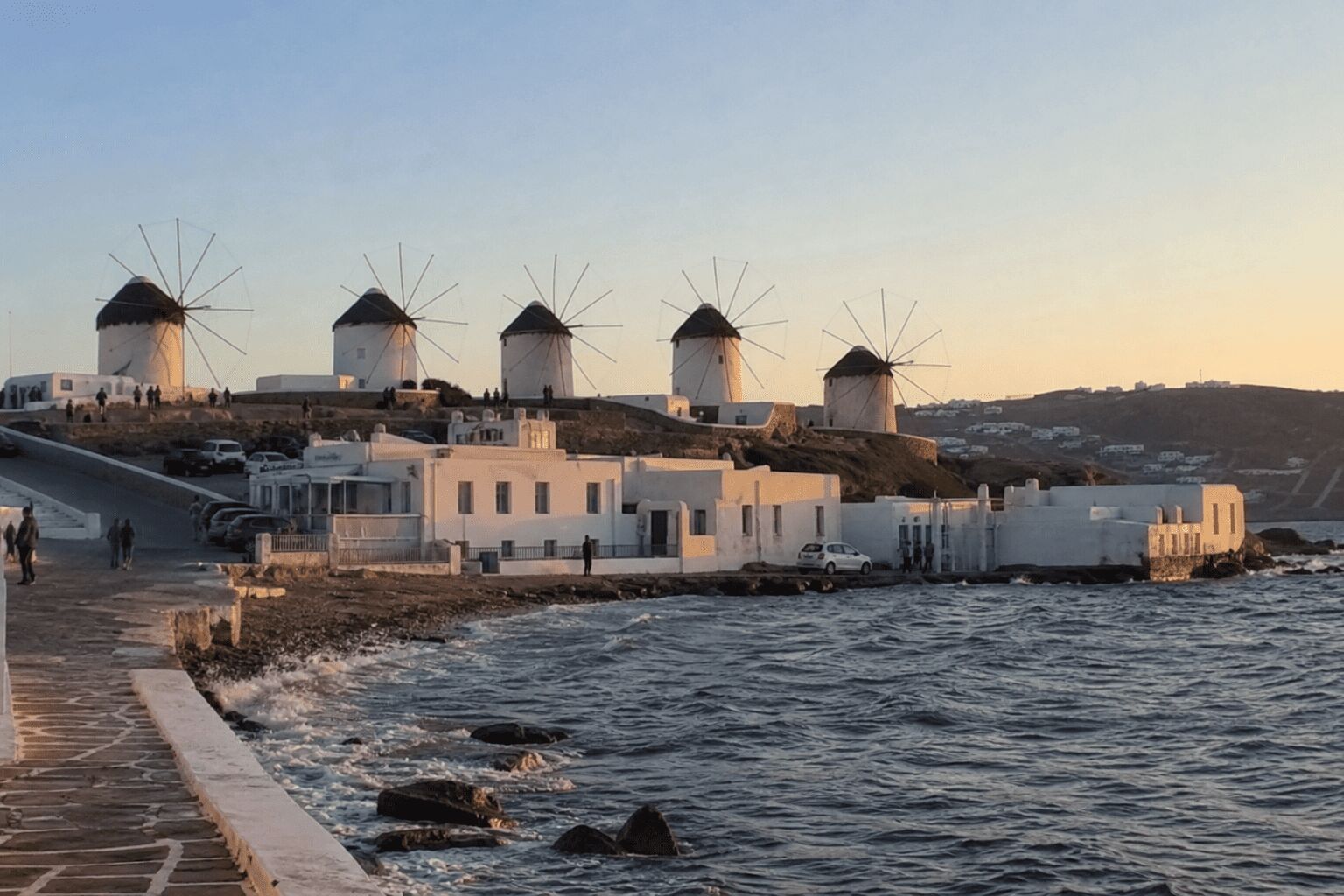
The line of round, thatched windmills on the ridge above the port is the island’s most recognisable view. They once ground grain using the same wind that gave Mykonos its “island of winds” nickname. Today they work as a viewpoint over Chora, Little Venice, and the open sea.
Panagia Paraportiani church
Five churches fused into one white structure with almost no straight lines — the strangest building in Chora and far more interesting outside than in. It photographs best in soft morning light or just before sunset. It is still an active church, so cover shoulders and knees if you go inside.
Petros the pelican and the 365 chapels
Petros is the island mascot: local fishermen nursed the first injured pelican back to health in the 1950s, and the role of resident pelican has been passed down ever since — the birds still wander the waterfront unbothered. The second local symbol is the scatter of tiny white chapels. Island tradition counts 365 of them, one per day of the year, and most are private family chapels tucked into courtyards and roadside bends.
Mykonos in one, two, or three days
Day 1: Cycladic classics and a harbour sunset
Keep the first day on foot. Chora, Little Venice, Panagia Paraportiani, the climb to Kato Mili, a long lunch in the shade, and an unhurried evening by the water. The Archaeological Museum near the old port is a good plan for the hottest hours — and it is where you see ancient sculpture if Delos does not fit your trip.
| Time | Plan |
|---|---|
| 08:30–10:00 | Breakfast in Chora before the cruise tenders unload |
| 10:00–11:30 | Little Venice, Panagia Paraportiani, back lanes while they are still quiet |
| 11:30–13:00 | Kato Mili windmills for the classic shot, then shade and water |
| 13:00–16:30 | Beach block — bus or scooter to whichever bay matches your mood |
| 17:00–19:00 | Back to Chora: boutiques, shops, coffee near the old port |
| 19:30–21:00 | Sunset in Little Venice, then dinner a few streets inland |
Day 2: beach clubs and bohemian gloss
Day two belongs to the south coast. The logic is simple: a bus from the Fabrika station to Paradise, Super Paradise, Elia, or Platis Gialos, then either stay until sunset or hop between bays by sea taxi. Ano Mera makes a good midday break — the inland village has the Panagia Tourliani monastery and normal tavernas without waterfront pricing.
If you are staying out for a club night, decide how you get back before you go. The last buses leave well before the sets end, and late-night taxis on Mykonos are genuinely scarce.
Day 3: Delos and the ancient context
Delos is an uninhabited open-air museum about half an hour by boat from Chora’s old port. Myth places the birth of Apollo and Artemis here, which is exactly why the island spent centuries as the religious centre of the Aegean: sanctuaries, the Terrace of the Lions, and residential blocks with surviving mosaics. The mythology matters as trip context — it explains the scale of what you walk through.
Practicalities: boats run on a morning schedule with afternoon returns, and staying overnight is not permitted. There is almost no shade, so water, a hat, and proper shoes are non-negotiable. The archaeological site ticket is sold at the official box office on arrival; no affiliate link replaces it.
Mykonos beaches: from party to empty
It helps to sort Mykonos beaches by volume rather than by looks. The south coast is sheltered from the meltemi and densely built with beach clubs; the north is exposed to the wind, which is precisely why bays there stay empty.
| Beach | Vibe | What to know |
|---|---|---|
| Paradise | Party | Daytime sets, wall-to-wall sunbeds, peak crowds in July and August |
| Super Paradise | Party | Club format that runs late — budget for the bar and for the ride home |
| Psarou | Glamour | Premium beach clubs with advance sunbed bookings; never a quiet option |
| Elia | Mixed | Long sandy stretch with both an organised club section and calmer ends |
| Agios Sostis | Quiet | No sunbed infrastructure — bring water, shade, and cash |
| Fokos / Merchia | Quiet | Northern bays down dirt tracks; ride slowly and check your rental terms |
The reliable rule: the harder the access, the quieter the sand. If your trip needs both a club day and a silent bay, put them on separate days — switching modes inside one afternoon is exhausting.
Getting to Mykonos and getting around
From Athens: ferry or flight
A fast ferry from Piraeus or Rafina is the default: roughly 2.5–5 hours depending on the vessel and how many islands it calls at. Flying takes about 40 minutes, though airport transfers and security shrink the advantage. Comparing flights early pays off, because summer pricing on this route climbs fast. For ferry timetables and tickets, use the operators’ own official channels.
The meltemi — the strong northerly summer wind — cancels sailings often enough to plan around. Do not book a Mykonos ferry on the same day you fly home from Athens; a full buffer day is standard practice here, not paranoia.
Buses, sea taxis, and scooters
The bus network runs from two hubs in Chora: the Fabrika station serves the southern beaches (Platis Gialos, Paradise, Ornos, Ano Mera) while the old port station covers the north. Summer frequencies are good, but evening service thins out — photograph the timetable at the stop. Sea taxis link neighbouring southern bays and often beat a bus connection with a transfer.
A scooter or quad buys freedom for the far beaches, but factor in the wind, narrow switchbacks, and unpaved final stretches down to the quiet coves. If all you need is a port transfer or an organised day out, a bus or transfer saves you assembling connections by hand, and island-hopping is easier with a booked excursion. We never present affiliate checkouts as the official Delos site ticket office.
Where to stay, connectivity, and cruise timing
A hotel in Chora means nightlife under your window; Ano Mera and Ornos are cheaper and calmer but tie you to the bus. Book early for high season — August inventory effectively disappears. Most travellers also add travel insurance and an eSIM, since offline maps matter more on a scooter than you expect.
On photos: cruise ships unload during the middle of the day, and that is exactly when Little Venice and the windmills look like a ticket line. Shoot before 10:00 or after 18:00 — it is the one trick that costs nothing and works every time.
A day on Mykonos: low-cost vs luxury
Mykonos can be affordable and absurdly expensive on the same day. The figures below are high-season ballparks per person, meant to show the spread rather than act as a price list.
| Line item | Low-cost | Luxury | Note |
|---|---|---|---|
| Accommodation per night | €60–110 | €300–700+ | A studio in Ano Mera vs a view room walking distance from Chora |
| Getting around | €3–5 (bus) | €60–120 (taxi / sea taxi) | A scooter sits in between at roughly €25–40 per day |
| Beach | €0 (towel on sand) | €80–250 (beach club sunbed set) | Glamour beaches usually enforce a minimum spend |
| Food | €15–25 | €90–200 | Gyros and backstreet tavernas vs a waterfront dinner |
| Day total | ≈ €90–150 | ≈ €500–1000+ | Per person; August runs noticeably higher across the board |
Overspending here rarely comes from accommodation — it comes from decisions made at the beach. A club sunbed set can easily cost more than a night in a studio, so choose your beach format before you arrive at the bay.
Mykonos in the Cyclades: versus Santorini and Corfu
| Island | What the trip is about | Prices | Who it suits |
|---|---|---|---|
| Mykonos | Beaches and nightlife | High | Compact whitewashed town, dozens of bays, the loudest club scene in the Cyclades |
| Santorini | Views and the caldera | High | Cliff towns and sunsets; beaches are volcanic and clearly secondary |
| Corfu | Green and slower | Noticeably lower | Ionian pines and olive groves — a different sea, rhythm, and budget |
For a first Cyclades trip, pairing Mykonos with Santorini works best: sharply different characters on one ferry corridor. The second island gets a full treatment in our Santorini guide. If you want archaeology and landscape variety instead of a third Cycladic island, add Crete. Corfu appears here only as a price-and-greenery reference point — it sits in the Ionian and belongs to a different itinerary.
Athens is almost always the gateway. Ready city plans: a three-day Athens weekend or a group-of-friends route if Mykonos is the party leg of a longer trip.
Food checklist and photo spots
- Kopanisti — the island’s sharp, aged spreadable cheese, served with bread or as meze
- Louza — locally cured pork, the natural partner to kopanisti and a glass of wine
- Amygdalota — flourless almond cookies and the standard edible souvenir
- Kremmydopita — onion pie, rarely found on waterfront tourist menus
- Photos: Kato Mili at sunrise, Little Venice balconies, Chora lanes before 10:00
A Cyclades route without the sprint
Set dates, pace, and budget — AlpacaBag will plan your Mykonos days and the island connections around them.
Ready-made routes
Routes for your destination
Day-by-day plans you can adapt to your dates right away.
FAQ
How many days do you need on Mykonos?
Two days cover Chora and a couple of beaches. Three days leave room for Delos and a second, quieter stretch of coast. Anything shorter really only works as a cruise stop.
Ferry or flight from Athens?
Fast ferries from Piraeus or Rafina take roughly 2.5–5 hours depending on the vessel and stops; the flight is about 40 minutes plus airport time. Summer meltemi winds cancel sailings regularly, so never schedule a ferry on the same day as your flight home.
Do I need to rent a scooter or car?
Not necessarily. Buses from the Fabrika station reach the main southern beaches and Chora is pedestrian anyway. Rentals pay off if you want the remote northern bays, where access is often unpaved and windy.
When can I photograph Chora without cruise crowds?
Before 10:00 and after 18:00. Ships unload during the middle of the day, which is exactly when Little Venice and the windmills fill up. Early morning in the lanes feels like a different island.
Can I visit Delos independently?
Yes. Scheduled boats leave from Chora’s old port and the archaeological site ticket is sold at the official on-site box office. The site closes in the afternoon and overnight stays are not allowed.
Mykonos or Santorini for a first Cyclades trip?
Pick Mykonos for beaches, bars, and movement; Santorini for cliffs, caldera views, and sunsets. Prices are broadly comparable — the type of holiday is what differs.