
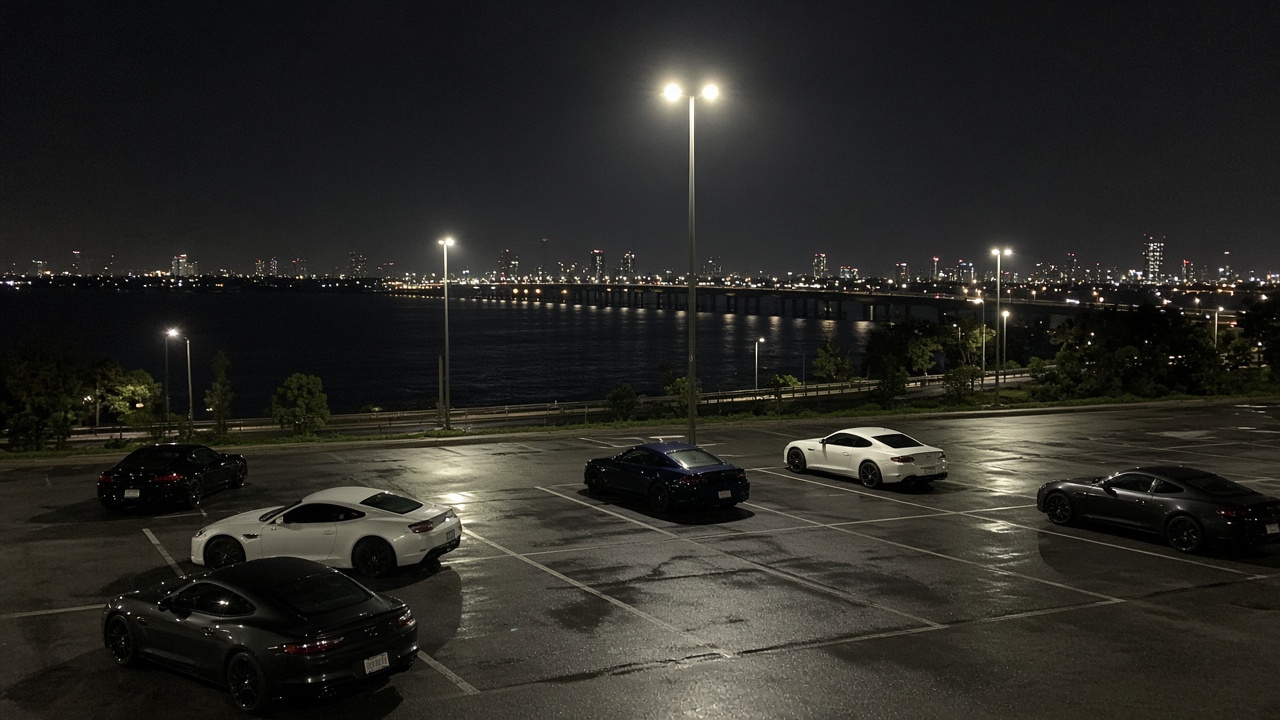
The rule
Checked 17 November 2026 against the Daikoku PA service page and Shutoko’s posted access notice. The address on that page is 15 Daikoku-futo, Tsurumi-ku, Yokohama. The listing shows 335 standard spaces, 58 large spaces, and 5 accessible spaces. That is capacity, not a promise the lot is open tonight. Rules and closures move. Read the notice again the day you go.
English posts call this the Tokyo car meet. The PA is on Tokyo Bay, and the drivers come from Tokyo, but the site is in Yokohama. It sits inside a junction. Highway users can enter from the Bayshore Route (Wangan) and the Daikoku Line. There is no admission ticket. The car you are in pays the expressway toll. There is no separate fare for standing next to someone else’s car.
The same notice is blunt about everyone else. Pedestrians, bicycles, and mopeds cannot enter or leave. The area is fenced, and the pedestrian gates stay closed. Ordinary roads do not connect, including the Daikoku Wharf entrance. There is no taxi rank and no bus stop inside, so you cannot leave by taxi. A navigation app that avoids the expressway is guiding you to the neighborhood, not into the PA.
What the map gets wrong
Search “Daikoku” and the pin often lands on the pier, the wharf roads, or a junction you are not allowed to walk. That pin can be a short distance from the cars on a satellite photo and still be the wrong side of the fence. Public transit does not drop you at the PA. A train that ends in Tsurumi or somewhere “near Daikoku” ends in the city. A city bus that serves the wharf serves the wharf.
Do not treat a blog map of a bus route as access. Shutoko says there is no bus stop in the PA, and this guide will not invent one. If a directions app draws a walking line from the pin to the parked cars, close it. That line crosses an expressway.
| The plan | Gets you in | Gets you out |
|---|---|---|
| Passenger in a car already on the expressway | Yes, from Bayshore or the Daikoku Line | Yes, the same car |
| Tour whose listing enters the PA and returns | Only if the vehicle actually does that | Same vehicle, agreed before you board |
| Taxi one way, or a taxi on local streets | No rank, and local streets do not enter | No. You cannot walk out to hail one |
| Train, subway, or a bus to the wharf | No. The stop is outside the fence | No |
| Walk, fence, shoulder, or ramp | No. Banned, and it is an expressway | No |
Ride with a driver
The ordinary way in without a rental is a seat in a car that is going onto the expressway anyway. A friend, a forum acquaintance you have actually met, or a driver who offered the seat before the night starts. You enter from the Bayshore Route or the Daikoku Line and you leave in that same car. Agree the exit before you go, including the backup if the PA is closed when you arrive. You do not get out and look for another ride inside. There is nowhere legal for that ride to collect you.
The driver pays the Shutoko toll. You are a passenger, not a pedestrian who will “just hop out for photos and find the way back.” If the lot is busy, stay with the car and out of the travel lanes. The PA is still a highway rest area: moving cars, tired drivers, and staff who can ask everyone to leave.
This does not replace a Tokyo base. Put the days on a plan you can do by train, such as a day in Tokyo with friends, and treat Daikoku as an optional night that depends on a car you are not driving.
A tour that leaves with you
The other realistic option is a guided drive whose whole point is the cars. Read the stop list before you pay. The listing has to say the vehicle enters Daikoku PA on the expressway and that you leave in that vehicle. “Daikoku Pier,” “Yokohama night views,” or a photo of the bay is a different trip. If the text is vague, ask. If the answer is that you will be dropped nearby, do not book it.
Search night drives in the excursion catalog. That link is a marketplace, not a reserved seat on a Daikoku departure, and it does not mean a Daikoku tour is on sale tonight. If the catalog has no listing that enters the PA, you do not have a tour. Do not invent one from a thumbnail.
A tour can still arrive to a closed gate. The useful operator tells you that before you board, and the backup is another legal stop by car, not a walk along the fence. You are still a passenger. The meet is not a ticket you can demand.
What not to try
Do not walk. Not from the pier, not from a station that looks close, not along the Bayshore Route, the shoulder, or a ramp. The notice says pedestrians cannot enter or leave, and the fence is the boundary. Climbing it is trespass on an expressway, not a shortcut. If a video shows someone doing it, that video is not a map.
Do not take a one-way taxi. Taxis are often refused because the PA is not a rank and a passenger cannot walk out. A driver who agrees to “get you close” on ordinary roads has not agreed to enter. There is no taxi home from inside.
Do not treat a closure as optional. When staff close the PA, the night is over. Construction closures are announced. Security closures, the ones aimed at dangerous driving and noise, are not a published timetable. Snow operations can shut the site as well. A forum post that says “Saturdays from 9” is a rumor. It is not tonight’s opening hours.
Do not stand in the driving line for a photo, and do not block a space so a stranger can film your driver’s car. People who live with this PA are the reason the closures exist. You are a guest in a working rest area.
If it is closed, or you have no car
Then you do not go. The honest version of this night, without a rental and without a driver, is a night you can reach by train. The last train in Shinjuku and Shibuya is that plan: a midnight window, a taxi that can actually drop you at a hotel, and a walk that stays on city streets. Daikoku is not a stop on that line.
If the cars were the point of the trip, use the Japan guide for car and motorcycle fans. Museums, Fuji, Suzuka, and the mountain roads are places with their own access notes. Daikoku in that guide is the same warning in shorter form: vehicle only, and never a guaranteed meet. Umihotaru is a different parking area, on the Aqua-Line, and it is not a substitute you can walk to either.
Want the Tokyo days on one plan, and this night only if a car is actually taking you?
Build an itineraryReady-made routes
Routes for your destination
Day-by-day plans you can adapt to your dates right away.

FAQ
Can I visit Daikoku PA without renting a car?
Only as a passenger in a vehicle that is already on the Shuto Expressway. Daikoku Parking Area is in Yokohama, inside the expressway, not in central Tokyo. Shutoko allows entry from the Bayshore Route and the Daikoku Line. There is no pedestrian entrance. A seat in someone else’s car, or a tour that drives in and drives you out, is the visit. Renting is how many drivers go. This page is for people who will not rent.
Does a train or bus stop at Daikoku PA?
No. Shutoko says there is no bus stop inside the PA, and no railway station serves it. A map pin at Daikoku Wharf, and any city bus that serves the wharf, stops outside the fence. Ordinary roads, including the Daikoku Wharf entrance, do not connect to the PA. Do not follow a blog that names a bus route to the gate. Public transit does not drop you there.
Can a taxi drop me at Daikoku PA?
Do not plan on it. Shutoko’s notice says there is no taxi rank inside, so you cannot leave by taxi, and a taxi that only reaches the local streets cannot enter from those streets. A one-way drop leaves you with no legal way out. Meet a driver who enters and leaves with you.
Is the Saturday night car meet official?
No. Daikoku is a working parking area, not a ticketed meet. Interesting cars are a reputation, especially on weekend nights, and those are also the nights the PA is often closed for noise and dangerous driving. Shutoko does not publish a nightlife calendar. The lot can also close for construction or snow operations. Check the day you go. A full turnout is never guaranteed.
Can I walk in from the pier or the nearest station?
No. The PA is fenced. Pedestrians, bicycles, and mopeds cannot enter or leave. Walking the expressway, the shoulder, or a ramp, or climbing the fence, is not a way in. If the gate is closed, you leave in the car you arrived in.
What if the PA is closed when we arrive?
Stay in the car and continue on the expressway. Do not get out to look for a gap in the fence. The night in the city still works: the last trains around Shinjuku and Shibuya are a plan that uses public transit. Museums and circuits are a different day, in the wider Japan car guide.