
The rule
Checked 17 November 2026 against the way Tokyo Metro and JR East publish urban timetables. Trains stop for the night. They do not run a 24-hour metro. The usual last departures on Tokyo Metro and JR city lines sit around 00:00–00:30. Some directions end a little earlier. A few end a little later. The next platform can disagree with the one you are standing on. Treat the window as a planning band, then read the board that night. A timetable revision moves the minute. This page will not pretend it has every one.
Last train means the last departure from this platform in this direction. People often mean the last Yamanote loop. That loop is useless if the hotel is on Odakyu, Keio, Tokyu, or a metro line whose own last train already left. Your last train is the one that reaches a station you can walk home from. A later train on a different line does not count.
The departure is the clock, not the moment you pay the bar. Shinjuku and Shibuya are large. From the street to the right platform, allow about 10 minutes if you already know the gate, and longer if you do not. Trains after midnight still belong to that evening diagram. Boards often show them as 24:xx.
Friday is the myth. Tokyo Metro splits sheets into weekday (平日) and Saturday/holiday (土・休日). A Friday that is not a public holiday uses the weekday sheet. Do not add half an hour because the week is over. Saturday night uses the other sheet, and it can differ, but the difference is not a flat 30 minutes on every line. Sunday night uses the Saturday/holiday sheet too. All-night running is a 31 December exception on some lines, announced each autumn. It is not how a Friday in November works. For the next New Year, read the operator notice in December.
Shinjuku is several last trains
Shinjuku Station is JR, Tokyo Metro, Toei, Keio, and Odakyu in one complex. JR here includes the Yamanote, the Chuo, the Saikyo, and the Sobu. Tokyo Metro is the Marunouchi. Toei is the Oedo and the Shinjuku line. Keio and Odakyu are the private railways toward the west. Each has its own last departure. Missing the Yamanote does not mean Odakyu is gone, and the reverse is also true.
Seibu-Shinjuku is not inside JR Shinjuku. It is a separate station a short walk north, signed Seibu-Shinjuku. If the hotel is on the Seibu line, the JR concourse is the wrong building. Leave Golden Gai or Kabukicho with enough time for that walk and then the platform.
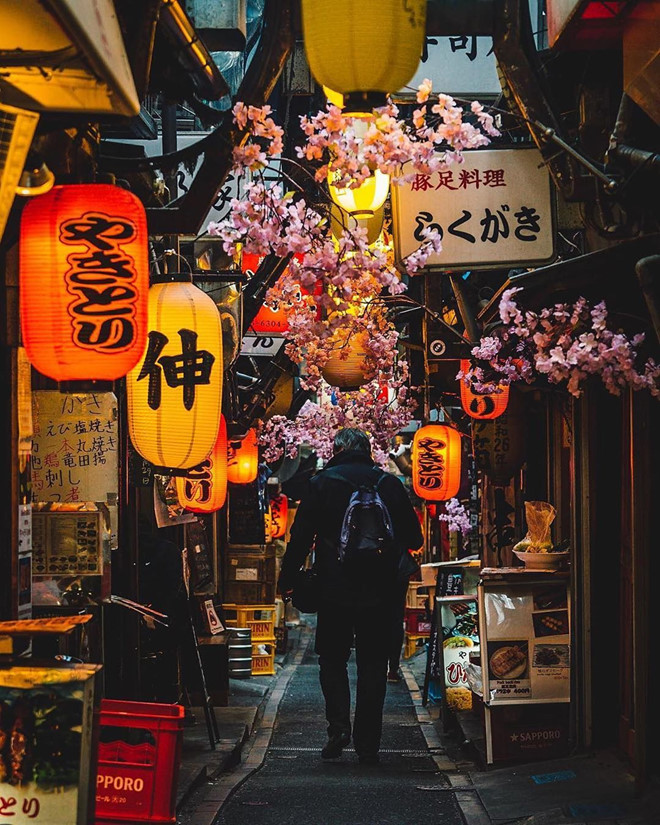
Kabukicho, Golden Gai, and Omoide Yokocho sit on the east side. The walk to the east exits is about 5–10 minutes before you even enter the gates. The east side is where most of the night is. The west side, Nishi-Shinjuku, is the tower side. A room there is still a walk from Kabukicho, longer than the east side, and realistic only if you know which exit you want before you are tired.
If the evening started on a deck, leave with the platform in mind. Shibuya Sky and Tokyo Skytree are sunset plans. They are not a reason to guess the last Marunouchi.
Shibuya is not one clock either
Shibuya has JR Yamanote and Saikyo, Tokyo Metro Ginza, Hanzomon, and Fukutoshin, Tokyu Toyoko and Den-en-toshi, and the Keio Inokashira line. Those are different platforms. The Ginza last train is not the Hanzomon last train. The Inokashira line, which is an easy one for Shimokitazawa, ends on its own board.
Tokyu Toyoko through-runs with the Fukutoshin line. The through-service ending is not the JR ending. If you need a Tokyu station southwest of Shibuya, the Yamanote board in the main concourse is the wrong one to trust.
Center-Gai and the scramble are a few minutes from the station doors, then the station itself eats the next ten. Dogenzaka and the love-hotel hill are close. Shibuya Stream is close to the south side. None of that helps if the room is in Shibuya ward but the pin is in Hatagaya or beyond Ebisu. The ward is large. The station area is not.
A day out of the city still has to be back before this window. Kamakura, Nikko, and Mount Takao are daytime trains. The return is the same last-train problem if you have a booking in Shinjuku that night.
How to check tonight
Do this at the bar, not on the platform.
- In Google Maps, set the destination to the station on the hotel confirmation. Not Shinjuku, not Shibuya ward, not the neighborhood name. The station you can walk home from.
- Choose transit. Set Depart at to the time you will be on the platform, not the time the bar closes. Add the 10 minutes inside the station.
- If the transit result disappears, turns into a long walk, or jumps to a departure around 5:00, that direction is finished. First trains start again around 5:00. The exact first one is on the same board.
- At the station, read the platform board and the last-train sheet for that direction. The Yamanote sheet is not the Odakyu sheet. Match the Japanese labels if you open the operator site: weekday is 平日, Saturday/holiday is 土・休日.
The phone check only works with data. If roaming is off, a travel eSIM is the practical fix before you go out. Station wifi is not a plan at 23:50.
The same IC card you used all day works on the last train. There is no special last-train ticket. Suica and Pasmo are the usual cards. Welcome Suica works the same way for a short trip.
If you miss it
Pick one of these before you are standing outside a closed gate.
Walk, if the next section says the pin is close enough. If it does not, do not invent a shortcut through a park you have not walked in daylight.
Taxi. Use the rank, or GO or S.RIDE. Those apps dispatch taxis. They are not a cheaper metro. The door card shows the late-night extra. In Tokyo it is commonly 20 percent from 22:00 until around 5:00. Read the card in the cab you enter. A ride inside Shinjuku, or Shinjuku to Shibuya, is the backup that stays sane. A ride out to a suburb along the private railways can cost as much as a night in a business hotel. Pay the meter. Do not negotiate a tourist price on the street.
Wait for the first train, around 5:00. Karaoke, a convenience store, or a bar that is still open can cover the gap. This works when you chose it. It is a bad surprise at a station with the shutters down. A few late buses exist. If Google Maps does not show a bus to your station, you do not have one that night. Do not follow a blog map of night buses.
Put the days and the room on one plan, including a day in Tokyo with friends, so the night is not an afterthought bolted onto a hotel in the wrong ward.
Where walking home is realistic
Walking times below are street walks, not train times. They assume you are steady on your feet. They are not a promise at 1:00 in the rain.
| The pin | After Shinjuku | After Shibuya |
|---|---|---|
| East Shinjuku, Kabukicho, Golden Gai | Yes. About 5–15 minutes to the east exits | No. About 45 minutes |
| Nishi-Shinjuku towers | Yes, if you know the west exit | No |
| Shibuya station, Dogenzaka, the scramble | No. About 45 minutes | Yes. About 10 minutes once you are at the station |
| Harajuku or Yoyogi | About 20–30 minutes | About 15–25 minutes |
| Ebisu | No | About 15–20 minutes |
| Roppongi, Asakusa, Ueno, Tokyo Station, Ikebukuro | No. Different last trains, not a stroll | No |
Roppongi is its own night, on the Hibiya and Oedo lines, with its own last trains. Do not treat it as the walk home from Shibuya. For the rest of the city in daylight, the Tokyo spots that are not the scramble are a different day.
The clean version is to sleep where the night is. A room you can walk to is the last train you cannot miss. Search a hotel next to that station for the nights you will be out, Shinjuku for a Shinjuku night and Shibuya for a Shibuya night, and read the pin on the map before you book the cheaper ward.
Want the hotel and the days on one plan, so the last train is not a surprise?
Build an itineraryReady-made routes
Routes for your destination
Day-by-day plans you can adapt to your dates right away.

FAQ
What time is the last train from Shinjuku and Shibuya?
Plan on a window around 00:00–00:30. Tokyo Metro and JR urban trains usually finish in that band, and the minute changes by line, direction, and station. This page does not print a last-train minute for every platform, because that number moves at timetable revisions and it is different on the next platform over. Check Google Maps for your hotel station that night, then the departure board.
Do Friday trains in Tokyo run later?
Not as a rule you can add in your head. Tokyo Metro prints a weekday timetable and a Saturday/holiday timetable. A Friday that is not a public holiday uses the weekday sheet. Saturday night can differ from Friday night. It is not a reliable extra half hour. All-night trains are a 31 December special on some lines, announced that autumn, not a normal Friday.
What does last train actually mean?
It is the last departure from that platform in that direction. It is not a citywide midnight bell, and it is not the last Yamanote if your hotel sits on the Odakyu, Keio, Tokyu, or a metro line that already ended. The clock is the departure, not the moment you leave the bar. At Shinjuku and Shibuya, allow about 10 minutes to reach the right platform.
What if I miss the last train?
Walk if the hotel is in the same neighborhood. Otherwise take a metered taxi. Tokyo cabs add a late-night extra after 22:00; the rate is on the door card, commonly 20 percent until around 5:00. A short hop inside Shinjuku or over to Shibuya is the realistic backup. A ride to a far suburb can cost as much as the hotel night you skipped. First trains start again around 5:00. There is no night metro.
Can I walk from Shinjuku to Shibuya?
Yes, in about 45 minutes, a bit under 4 km along Meiji-dori. That is a real walk for a sober person whose hotel is at the other station. It is a poor plan after drinks, in dress shoes, or if the pin is only near Shibuya on a map of the ward. Ebisu is a 15–20 minute walk from Shibuya. It is not a walk from Shinjuku.
Should the hotel be next to the station?
Yes, if the night is the point of the trip. Book Shinjuku for Kabukicho and Golden Gai, and Shibuya for a Shibuya night. The walk from the bar to the room replaces the last train. A cheap room in a distant ward is how people meet the taxi rank at 00:40.