
Sizes: S, M, L, and a real suitcase
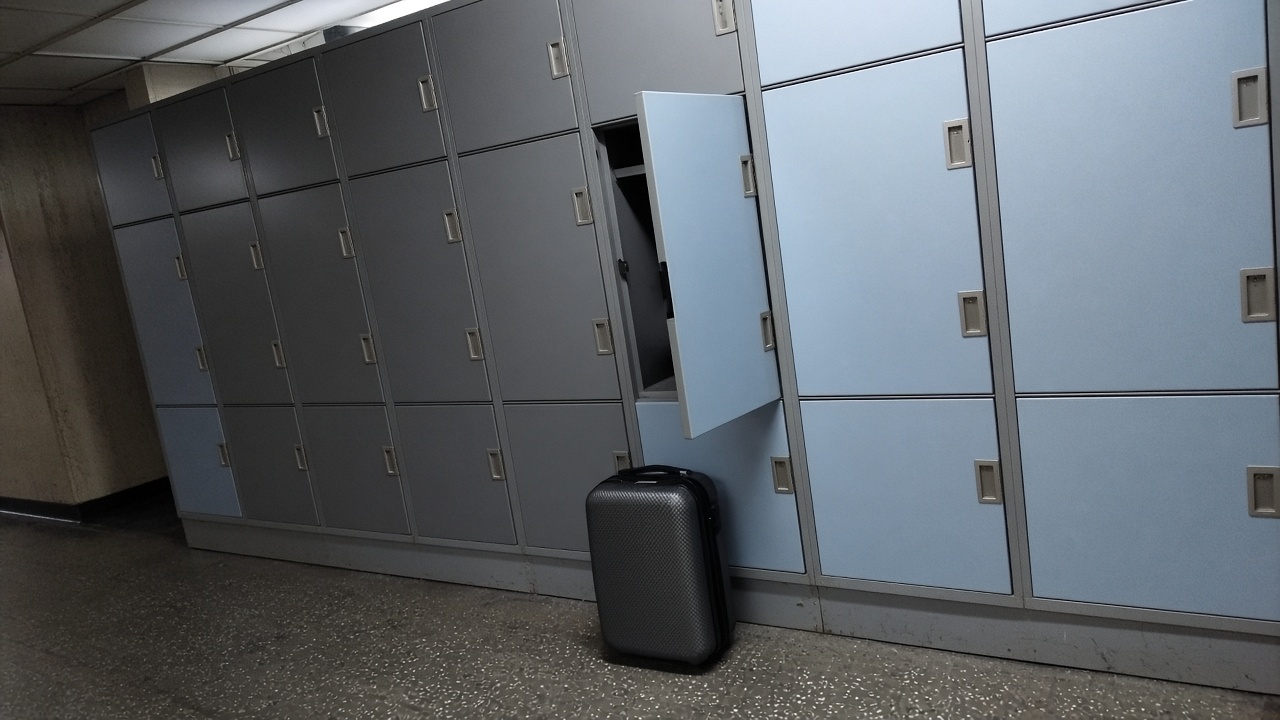
Letters are labels, not a national centimeter chart. On JR East’s Ueno guide, updated 14 October 2026, SS is a small bag, S is about a cabin suitcase, M is that cabin bag plus shopping, L is a larger suitcase, and LL is a larger suitcase plus shopping. The same letters at another station can be a different box. Look at the drawing on the door, then at the opening, not at the letter alone.
Where an operator does publish millimeters, use those and still check the frame. SPACER, which runs cashless banks for JR West, lists a standard small door at 33 cm wide, 64.5 cm deep, and 24.1 cm high; medium 33 × 64.5 × 52.4 cm; large 33 × 64.5 × 80.8 cm. The maker also says door size can be changed to order, so a station bank may differ. A 75 cm suitcase often fails on width: the wheels and the shell have to pass 33 cm, not the diagonal you measured at home.
JR East’s Tokyo magazine, updated 20 October 2025, gives a price range for its own lockers and says the yen changes with the place and the machine: SS 300 yen, S 500 yen, M 700–800 yen, L 900–1,000 yen. That is not a fare for Kyoto, Hiroshima, or the subway. If the door in front of you shows a different number, the door wins.
How to pay: coins, IC cards, and cashless screens
Read the icons before you put the bag in. A coin slot wants coins — carry 100-yen pieces, because many slots are built around them, and do not assume a 1,000-yen bill or a card will work on that row. An IC mark wants a transport card such as Suica, PASMO, or ICOCA. A touchscreen with no coin slot is cashless.
JR East’s Welcome Suica page is the clearest rule for IC lockers: the card pays and the same card is the key. You cannot mix it with cash. Tap the physical card, or the same phone if the card lives in the wallet app. A photo of the card does nothing. If two people share the bag, the person who tapped has to come back, or you pay in a way that prints a slip.
Multi eCube, JR East group’s smart lockers, is the row that also takes QR payments (PayPay, d Barai, au PAY, Rakuten Pay, J-Coin Pay, Alipay, WeChat Pay) and Visa, JCB, Mastercard, and American Express. JR East says many other lockers take only cash or only IC. Its Sendai guide says the Multi eCube row there does not take cash. If you only have coins, find a door with a slot.
A reservation on Multi eCube is a separate 500 yen per box, on top of the locker fee, from up to a month ahead, for one to three days. You need a membership and a card. The site can show a free door that the platform does not match if the connection is poor. JR East says so on the Shinjuku page.
SPACER’s own guide says its lockers are fully cashless: the app, or a touch panel with transport IC, a credit card, or PiTaPa. Some sites take only IC. One payment opens the door once at the end. You do not duck in for a jacket and close it again on the same charge. The maximum it states is 96 hours.
Station basements are a bad place to discover that roaming will not load the map. An eSIM for Japan is what makes JR East’s locker search and JR West’s ICOCA locker search usable before you pick a gate.
When the lockers are full
The suitcase row goes first, and it goes in the morning. JR East’s Shinjuku guide, updated 24 September 2025, says the large sizes can be almost full before noon, and that the easiest banks — the ones you see as soon as you exit — fill earlier than a passage further in. Tokyo Station has more than 100 locker locations, which does not mean the door next to the shinkansen gate still has a large box at 11:00.
JR West does not publish a clock time for Kyoto or Hiroshima. Use the ICOCA locker search on JR West’s hands-free page before you leave the platform. Weekend and holiday mornings, and the weeks people come for temples or Miyajima, are when the obvious banks go. A live count beats a blog that says “usually fine.”
Hours are part of “full.” A door you cannot open after the stated closing time is as useless as a door that was taken. Many JR East banks run from the first train to the last. The cashless banks below publish tighter windows. If your train back is later than the window, pick a different bank or do not use a locker.
Tokyo Station
JR East’s Tokyo Station article, updated 20 October 2025, is the source for the counts below. They are a snapshot, not a promise for your morning.
Outside, near the shinkansen gates. Yaesu North: first train to last, SS 5, S 80, M 51. Handy if you are not going back through a gate. That published count has no L. A big case may have to go inside.
Inside, the large bank. B1 near Gransta: more than 900 doors, S 728, M 152, L 40, first train to last. This is the only L count in that Tokyo roundup. It is inside the gates. Marunouchi Central inside is easier to find (S 40, M 19) and therefore easier to find already taken. The Keiyo underground passage, toward the Keiyo Line, is the one JR East calls relatively less crowded: SS 5, S 78, M 33, and again no L in that count.
JR East’s Chiba locker guide states the inside-gate rule in plain language: if you are not riding, you need a platform ticket to use lockers inside the gates. The same constraint is why an outside bank is the one for a day on foot. The price of that ticket is on the machine at the gate you are using.
A walking frame for the days you are dropping a bag here is 3 days in Tokyo on a budget. Ueno, one stop up the Yamanote line, is a real second station, not a rumor: JR East’s guide updated 14 October 2026 lists 21 locker locations in the Ueno complex — 13 at JR Ueno, 5 at Tokyo Metro Ueno, 3 at Keisei Ueno — and says the figures are as of October 2026 and can change. JR’s 13 sit around the Central, Shinobazu, Park, and Iriya gates. Most of those machines are cashless or IC; the article marks only some as taking cash. Outside Shinobazu it lists an LL row (20 doors in that snapshot), which is the one to look at when a normal L is too narrow.
Shinjuku Station
JR East’s Shinjuku guide, updated 24 September 2025, prints two tariffs. Multi eCube: SS 300 yen, S 500, M 700, L 900. Other lockers: SS 300, S 500, M 800, L 1,000. In busy periods, Multi eCube M and L add 100–200 yen. Box counts below are marked August 2025 in that article. The east-exit floor has also been rebuilt around the old highway-bus office, so follow the station map if a photo in the article no longer matches the room.
Inside, South Gate, 2F. Close to the gate and to the Odakyu transfer: SS 5, S 80, M 85, L 76, first train to last. This is the obvious row, which is why the large doors go.
Inside, B1 toward platforms 5 and 6. JR East’s less-crowded tip, on the way to the Narita Express platforms: S 22, M 12, L 42. Worth the extra walk when the South Gate row is done.
Outside. East exit, 1F: SS 15, S 77, M 47, L 64. New South Gate, by the Suica penguin square, for the highway-bus terminal: SS 10, S 15, M 13, L 41. Outside is the right choice if you are leaving JR for the day and do not want a platform ticket standing between you and the bag.
Kyoto Station
Kyoto Station is several operators in one building: JR West, the shinkansen side, and Kintetsu among them. There is no one Kyoto price. Ordinary coin lockers show the yen on the door. The tariff that is actually published, and only for specific cashless banks, is SPACER’s.
SPACER’s page for the JR West bank inside the Karasuma gate is dated 11 July 2026. Hours 4:35–23:55. You enter the central (Karasuma) gate and turn right, so this bank is inside the gates. First 60 minutes are 0 yen on the small, medium, and large doors listed there. After that, every three hours: small 300 yen, medium 400, large 600, with a 24-hour cap of 900, 1,200, and 1,800 yen. That cap is not “900 yen anywhere in Kyoto Station.”
JR West’s hands-free page lists coin-operated lockers across its stations, with the ICOCA locker search for live size and quantity, plus staffed storage and delivery at Kyoto Station. Fees for those counters are on JR West’s page, not guessed here. If the case is too wide for 33 cm, the counter or a same-day send is the path, not a harder shove.
Temple days pair with a light bag. A frame for the walking is 3 days in Kyoto on a budget.
Hiroshima Station, and a Himeji stop
SPACER’s page for the bank beside the Minamoa gate is dated 3 August 2026. It is inside the gates: enter Minamoa and turn right, locker corner F. Hours 5:30–00:15. Large: first 60 minutes 0 yen, then 600 yen per three hours, 1,800 yen per 24 hours. Medium: 0 yen, then 400 and a 1,200 yen cap. Small is listed at 300 yen per three hours and 900 yen per 24 hours; when we read the page on 17 November 2026 the first-hour line for small did not show a yen figure, so confirm that line on the screen before you close the door. This is one cashless bank, not every locker in Hiroshima Station.
JR West also lists Hiroshima for its hands-free storage and delivery, alongside ordinary coin lockers you find with the ICOCA search. We did not find a JR West sentence that says Hiroshima lockers are full by a set hour. People dropping bags for Miyajima still hit the nearest row first. If your ferry day ends after 00:15, this SPACER bank will not open, even if you paid.
Himeji is a real locker station if the castle is the stop and the suitcase should not climb the hill. JR West’s Himeji station page lists coin lockers. Visit Himeji places banks outside the central gate: toward the castle exit (4 small, 26 medium, 28 large) and toward the south exit, including 70 small, 35 medium, and 30 large behind the souvenir hall. Those station banks are listed at 6:30–midnight. The city page does not print a yen figure. More rows sit in Piole, Grand Festa, and Sanyo Railway’s station, with earlier closing times. Use an outside-gate door so the walk to the castle does not require a ticket to fetch the bag.
What does not fit
A suitcase wider than the frame. On a SPACER standard large door that width is 33 cm. Forcing the shell marks the door and still leaves the bag in the concourse. Measure the widest point, wheels included.
Anything the drawing does not show. An open stroller, a bicycle, and a golf bag are not a suitcase door. A few stations have odd oversized boxes; the drawing on that door is the test. SPACER’s product sheet rates the cabinet at 30 kg. A station unit can differ. If the sticker shows a lower number, that number is the one.
The things you cannot replace this afternoon. Passport, cash, medication, the only house key, and the laptop you need tonight stay with you. A locker receipt is not a safe-deposit contract. If the bag is simply too big for the train as well, the limit and the reserved baggage seat are in the Shinkansen oversized-baggage guide.
When the row is full: hotel and forwarding
Ask the hotel before you promise yourself a 3 p.m. drop. JR West says guests at a JR-West Group hotel may be able to leave bags before check-in or after check-out, and tells you to ask that hotel. A random booking does not inherit the rule. The desk that already has your name is still the calmest backup in Kyoto or Hiroshima.
Sending the bag is the other backup, and the yen depends on size and distance. The hotel-to-hotel luggage guide is the walkthrough for takkyubin. JR West’s hands-free page lists station storage and delivery at Kyoto and Hiroshima. Multi eCube can also send a bag the same day to a hotel from Tokyo, Shinjuku, Ueno, and Kyoto, among other stations; the fee and the hotel list are on their site. A 2025 campaign price in the magazine is a campaign price. Do not budget it as today’s tariff.
If you are landing and the suitcase is still in your hand at immigration, set up Visit Japan Web before the plane so the airport queue is not the moment you are also hunting a locker map. The QR does not reserve a station door.
A travel insurance policy is the paperwork if a bag is gone when you come back. It does not open the door, and it does not refund the locker fee.
Want the station stops set against the days you are actually changing cities, so the suitcase is not on the temple day?
Build an itineraryReady-made routes
Routes for your destination
Day-by-day plans you can adapt to your dates right away.
FAQ
Is there one price for station coin lockers in Japan?
No. JR East’s own magazine publishes a Tokyo-area range — about 300 yen for SS, 500 for S, 700–800 for M, and 900–1,000 for L — and says the amount changes by station and locker type. Multi eCube M and L doors can be 100–200 yen more in busy periods. Kyoto and Hiroshima cashless banks run by SPACER for JR West use a different tariff: a free first hour on the doors that list it, then a charge every three hours with a 24-hour cap. Read the yen on the door you are closing.
Can I pay with Suica, ICOCA, or my phone?
Only if that door shows an IC or cashless icon. Many ordinary JR East lockers take only coins or only a transport IC card. Welcome Suica can pay and acts as the key; you cannot split the payment with cash, and you must tap the same card or the same phone. Multi eCube adds QR payments and major cards. SPACER’s cashless lockers do not take cash. A screenshot of a Suica balance is not a key.
What if the large lockers are full?
Walk to another bank before you give up on the station. At Shinjuku, JR East says suitcase sizes can be almost full by late morning and points to the B1 passage toward platforms 5 and 6. At Tokyo Station the Keiyo underground passage is described as less crowded, while the only large doors in JR East’s Tokyo roundup sit inside the gates near Gransta. In the JR West area, open the ICOCA locker search. If nothing fits, send the bag or leave it at the hotel.
Can I leave a bag overnight?
Sometimes, and another day is usually another charge. SPACER’s guide caps one use at 96 hours, and you do not get to open the door in the middle and close it again on the same payment. A Multi eCube reservation is up to three days, with one drop-off and one pickup. Ordinary coin lockers print their own cutoff and maximum on the door. A locker is not a hotel room, and a bank inside the gates may be unreachable after the last train.
Will a big suitcase fit?
Often the large door, and often not if the shell is wide. SPACER’s standard large door is about 33 cm wide, 64.5 cm deep, and 80.8 cm high. Height is rarely the problem; the wheels and the hard shell are. JR East’s Ueno guide uses S for a cabin-size case and L for a larger suitcase, without publishing centimeters. If the bag does not pass the frame, it does not “almost” fit.
The locker is inside the ticket gates. Can I still use it for sightseeing?
Only if you can pass that gate again. JR East’s Chiba locker guide says a platform ticket is required when you are not riding a train and the lockers are inside the gates. Tokyo, Shinjuku, Ueno, Kyoto’s Karasuma SPACER bank, and Hiroshima’s Minamoa SPACER bank all include inside-gate rows. Use an outside-gate bank when you are leaving the station for the day. The platform-ticket price is on the machine.