
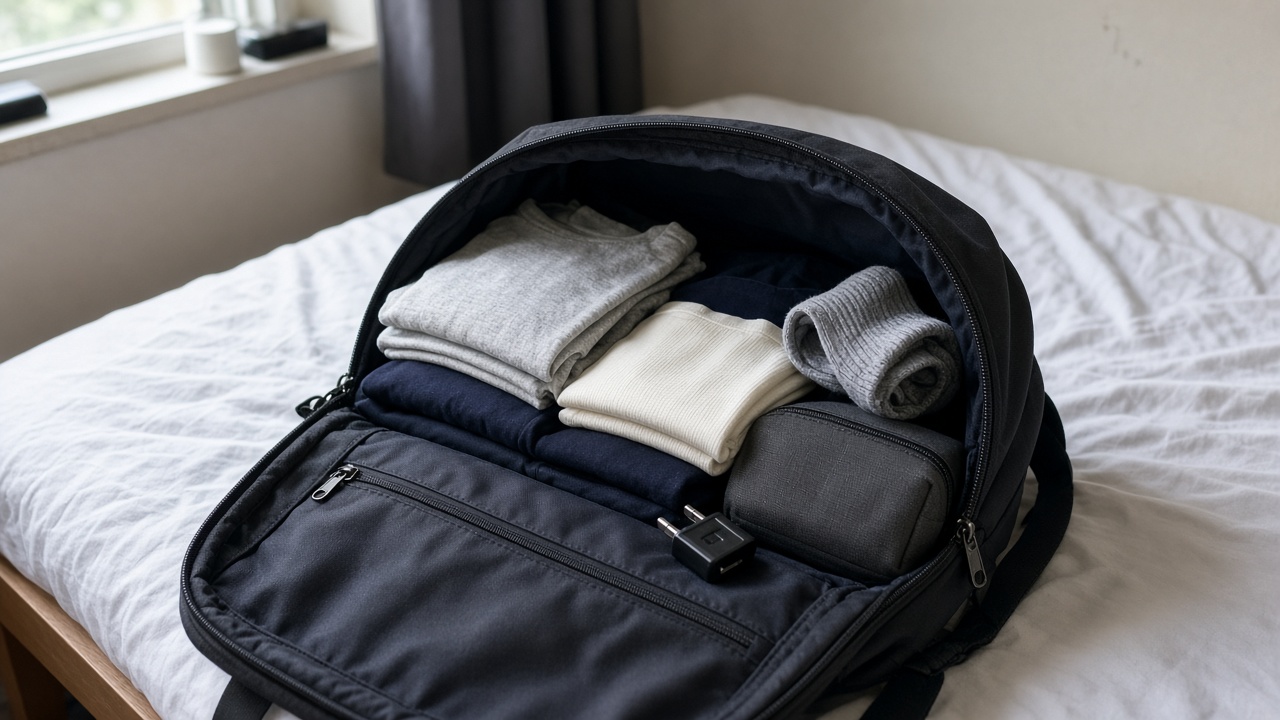
The three regrets, in the order people say them
A second pair of trousers. A pile of tech that never leaves the hostel. The adapter still in a drawer at home. Those three show up after a two-week Europe trip more often than a missing souvenir or a forgotten scarf. The bag was big enough. The choices inside it were the problem.
Two weeks is a laundry problem, not a wardrobe problem. Wash on day four or five, in a sink or a machine, and the same small stack covers the second week. The pieces you wear on the travel day — trousers, shoes, a layer — should be the heavy ones, because they do not count against the zip until you take them off.
Whether that bag is the free personal item or the overhead cabin bag depends on the fare. Published boxes for the under-seat pack are in the personal-item backpack guide. The airline size table, including what happens when a bag fails the sizer, is in the carry-on checklist. Rules and fees move. This list is about what goes inside.
Extra trousers are the heavy regret
Jeans are the usual second pair. They are dense, they take a night and a morning to dry on a hostel line, and after the third city you are wearing the pair you boarded in. The spare sits under the cubes until the flight home, when you notice the weight you carried through every station.
Wear the pair you will live in. Pack one lighter spare: a thinner trouser or a pair you can wash in the evening and wear again after it dries. Shorts under the worn pair only help in real heat. In November, and in a lot of spring weeks, a second pair of the same denim does not make you warmer. A thin layer under the pair you are already wearing does.
The same rule covers the “nice” outfit. One shirt you would wear to dinner is enough if it can also be a day shirt. A blazer, a second belt, and shoes you will change into at the restaurant are three regrets that travel as one idea.
Heavy tech that stays in the locker
The laptop comes “just in case” and opens for a boarding pass you already have on the phone. A camera body with two lenses is a second packing project. A drone adds batteries and a city that may not want it in the air. Each of those is a fair tool on a trip built around it. On a two-week city trip they are the kilos people wish they had left on the bed.
What holds up is smaller. The phone you already carry. One USB charger whose label reads 100–240V, so the European 230V socket is a plug change and not a new brick. Cables for the devices that will actually run out. A spare battery in the cabin bag, not in the hold. The usual ceiling people plan around is 100 Wh. Between 100 and 160 Wh, many airlines want approval before you fly. Above 160 Wh the battery is generally refused. The carrier on your ticket can set a lower line. Read that page before you buy a larger pack. That ceiling moves.
If the trip is work, the laptop stays and the trade is explicit: the second trousers, the spare shoes, or the paperback go home. A two-week bag cannot absorb a full desk and a full closet.
The adapter people remember at the hostel
Continental sockets are a family, not one shape. A slim Type C Europlug fits the ordinary outlet in France, Spain, Portugal, the Netherlands, and most of Italy’s everyday sockets. Germany and much of Central Europe use Type F, the Schuko socket, and Type C fits that too. France is Type E. The earth pin sticks out of the socket; Type C still goes in. A fat UK plug fits none of these.
Type G is the one people forget when the trip is “Europe” and the first night is London, Dublin, Valletta, or a Cypriot stop. A Europlug does not fit a Type G socket. If those countries are on the ticket, pack Type G as well, or a small multi-country plug that includes it. Switzerland is Type J. A slim Europlug often fits. A chunky Schuko plug does not. Pack for the countries on this itinerary.
The other half of this regret is the voltage converter: a heavy box bought because Europe is 230V. A phone charger, a laptop brick, and most camera chargers already say 100–240V on the label. Those need the right plug shape. They do not need a voltage converter. Read the label before you pack the box. Hair dryers are the appliance that often is single-voltage, and a hostel front desk usually has one you can borrow.
What people were glad they brought
The glad list is dull, which is why it works.
- Four or five tops that dry overnight, in colours that share one pair of trousers.
- The walking shoes on your feet. A packed second pair is the cousin of the extra trousers.
- Enough underwear and socks for four or five days, then a wash.
- A sleep shirt. Hostels are not pyjama shops, and the day shirt gets a night off.
- A wash kit decanted into small bottles. Many airports still want 100 ml containers in the cabin. Scanner rules have tightened and loosened by airport, so check the one you depart from in the week you fly.
- Blister plasters, the medicines you already take, and a few pain tablets. Prescriptions ride in the cabin bag.
- Earplugs and a small locker lock.
- One empty tote for a market or a museum. It lives flat until you need it.
- The plug for night one, in the pocket you can find without unpacking.
A thin rain shell worn on the plane beats a second coat in the bag. A scarf or a light fleece does the evening job in shoulder season. Neither of those is a product to hunt. They are the layer you already trust at home.
A list you can pack tonight
This is a two-week cabin list for a city trip, with laundry once. It is not a catalogue, and it is not a promise that every airline will take the bag. Measure the closed pack against the fare you bought.
| Where | Pack | Leave at home |
|---|---|---|
| On you | Trousers, top, rain shell, walking shoes. | A second coat in the suitcase you do not have. |
| Clothes | 4–5 tops, 1 light spare bottom, 5–7 underwear, 4–5 socks, sleep shirt. | A second pair of jeans. Outfit shoes. |
| Wash | Decanted toiletries, a little soap for the sink, a cloth. | Full bottles. A single-voltage hair dryer. |
| Tech | Phone, one 100–240V charger, cables, a cabin battery at or under 100 Wh unless the airline said otherwise. | Unused laptop, extra lens, drone, voltage converter. |
| Paper and plugs | Passport, cards, a little cash, Type C, plus Type G if the UK, Ireland, Malta, or Cyprus is on the trip. | A “world” brick you have not checked against the sockets. |
Leave a corner of the bag empty on purpose. Two weeks in Europe produces a book, a biscuit tin, or a shirt you will actually wear at home. If the bag is full at the hostel on night one, that corner does not exist on night fourteen.
A weekend in the middle still uses the same bag
Two weeks is a string of cities. One of them can be three days. Paris runs on Type E sockets, so the Type C plug in the pocket is the one for those nights. You do not pack a separate bag for the weekend if the two-week bag already left the second trousers at home.
A three-day plan that stays inside the city, on foot and on the metro, is a weekend in Paris. Use it as the city block inside the longer trip. The rucksack that closed on the bed is the one you take to the station.
Build the two weeks first. The bag is easier to pack once the cities are real.
Build an itineraryReady-made routes
Routes for your destination
Day-by-day plans you can adapt to your dates right away.




FAQ
Is one bag realistic for two weeks in Europe?
Yes, if you wash once in the middle and you wear the heavy pieces. Two weeks is not fourteen outfits. It is about five days of clothes and a sink or a machine on day four or five. The bag fails when the second trousers, the unused laptop, and a full toiletry kit all come along.
How many pairs of trousers should I pack?
Wear one pair. Pack one lighter spare you can wash and hang overnight. A second pair of trousers in the same heavy denim is the regret people name after the trip: the spare stays at the bottom, and the pair from the airport is the one they lived in.
What tech is worth the weight?
A phone, one USB charger printed 100–240V, and the cables for the devices you will actually charge. A laptop stays home unless the trip is work. If the laptop stays, something else leaves. A spare battery rides in the cabin. The usual ceiling people plan around is 100 Wh. From 100 to 160 Wh many airlines want you to ask first. Above that, the battery is generally refused. Your airline can be stricter.
Which plug does Europe use?
Most of the continent, including France, takes a slim Type C Europlug. Germany’s socket is Type F and France’s is Type E; Type C fits both. The United Kingdom, Ireland, Malta, and Cyprus use Type G, and a Europlug does not fit those. Switzerland is Type J: a slim Europlug often goes in, a chunky Schuko plug does not. Pack the countries on this ticket. A voltage converter is a separate, heavier object, and a dual-voltage USB brick does not need one.
What were people glad they brought?
Clothes that dry overnight, the walking shoes already on their feet, a decanted wash kit, blister plasters, earplugs, prescriptions in the cabin bag, and the plug for the first country. An empty tote for a museum day or a grocery run earns its few grams. A second camera lens rarely does.