
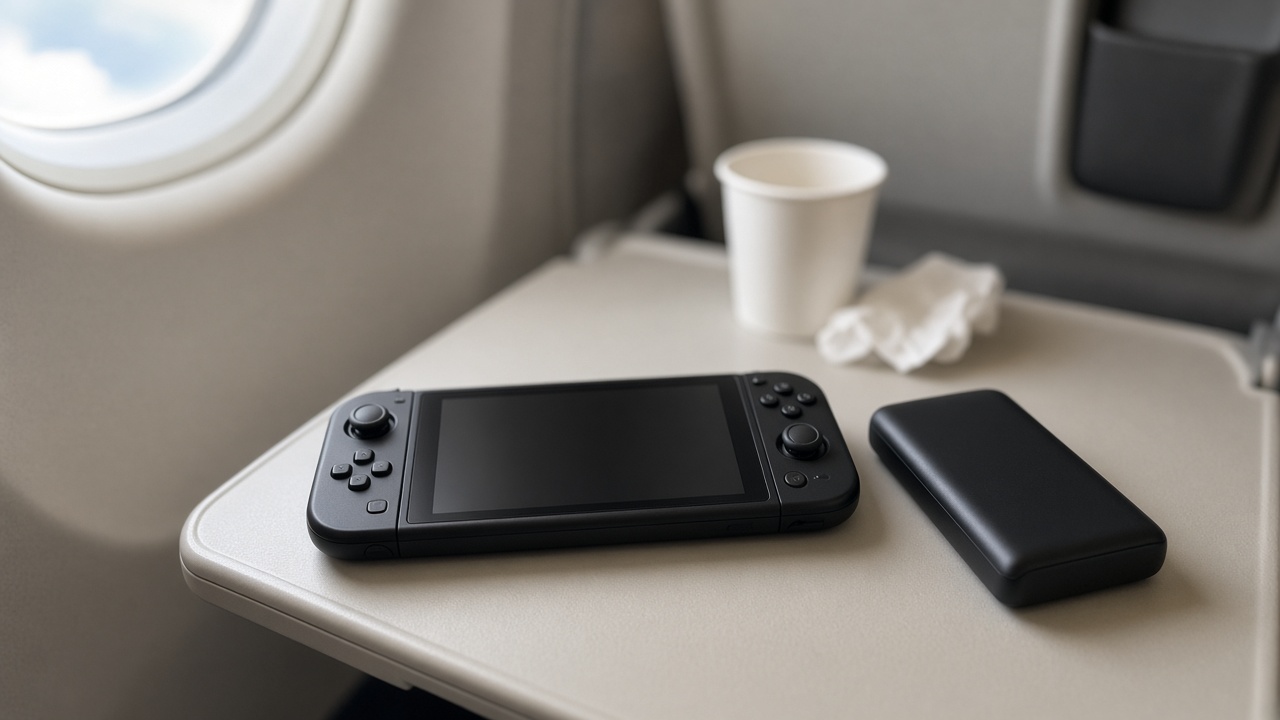
When the weight is worth it
The question people pack around is simple: a Steam Deck, or another handheld, and the 20,000 mAh Anker they already own, against every gram on a long trip. There is no shopping link on this page. The console is a dense brick. The bank is another brick, often a few hundred grams, plus the cable. On a two-week trip that pair is in the bag on every platform.
It earns the weight when the screen will be on for a flight or a long train, and the watt-hours printed on the bank sit in the cabin range below. After conversion loss, expect one extra play session from a bank in that class, not a second week of games. It is a poor trade when you play one evening and the rest of the trip is walking. A 10,000 mAh bank at the same 3.7 V is 37 Wh: 10,000 × 3.7 / 1,000. Less play, less weight. One bank, not a second one “just in case”.
The other electronics people wish they had left at home are in the two-week one-bag regrets guide. This page is only the console and the battery that feeds it.
Watt-hours, not milliamp-hours
Milliamp-hours are a charge at a stated voltage. Airlines and airport security do not use that marketing number by itself. They use watt-hours. The conversion is the capacity in mAh, times the voltage printed with it, divided by 1,000.
| What the label says | Watt-hours | How to read it |
|---|---|---|
| 20,000 mAh at 3.7 V | 74 Wh | 20,000 × 3.7 / 1,000. The usual cell voltage. |
| 20,000 mAh at 3.6 V | 72 Wh | Same formula, the voltage on that unit. |
| 20,000 mAh at 3.85 V | 77 Wh | Still under a typical 100 Wh line, if the print agrees. |
| 20,000 mAh × 5 V USB | 100 on paper | The wrong voltage. USB output is not the cell rating. |
If the case prints watt-hours, that printed number is what security uses. A 20,000 mAh Anker is the bank in the question only when its own print matches the row. If your unit prints a different Wh, the print wins. If the case shows mAh and a voltage and no Wh, multiply those two figures. Do not invent a voltage that is not on the bank.
The cabin lines
These are the usual passenger-aircraft lines people plan around. They are not a promise from the airline on your ticket. Checked 17 November 2026. Carriers change the page, and some set a lower number than the line below.
- Up to 100 Wh: a typical cabin allowance without asking the airline first. The carrier can still cap how many spare batteries you bring.
- Above 100 Wh and up to 160 Wh: often allowed only with that airline’s approval before the flight. Carriers that allow this band often limit you to two spares. Ask the airline on the ticket. Approval is not a conversation you start at the belt.
- Above 160 Wh: generally forbidden on a passenger aircraft. Leave that pack at home. This page does not describe a way to carry a battery the rule forbids.
A bank that prints 74 Wh sits under the usual 100 Wh line. A bank that prints 100 Wh sits on it. Read the digits on the case, then the rule for your carrier. The carry-on checklist is the page for bag size. It is not a substitute for the battery rule on your ticket.
Cabin, not the hold
Spare lithium batteries and power banks go in the cabin. They do not go in a checked bag. That is the rule to pack around, not a tip for the queue. If staff send your suitcase to the hold, lift the power bank out first and keep it in the bag that stays with you. Do the same for any spare lithium battery that is not already installed in a device.
Bring the handheld in that same cabin bag. You wanted it for the flight, and the bank that feeds it has to be there anyway. The battery installed inside the console is part of the device. The power bank is the spare. The spare is the piece that stays out of the hold.
Keep the bank where you can reach it. You are showing the printed watt-hours if someone asks, and you are taking it out if the larger bag goes to the hold. Nothing on this page is a method for slipping a battery past security.
What rides with the console
| Piece | Where it goes | Why |
|---|---|---|
| Handheld | Cabin bag, with you | It is the reason the bank is in the bag. |
| One power bank | Same cabin bag | Spares and power banks do not go in the hold. |
| Cable | With the console | A second cable is the thing to leave if the bag is tight. |
| Wall charger | Either bag | A charger brick is not a lithium battery. It is still weight. |
If the cabin bag only zips when you kneel on it, the bank is the heavy extra to drop before you leave home, unless you know you will play. The console can stay if the bag still fits the box on your ticket. Measure the packed bag. Litres on a hangtag are not a pass.
If you are packing tonight
Read the watt-hours on the bank before it goes in the bag. Under the usual 100 Wh line, one bank in the cabin bag is the ordinary pack. Between 100 and 160 Wh, get the airline’s approval before you travel, or leave it. Above 160 Wh, it stays at home.
Then decide the days. A flight and a long train justify the brick. A city week of walking does not. Build those days first, and leave the second bank on the shelf.
Plan the days you will actually play, then pack one bank that matches them.
Build an itineraryReady-made routes
Routes for your destination
Day-by-day plans you can adapt to your dates right away.
FAQ
Can the power bank go in the checked bag?
No. Power banks and spare lithium batteries belong in the cabin bag you keep with you. If the gate sends the suitcase to the hold, take the bank out first and carry it on. Checked 17 November 2026. Your airline can be stricter than this page.
Is 20,000 mAh under 100 Wh?
Only after you convert it. Watt-hours are mAh × voltage / 1,000. At 3.7 V, 20,000 × 3.7 / 1,000 = 74 Wh. At 3.6 V the same label is 72 Wh. Multiplying by the 5 V USB output gives 100 on paper, and that voltage is the wrong one. Security uses the watt-hours printed on the bank.
What if the printed number is between 100 and 160 Wh?
That band often needs the airline’s approval before you fly, and carriers often limit how many such batteries you bring. Above 160 Wh is generally forbidden on a passenger aircraft. A typical cabin line without approval is 100 Wh. The airline on your ticket can set a lower one. Checked 17 November 2026.
Does the handheld’s own battery count as a spare?
The battery installed in the Steam Deck, or a similar handheld, is part of the device. The power bank is the spare. Keep the console and the bank in the cabin bag. Switching the console on does not turn its internal battery into a second spare.
Is the weight worth it for two weeks in Europe?
On long flights and train days, one bank whose printed rating is under 100 Wh is the usual yes. A second large bank is weight you carry through stations for a day you may not play. The one-bag regrets guide lists the other electronics people wish they had left at home. Bag size is in the carry-on checklist, and those boxes change.