
Short answer
The three temples worth one trip are Gandantegchinlen (Gandan) in Ulaanbaatar, Erdene Zuu in Kharkhorin, and Amarbayasgalant under Mount Buren Khaan. The first is the working center of Mongolian Buddhism. The second is the oldest surviving monastery, founded in 1586, inside the Orkhon Valley UNESCO site. The third is a large 18th-century complex that day tours from the capital rarely reach.
Choijin Lama Temple in central Ulaanbaatar is a museum, not a fourth stop on this route. If you have a spare afternoon in the city, go after Gandan. It does not need its own day.
The same idea — a temple axis, not a list of everything — shows up elsewhere. See the Yonghe Lama Temple guide in Beijing and the Kyoto temples route.
The three temples: where they are and why go
| Temple | Where | Why | Time |
|---|---|---|---|
| Gandantegchinlen | Ulaanbaatar | Main working monastery, 26.5 m Janraisig statue | 2–3 hours in the morning |
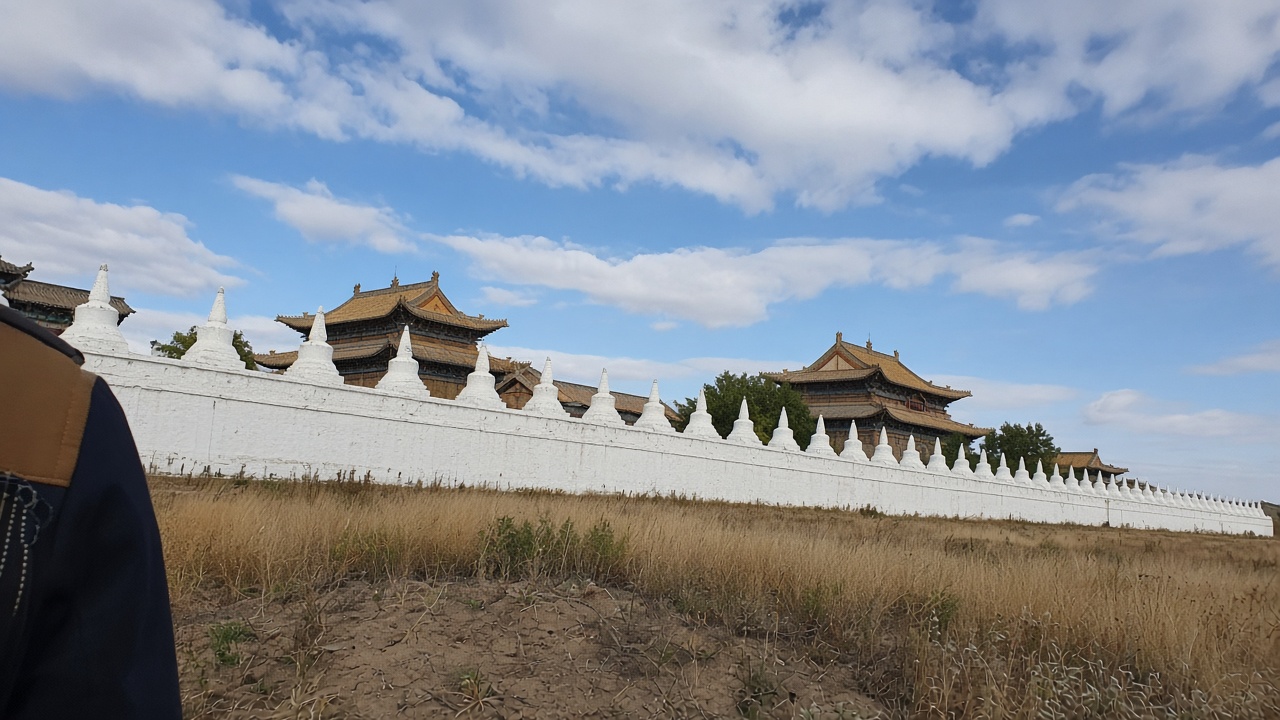
| Erdene Zuu | Kharkhorin, Orkhon Valley | Monastery from 1586, wall of 108 stupas, UNESCO site | Half a day plus a night nearby |
| Amarbayasgalant | Selenge Province | 18th-century complex built for Zanabazar, few visitors | A morning plus a ger-camp night |
Do not plan a direct Amarbayasgalant to Kharkhorin crossing. There is no useful road. Both drives start in Ulaanbaatar. Do the north first, then the west, so the dirt section is not on your most tired day.
Gandantegchinlen: a morning in Ulaanbaatar
Gandan sits about two kilometers northwest of Sukhbaatar Square. The first temple here dates to 1809; by the mid-19th century the monastery was the seat of the Bogd Gegeen. It was closed in the 1937–1938 purges and reopened in 1944, for a long time the only working Buddhist monastery in the country.
The main hall holds Megjid Janraisig, a 26.5-meter Avalokiteshvara consecrated in 1996 to replace the statue destroyed in 1938. Sutras and medicinal herbs are sealed inside. You can usually walk the grounds without a ticket. The statue hall is separate, and photos inside are often extra. Prices at the window change, so carry small tugrik notes.
Arrive at 9:00. The morning chant is the hour worth keeping; after noon the courtyards fill with groups. Two to three hours is enough. Cover shoulders and knees and walk clockwise. A taxi from the square takes 10–15 minutes. Drivers know the word Gandan.
Erdene Zuu: Kharkhorin and a wall of 108 stupas
Abtai Sain Khan built Erdene Zuu in 1586, partly with stones from Karakorum, capital of the Mongol Empire. It is about 360 km of paved road west of Ulaanbaatar, 6–7 hours without long stops. The monastery stands on the east bank of the Orkhon, in Kharkhorin sum.
There were once several dozen temples. After the 1930s, three survived inside the wall of 108 stupas: Lavrin, Zuu, and Gol. The rest is reconstruction. In summer, 1 May to 30 September, the complex is usually open 9:00–18:00. From October to April it closes at 17:00 and often on weekdays only. The courtyard is free to walk; the museum halls need a ticket.
The Karakorum stone turtle and the small town museum are next door. That is a day, not an hour on the way through. Sleep in Kharkhorin or a ger camp in the valley. Do not drive back to the capital the same evening.
Amarbayasgalant: the quiet complex in the north
Amarbayasgalant was built from 1727 to 1736 to house the remains of Zanabazar, the first Bogd Gegeen and a sculptor. The plan is symmetrical, in the Manchu-Chinese tradition, not like the steppe halls at Erdene Zuu. It stands in Baruunburen sum, Selenge Province, at the foot of Mount Buren Khaan.
The distance from the capital is also about 360 km, on a different road. Pavement holds to Darkhan, then it worsens, and the last 30–40 km are dirt. After rain, allow 7–8 hours, not five. There is no public bus to the gate.
More buildings survived the purges than in Kharkhorin, so the complex still reads as a whole. Fewer people than at Gandan. A morning is enough. The entry fee is small; ask the current price on site.
A 7-day route
Seven days is the working minimum if you do not want a night drive. Five days only works if you drop the buffer and leave Erdene Zuu the same day you arrive. That is 12 hours or more in the car around a single monastery.
| Day | Plan |
|---|---|
| 1 | Ulaanbaatar: Gandan in the morning, city in the afternoon |
| 2 | Drive north, sleep near Amarbayasgalant |
| 3 | Morning at the monastery, night in Darkhan or back in the capital |
| 4 | Buffer in Ulaanbaatar: laundry, cash, early night |
| 5 | Drive to Kharkhorin; Erdene Zuu if you arrive before closing |
| 6 | Temples, the Karakorum stone turtle, the town museum |
| 7 | Return to Ulaanbaatar |
How to chain nights in different places is in the multi-city route guide. Season windows for other countries are in the when to travel roundup.
Put Gandan, the north, and Kharkhorin on separate days so the two drives do not collapse into one.
Build the routeThe drive, a driver, and where to sleep
One driver for the week beats two separate day tours: the empty return is yours either way. Take a car with ground clearance. The road to Kharkhorin is paved. After rain a low car can get stuck on the way to Amarbayasgalant.
Sleep in a hotel in Ulaanbaatar on days 1 and 4, and in a ger camp by the monasteries. Book the camp ahead in July: Naadam takes the free gers. If you do not want to find a driver yourself, a guided day covers the capital. The countryside legs still need their own arrangement.
Flights land at Chinggis Khaan (UBN), about 50 km from the city. The old in-town airport no longer takes flights. Compare flights before you lock the first hotel. On the dirt road you need a signal: install an eSIM or Yesim and download offline maps. The phone checklist is in smartphone prep for a trip.
Season, clothes, and cash
The useful window is late May through September. The steppe is hot by day and a ger is cold at night even in July, so pack a warm layer. Use the long-trip packing guide. Dust on the dirt road gets into shoes. Naadam is usually 11–15 July. Monasteries stay open, but roads and beds fill up.
Cards work in capital hotels and almost never at monastery ticket windows. Change tugrik in Ulaanbaatar. Estimate the week in the travel budget calculator. Long dirt drives are a reason to buy travel insurance with evacuation, not only a baggage policy. A comparison is in the travel insurance guide.
Ready-made 3-day Mongolia scaffolds, if the capital matters more than the steppe: Mongolia for architecture lovers, history and culture, and an independent trip. The temple loop is longer than those three days. Use them as the Ulaanbaatar base and add the north and the west on top.
FAQ
Which three Buddhist temples in Mongolia belong on one route?
Gandantegchinlen in Ulaanbaatar, Erdene Zuu in Kharkhorin, and Amarbayasgalant in Selenge. They are the three large Gelug complexes: the capital one, the oldest, and the quietest.
Can you visit all three temples in one day?
No. Erdene Zuu is about 360 km west and Amarbayasgalant about 360 km north, with a dirt road at the end. A realistic trip is 6 to 7 days with two nights outside the capital.
How do you get to Erdene Zuu and Amarbayasgalant?
Kharkhorin is on a paved road, with intercity buses from the Dragon terminal. Amarbayasgalant has no public bus to the gate, so you need a driver. The last 30 to 40 km are dirt and slow after rain.
When is the best time to visit Buddhist monasteries in Mongolia?
Late May through September. July is Naadam: Ulaanbaatar is crowded and the roads are busy. From November to March the track to Amarbayasgalant is often closed and monastery days are short.
What should you wear at a Mongolian monastery?
Cover shoulders and knees, take off hats indoors, and walk clockwise around stupas. Do not point your feet at statues. Ask before photographing monks. Some halls charge extra for photos.