
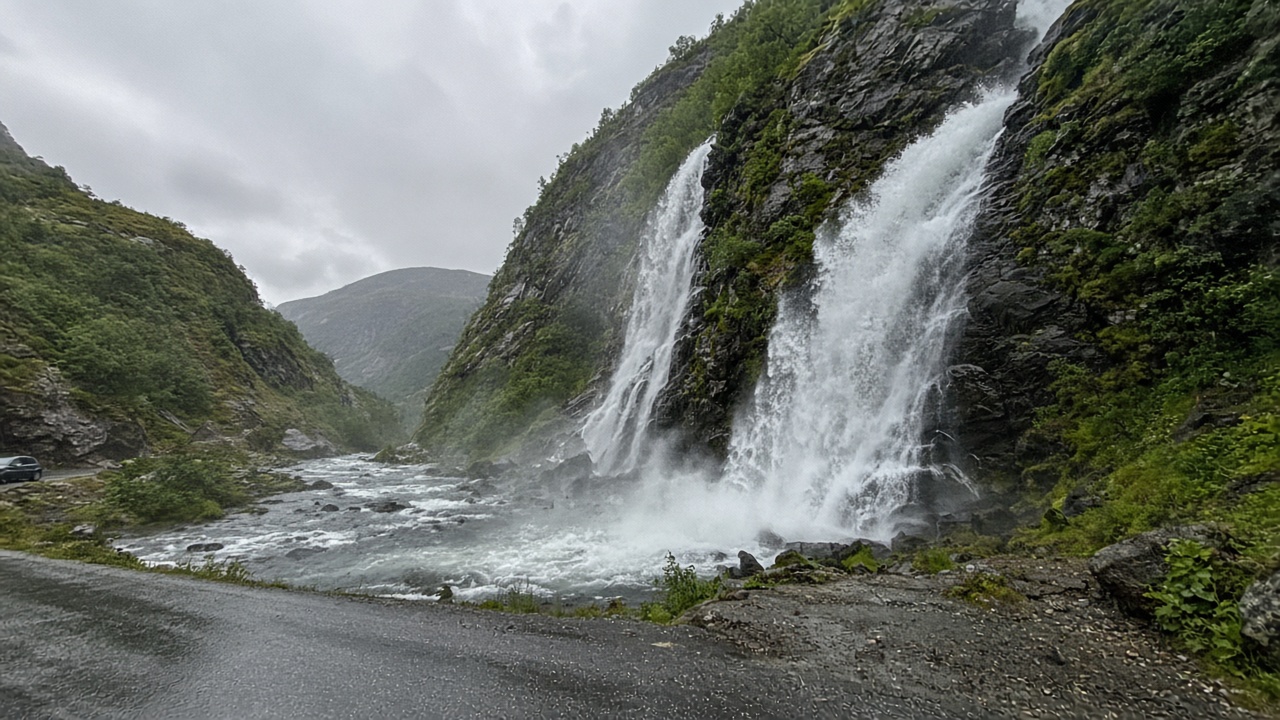
Short answer
Driving from Bergen, the core is Steinsdalsfossen near Norheimsund, Vøringsfossen on Rv7, Låtefossen on Rv13, and Langfossen on the E134. The Seven Sisters are not a road stop. You see them from the Geiranger–Hellesylt ferry. Kjosfossen is a Flåm Railway stop if you skip the car.
May and June are the wall-of-water months. August is still beautiful and already thinner than the postcards. Trolltunga is not a waterfall and not a one-hour detour. It takes 8 to 12 hours.
The same west-coast country, if you care more about plateaus and glaciers, is in the Norway national parks guide. An Oslo start with the Bygdøy museum is in the Fram Museum guide.
Seven waterfalls worth the stop
This is not a list of the tallest falls on earth. It is the set that fits one arc from Bergen through Hardanger and Odda to Geiranger. The road matters more than a pin: search the name and stay on the highway named here.
| Waterfall | Where | Time | Why |
|---|---|---|---|
| Vøringsfossen | Rv7, Eidfjord | 45–90 minutes | Classic plateau fall, two viewpoints |
| Seven Sisters | Geiranger–Hellesylt ferry | about an hour on the ferry | Seen from the water, not a pullout |
| Låtefossen | Rv13, south of Odda | 20–40 minutes | Twin cascade beside the road |
| Steinsdalsfossen | Rv7, Norheimsund | 30–45 minutes | Path behind the water |
| Langfossen | E134, Åkrafjorden | 15–25 minutes | Long drop from the roadside |
| Tvindefossen | E16, north of Voss | 15 minutes | Short stop between Bergen and Flåm |
| Kjosfossen | Flåm Railway | train stop | No car, part of Norway in a Nutshell |
The map is the road itself: Rv7 across Hardanger, Rv13 by Odda, the E134 along Åkrafjorden, and the Geiranger ferry. Ferry season and mountain-road status are on visitnorway.com and with the roads authority the morning you leave.
Vøringsfossen: the classic view
Two viewpoints, not one photo
Vøringsfossen drops into Måbødalen above Eidfjord. The total fall is about 180 metres. Since 2020 there is a new walk with viewpoints over the canyon, plus the older Fossli hotel view. The new path is about an hour out and back if you stay on the built walkway. The hotel view is 20 to 30 minutes if the lot is not full.
The expectation is a white wall of water. August reality is a thinner stream and wind that pulls the hood off. If the gorge is in cloud, wait 15 minutes or drive on to Låtefossen. Do not stand in fog for an hour.
This is the edge of the Hardangervidda plateau. If you want to walk, not only photograph, use the Hardangervidda section of the parks guide. The waterfall is ninety minutes. The plateau is a separate day.
The Seven Sisters on Geirangerfjord
A ferry, not a car park
De syv søstre is a set of streams falling into Geirangerfjord. Across the water is the Suitor, Friaren. The tourist view is from the Geiranger–Hellesylt ferry, about an hour on the water. You see the streams for a few minutes as the boat passes. This is not a hike to the base.
The ferry runs roughly May to October. In July the car queue starts early, so take a morning departure. The deck is wet and windy even on a sunny day.
Geiranger does not pair with Bergen as an evening add-on. From Odda it is several hours of switchbacks and often another ferry. With few days, pick the Seven Sisters or Trolltunga, not both.
Låtefossen and Steinsdalsfossen
Låtefossen is a drive-in twin
Låtefossen sits on Rv13 between Odda and Røldal. Two streams fall almost onto the road, about 165 metres. Stop for 20 to 40 minutes. The July pullout is small. Do not leave the car on the bend. Spray hits the windscreen. Shoot from the side, not under the stream, and keep a cloth for the lens.
Steinsdalsfossen walks behind the water
Steinsdalsfossen is by Norheimsund, on the way from Bergen toward Hardanger. A path goes behind the curtain and you come out wet. Allow 30 to 45 minutes including the car park. The rock is slick. Smooth-soled sneakers are a bad idea.
Around it is low birch forest. Above the treeline the rock is bare.
A route that includes Trolltunga
Trolltunga starts at the P2 car park in Skjeggedal, near Odda. From P2 the loop is 27 km and takes 8 to 12 hours. From the upper P3 at Mågelitopp it is shorter: 20 km and 7 to 10 hours, and the space is booked. From 1 June to 30 September experienced hikers go on their own. Outside those dates the official site recommends a guide. A shuttle runs from Odda to P2 and on to P3. Check trolltunga.com for whether the trail is clear that week. Snow decides the year.
| Day | Plan |
|---|---|
| 1 | Bergen. If you land early, Norheimsund and Steinsdalsfossen |
| 2 | Rv7 to Vøringsfossen, night in Eidfjord or Odda |
| 3 | Låtefossen and Langfossen. Do not add Trolltunga this day |
| 4 | Either Trolltunga as a full day, or the drive toward Geiranger |
| 5 | Geiranger–Hellesylt ferry: Seven Sisters and the Suitor |
| 6 | Weather buffer, or on to Ålesund / back to Bergen |
If you do not want to drive, Kjosfossen is seen from the Bergen–Myrdal–Flåm train. That is the core of Norway in a Nutshell. Fewer waterfalls, and no car ferries.
How to join cities when you fly out of a different airport is in the multi-city vacation guide.
Waterfalls without the coach crowds
Coach groups stop at Vøringsfossen, Låtefossen, and Geiranger. Quieter options:
- Skjervsfossen near Granvin, by Voss: a short walk, few large coaches.
- Espelandsfossen off the Odda road: a path, not a pullout.
- Feigumfossen in Luster, on the Sognefjord: a detour, not part of the main arc.
An early start beats a secret name. At 9:00 the Rv13 pullout still has a gap. At 13:00 in July it does not. Shoot from the side. A head-on frame fogs the lens in seconds.
When to go, driving, and what it costs
High water versus a dry August
Late May to early July: snowmelt, the falls are fullest, and some high roads are still shut. July: good water and the most people. August: warmer and drier, postcards look thinner. September: fewer groups, a shorter day, more rain and wind closures. This loop does not work in a normal car in winter.
Car, ferries, and the roadside stops
Pick the car up in Bergen or Oslo. Ask the rental desk how tolls are billed. AutoPASS invoices often go to the company, then back to you as a service fee. Car ferries are paid on the spot. You usually do not book a slot, except at the Geiranger peak.
Viewpoint parking is often paid, 0 to 150 kroner, sometimes Vipps only. For a week of tolls, ferries, and parking, set aside a few thousand kroner on top of fuel. Fuel is the main line, not the viewpoint car park. Build the whole trip in the travel budget calculator. How European roads behave on a long drive is in the Europe road-trip cost guide.
Sleep in a hotel in Bergen, Odda, or Eidfjord. Do not count on a random campsite after Trolltunga. Flights into Bergen or Oslo are in the flight search. For Trolltunga and the fjord ferry, a guided trip is simpler if you do not want to time the shuttle and the weather yourself. Signal dies in the gorges. Install an eSIM or Yesim before you leave and download offline maps. The phone checklist is in smartphone prep for a trip.
The rock is always wet. You need a shell, hiking boots, and a layer you can soak. What to put in the suitcase is in the long-trip packing guide. For Trolltunga, buy travel insurance that covers evacuation, not only lost luggage. A comparison is in the travel insurance guide.
At the viewpoints the setup is a car park, a toilet, and a sign. If you still want a town after the fjords, use the ready routes for Bergen, 3 self-guided days, Bergen off the beaten path, and Ålesund, 3 self-guided days.
Ready-made routes
Routes for your destination
Day-by-day plans you can adapt to your dates right away.
Questions and answers
Which Norway waterfalls fit in one trip?
From Bergen, five or six days cover Steinsdalsfossen, Vøringsfossen, Låtefossen, and Langfossen. The Seven Sisters are a Geirangerfjord ferry, so they take their own day. Trolltunga is a full daylight hike and does not share a schedule with three waterfalls.
When do Norway waterfalls have the most water?
Late May through early July, while the snow is melting. August is still scenic, but thinner than the May photos. Glacier-fed falls hold water longer. Rain-fed ones fade after a dry August.
Do you need a car to see the waterfalls?
A car is the practical way to Låtefossen, Vøringsfossen, and Langfossen. The Seven Sisters are seen from the ferry. Kjosfossen is a stop on the Flåm Railway and works without a car on the Norway in a Nutshell route.
What should you budget for parking and ferries?
Parking at popular stops is often 0 to 150 kroner, sometimes Vipps only. A car ferry on the west coast is usually a few hundred kroner. Tolls on Rv7, Rv13, and the E134 come through AutoPASS or the rental company. Check Statens vegvesen for the day you drive.
Can you combine the waterfalls with Trolltunga?
Yes, if Trolltunga is its own day from Odda. From the P2 car park in Skjeggedal it is 27 km and 8 to 12 hours. Self-guided hiking is recommended from 1 June to 30 September. Do not add Geiranger that day.