
The night before you land
A long-haul with a one-year-old fails in the first six hours on the ground, not in the seat map. You land, the hotel check-in is still hours away, and someone suggests a neighborhood “on the way.” The child has already done a night on a plane. The city can wait. The room cannot.
The booking that fixes this is dull. Add the night before the landing date to the start of the stay. If you land on the 18th, the reservation starts on the 17th and ends on the day you actually leave. You pay for a night you will not sleep in. That empty night is the point: by the time you clear the airport, the stay has already begun, so you are not asking a full hotel for a favor at 9 in the morning.
A one-night booking that checks out on the morning you land is a different, worse product. You would have the room only until checkout, often around late morning, and then you would be back on the street with the child. The extra night has to be the first night of the real stay, not a reservation that ends when you arrive.
Japan is the worked example because the mismatch is easy to see. A lot of long-haul schedules into Haneda and Narita are morning arrivals. Yours might be afternoon. Read the ticket. Many Tokyo hotels still print 15:00 as check-in and about 11:00 as checkout. Those hours are house rules, not a city law, and your confirmation can say something else. The gap between a morning landing and 15:00 is a long time to push a toddler who just sat on a plane.
The same shape fits any long-haul that lands before check-in: a red-eye into Europe, a morning arrival in Seoul, a dawn landing after a transpacific flight. Book the night before, tell the hotel, and sleep. Start the days you actually wanted after that. In Tokyo those later days are the family walks, not the transfer: 3 days in Tokyo with children and 7 days in Tokyo with children. Open them after the nap, not between the jetway and the hotel.
Search that first night as its own date on the reservation, not as a sentence in the comments. Hotels will sell you the dates you type. They will not invent an early key because you mentioned a toddler in the notes.
Lap infant or a seat
Airlines usually treat a child under 2 on the date of that flight as a lap infant: the child sits on an adult’s lap and does not get a seat. One lap infant per adult is the usual limit. The fare is not one world price. On many international tickets it is a fraction of the adult fare, sometimes about 10 percent, and on some domestic tickets it is a flat fee or nothing. Read the infant line before you pay. It changes by airline and by route.
Age is counted per flight. A child who is 1 on the way out and turns 2 before the return needs a seat for the way home, even if the outbound was a lap fare. Put both dates next to the birthday before you buy two lap fares and discover the return at the airport.
A purchased seat is a different product. It gives the child a place that is not your lap for a 12-hour night, and it is what lets you use an approved child restraint if the model fits the airline’s width rules and the airline accepts it. Airlines often want that restraint in a window seat so it does not block the aisle. Confirm the model and the seat with the carrier. A lap fare does not include a restraint. When the seatbelt sign is on, the child is on you.
A bassinet, or a cot on the bulkhead, is a third thing. It is a request, not a seat you already bought. It is not on every aircraft. The airline sets its own age and weight limit, and that number is on their page, not in this guide. Crew stow it for taxi, takeoff, and landing. Ask when you book. A full flight can mean there is no bassinet left, and the gate is the wrong place to find that out.
For a one-year-old on a long-haul, the seat is the choice that gives the child somewhere to sleep that is not an adult’s lap. The lap fare is the cheaper ticket. Neither line is medical advice. Compare the two prices before you decide the lap fare was the thrifty one. Flight search is where the extra seat either costs less than you feared or makes the lap fare obvious.
The hours in the air are the other half of the same night. Seat pitch, layers, and when to stand up are already written up in how to get through a long flight. This page is the child, the cabin bag, and the room at the other end.
What to pack in the cabin
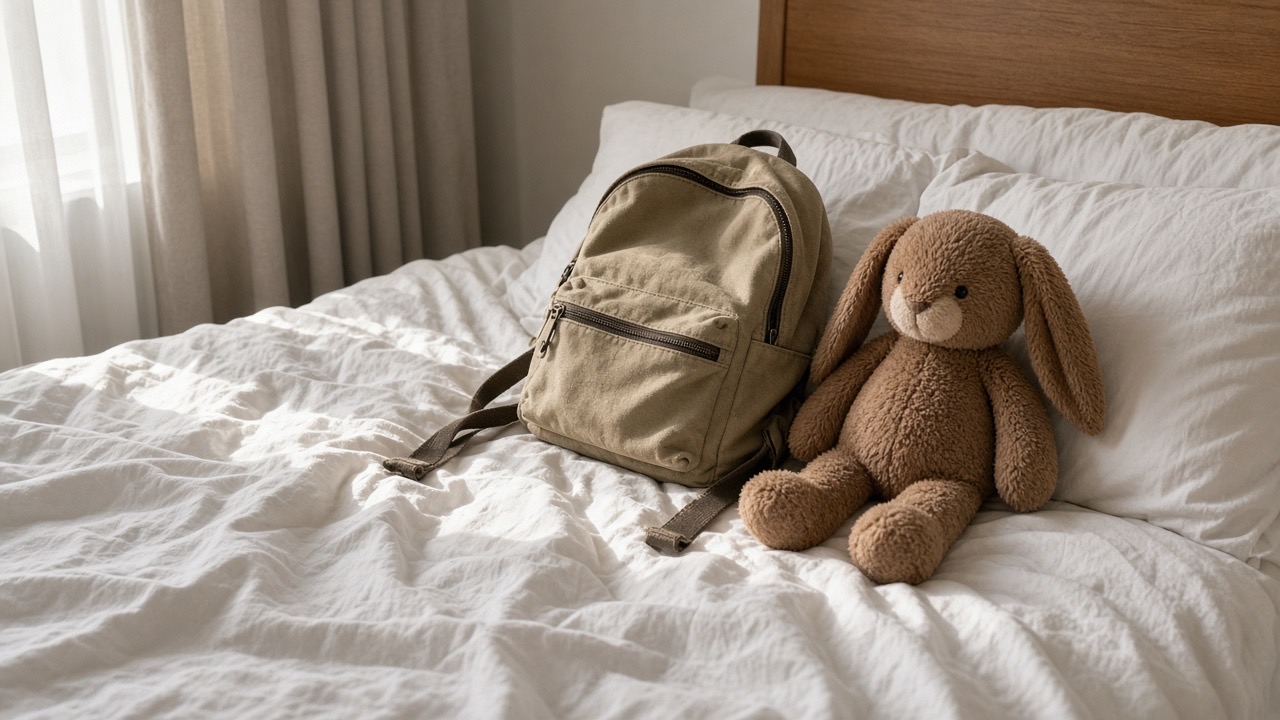
Pack the cabin bag for a delayed flight, not for the time printed on the ticket. If you cannot carry it with a child on one arm, it is the wrong bag. A small backpack under the seat in front of you beats a suitcase you have to gate-check and then cannot find.
- Diapers and wipes for longer than the scheduled block. A two-hour hold on the ground is still the cabin.
- A full change of clothes for the child and a shirt for the adult who is holding them. A zip bag for the dirty set. One blowout without a spare shirt is how the seat becomes the story.
- The milk, formula, or food the child already eats. At many airports, baby milk and baby food can exceed the usual 100 ml liquids cap for the journey, and security can ask you to open them. The airport you depart from publishes the rule, and it can change. Check it before you rely on a large bottle. Buy water after security rather than arguing about an empty flask.
- Snacks they already know, if the airline allows outside food. Do not assume the tray will be the right texture or the right hour.
- One familiar soft toy or the cloth they sleep with, plus one quiet toy. Leave the toy that beeps. The familiar one is also the jet-lag plan: the room should smell like bed, not like a new shop.
- Layers. Cabins get cold once the flight is underway. The blanket you want is the one in the bag, not the one the crew might still be handing down the aisle.
- Copies of the passports, including the child’s, and the hotel message that says they will hold the room. An international flight needs the child’s own passport. This page is not a visa guide.
Ask the airline whether a stroller can go to the aircraft door and come back there, or only at baggage claim. That is a carrier rule, not a right. Do not plan the arrival as if the stroller will be in your hand at the jetway unless they said so. If it comes back at the belt, the cabin bag is the bag you have in the terminal.
Finish the arrival paperwork before you fly if the country has a form you can do at home. For Japan, that is Visit Japan Web and the QR codes. It is not a visa, and it does not replace the passport. It does mean you are not filling in a paper card in a queue with a child who wants to get down.
Jet lag without a dosing plan
The clock change is arithmetic, and then it is a child who does not care. In November 2026, Japan (UTC+9, no daylight saving) is 9 hours ahead of the UK, 8 hours ahead of central Europe, 14 hours ahead of the US east coast, and 17 hours ahead of the US west coast. Summer dates move the Europe and US side, not Japan. Use the cities on your ticket if you are not flying from those coasts.
A one-year-old will not land on Tokyo time because a schedule said so. The useful landing day is short: the hotel, a dark room, the familiar toy, food, and bed. Sightseeing is the next day. Light in the local morning helps the household more than a second neighborhood does. A blackout nap that eats the whole afternoon often means a child who is awake around 2. A common habit is one short nap and then an early night. A toddler can ignore that. Keep the plan small enough that a failed nap does not include a temple and a crossing of the city.
This guide does not cover medicine or doses, including melatonin. If you want a drug in the plan, ask the child’s clinician before you fly. Do not borrow an adult dose, and do not take a dose from a forum because the flight is long. Sleep, food, and a room you can enter are the parts this page can actually plan.
Ask the hotel before you rely on the room
Early check-in is not guaranteed. On a reservation that starts the day you land, it means you hope a room is free before the published hour. A busy Tokyo morning is when that hope fails: yesterday’s guest is still in the room, and the desk cannot invent a second one. Do not build the landing day on “we’ll ask when we arrive.”
The night-before booking is not that request. You are a guest whose stay started the previous afternoon, if the hotel kept you on the books. The failure mode is a no-show. Many properties cancel a reservation, sometimes the later nights as well, if nobody arrives on the check-in date. An empty room you already paid for does not help if the system released it at midnight.
Send this before you fly, in the booking thread or to the hotel’s own desk:
- We land the morning after the check-in date. The first time we reach the hotel is then. Please keep the reservation. Do not cancel it as a no-show.
- What time do you release a no-show if the guest has not arrived?
- Will the room be ready when we arrive, or could it still be occupied or uncleaned?
- Where do we leave bags if the room is being cleaned?
- Which message or phone reaches the desk on the morning we land?
Get the answer in writing. “Usually fine” from a call center that cannot see the property is not a hold. If they say they cancel no-shows and will not make an exception, this trick does not work there. Book a stay that starts on the morning you actually arrive, and use the backup below, or pick a property that will keep the room.
A paid early check-in on the arrival date is a separate product. It can be a fair buy when they confirm a room, and it can be cheaper than a whole empty night. It is still a request until they accept it. A line on the website that says “early check-in subject to availability” is the same sentence as “maybe.”
If the room is not ready
If you reach the desk and the room is in housekeeping, the day is still a rest day. Leave the bags if they will take them. Stay near the hotel. Eat. Do not start a list of neighborhoods while you wait for a text. The family days in Tokyo are for after you have slept, including the 7 days with children. A station locker is a bag plan if you are not at the hotel yet. It is not a reason to sightsee.
If the hotel will not hold the night-before reservation at all, decide that before you fly. The backup is a room that can take you when you land: an airport hotel with check-in that matches the flight, or a day-use room the city hotel actually offers, booked as that product and not as a hope. Pay for the one you can enter. A cheaper rate you cannot enter until 15:00 is the expensive one, because the afternoon with a jet-lagged child is the cost.
If you only hold an arrival-date reservation and early check-in was refused, the honest plan is the lobby or a short walk until the time they named. A park is fine. A same-day itinerary is how the landing day falls apart. The flight you already survived does not need a second shift of sightseeing on the end of it.
The landing day is a room, not a city. The Tokyo days start once a one-year-old has slept.
Build the days that start once you have sleptReady-made routes
Routes for your destination
Day-by-day plans you can adapt to your dates right away.


FAQ
Does booking the night before guarantee a room when we land?
No. It puts the check-in date on the day before you land, so the stay has already started if the hotel does not cancel you as a no-show. Ask them to keep the whole reservation and to confirm that in writing. Early check-in is not guaranteed on a booking that starts the morning you arrive.
Is a lap infant the same as buying a seat?
No. A lap fare is a child under 2 on the date of that flight, on an adult’s lap, usually one child per adult. The price is the airline’s, not one global fare. A seat is their own place and the option that fits an approved child restraint. A bassinet is a third request, not a seat. A child who turns 2 before the return needs a seat on the way home.
What should be in the cabin bag?
Diapers and wipes for longer than the scheduled flight, a change of clothes for the child and a shirt for you, the milk or food they already take, one familiar toy, and a layer for a cold cabin. Keep the hotel message that says the room will be held. Baby-milk rules at security depend on the airport you leave from.
How do you handle jet lag with a one-year-old?
Sleep before any sightseeing. In November 2026, Japan is 9 hours ahead of the UK, 8 ahead of central Europe, 14 ahead of the US east coast, and 17 ahead of the US west coast. Summer dates change the Europe and US side. This guide does not cover medicine or doses.
What if the room is not ready?
Leave the bags if the desk will take them, stay near the hotel, and do not start the city. If the property will not hold a night-before reservation at all, book a place that can take you when you land, such as an airport hotel, before you fly.
Does this only work for Tokyo?
No. Any long-haul that lands before the hotel’s check-in hour has the same shape. Tokyo is the worked example because morning arrivals and a 15:00 check-in are a common pair. The clock on your confirmation is the one that counts.