
History of the “temporary” castle: from cardboard to stone
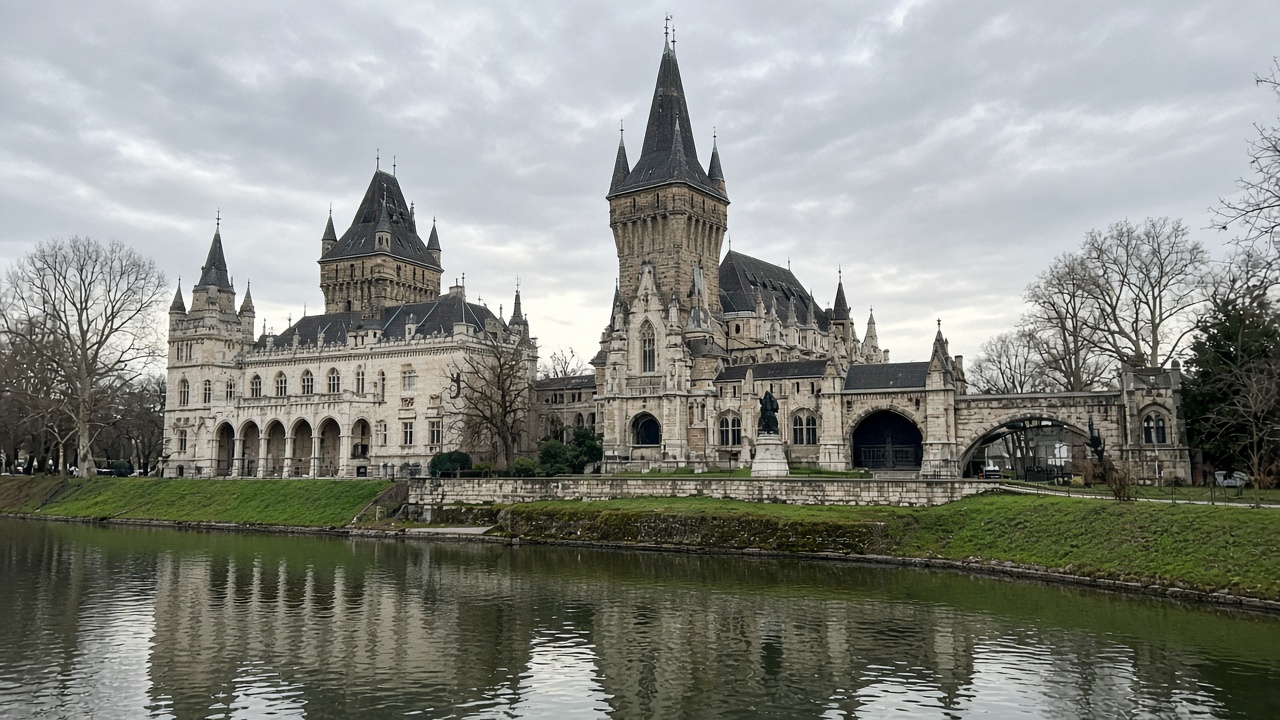
Vajdahunyad Castle was built for Hungary’s 1896 Millennium Exhibition in City Park (Városliget). Architect Ignác Alpár designed a collage of historic styles—intended as a temporary pavilion of wood, cardboard, and plaster. The public loved it so much that the complex was rebuilt in permanent materials between 1904 and 1908. Today it houses the Hungarian Agricultural Museum and remains one of Budapest’s most photogenic “fake” castles that somehow feels real.
The name nods to the Hunyadi / Corvin stronghold in Transylvania (today’s Romania). On the ground you are not visiting a medieval fortress but a late-19th-century teaching tool: roughly two dozen fragments of famous buildings from historic Hungary—including a tower echo of Sighișoara—stitched into one park address. Inside, museum rooms also touch rural life, farming heritage, and moments of modern Hungarian history, including echoes of 1956, without turning the visit into a politics seminar.
Technical card for your maps app: Városliget / Vajdahunyad sétány, Budapest XIV; approximate coordinates 47.5156° N, 19.0824° E; nearest metro Hősök tere on the yellow M1. If you are sequencing a first trip, drop the castle into our 3-day Budapest itinerary for first-timers or the tighter 2-day first-time plan.
What to see on site: an architecture guide
Romanesque and Gothic wings: the Corvin copy
Start with the neo-Romanesque cloister and chapel volumes, then walk toward the tall neo-Gothic wing that quotes Corvin Castle. Pointed arches, steep roofs, and the canal reflection are the Instagram magnets—but they reward a slow loop, not just one selfie. Count towers and stone details: Alpár packed references so densely that a second lap always finds something new.
Renaissance and Baroque: the Austrian-facing façades
On other elevations the mood flips to Renaissance loggias and calm Baroque fronts—the “Austrian” half of the collage. Treat the complex as four lessons in one lunch break: Romanesque solemnity, Gothic vertical drama, Renaissance proportion, Baroque polish. Couples who like photogenic parks more than cramped museum queues often prefer this exterior circuit; it slots neatly into our 3-day Budapest itinerary for couples.
The famous Anonymous statue
In the courtyard garden stands Miklós Ligeti’s hooded chronicler—Anonymous, the unnamed notary of King Béla. The bronze face never shows; tourists still queue for the classic side-angle photo. Stay a minute: it is one of Budapest’s quietest “must-see” monuments, and it costs nothing beyond a respectful pause.
After architecture, contrast the park with steam or nightlife: our Budapest thermal baths guide and ruin-bars evening itinerary cover the city’s other signature moods.
Practical information for visitors in 2026
Opening hours and Agricultural Museum tickets
The park and exterior courtyards are open freely. Museum galleries and the tower keep their own calendars—typically daytime Tuesday–Sunday patterns with shorter winter hours, but holidays and renovation closures happen. Adult museum tickets often land around 2,000–3,500 HUF; the tower may be a separate or combo ticket in the 1,000–2,000 HUF range. Treat these as orientation figures for 2026 and buy or check on the official Hungarian Agricultural Museum channels.
Season flip: in winter the City Park ice rink sits between the castle and Széchenyi; in summer the lake boat station and shady paths take over. Either way, exterior photography works in rain—reflections improve when the canal is still.
How to get there: Europe’s oldest metro line
Ride M1 (the yellow Millennium Underground, opened 1896) to Hősök tere. Walk into Városliget past Heroes’ Square; Vajdahunyad appears within a few minutes on the park’s eastern side. From central Pest you can also stroll Andrássy Avenue end-to-end and finish at the square—an easy urban approach that needs no transfers.
Sleep near City Park or along Andrássy for an easy morning start—compare hotels near Városliget and Heroes’ Square. If you want a narrator for the museum and tower, a guided Budapest city or museum tour can help; the park loop itself is simple to self-guide. Before you fly, lock in flights, travel insurance, and an eSIM.
| Cost | Range | Note |
|---|---|---|
| Courtyard & park walk | Free | Exterior circuit and Anonymous statue |
| Agricultural Museum | ~2,000–3,500 HUF | Adult orientation; confirm on museum site |
| Tower viewpoint | ~1,000–2,000 HUF | Often sold as an add-on; seasonal |
| Metro M1 single | ~450–650 HUF | Hősök tere on the yellow line |
| Coffee in the park | ~1,500–2,500 HUF | Café near the baths or lake |
| Half-day total pp | ~5,000–10,000 HUF | Museum + coffee, excluding lodging |
Weekend walk: Vajdahunyad and the neighbourhood
Keep the spine clear: Andrássy Avenue → Heroes’ Square → Vajdahunyad loop → Széchenyi Baths (or the winter rink). Do not stack a full ruin-bar night and a dawn thermal booking on the same calendar unless you enjoy running on fumes.
Heroes’ Square—and Shoes on the Danube as a separate stop
Heroes’ Square (Hősök tere) is the ceremonial gateway: Millennium Monument, colonnades of Hungarian leaders, and museum façades on either side. The Shoes on the Danube Bank memorial sits on the Pest embankment downtown—not in City Park. Visit it on a separate riverside walk from the centre; do not expect it as a five-minute detour from the castle. Pair the park morning with that memorial on another half-day if remembrance sites matter to you.
Széchenyi Baths and the city ice rink
A short walk from the castle brings you to Széchenyi’s yellow neo-Baroque baths—the classic outdoor-pool postcard. In winter the City Park ice rink fills the space between castle and baths; in summer swap skates for a lake stroll or a rented boat. Full bath logistics, prices, and etiquette live in our thermal baths guide; after dark, District VII’s courtyards wait in the ruin-bars itinerary.
| Time | Stop | Note |
|---|---|---|
| 09:30 | Hősök tere (M1) | Exit the yellow Millennium Underground at Heroes’ Square |
| 09:45 | Heroes’ Square | 15–20 minutes on the colonnade and Millennium Monument |
| 10:15 | Vajdahunyad exterior | ~40 minutes for façades, canal bridge, and courtyard |
| 11:00 | Agricultural Museum / tower | Optional 1–1.5 hours inside (ticketed) |
| 12:45 | Széchenyi Baths | Thermal break or winter ice rink in City Park |
AlpacaBag tip: the “secret” angle is the canal footbridge facing the neo-Gothic wing—spires mirrored in the water beat the crowded courtyard shot on calm afternoons.
Preparing for Hungary: Schengen and logistics
Hungary uses Central European Time (CET/CEST). For short stays, many passports enter Schengen visa-free; others need a Schengen visa, commonly filed through the Hungarian consulate network or VFS Global. Appointment rules and document lists change—start the process early and rely on official embassy/VFS pages, not forum screenshots.
Language note: Hungarian is not Slavic or Romance. English covers museum desks and park cafés in tourist season; German appears often too. Useful scraps: köszönöm (thank you), kérem (please), viszontlátásra (goodbye). Budget for forints (HUF); cards are widely accepted in Budapest, but a little cash helps for small park kiosks.
When you are ready to sequence baths, castle, and evenings without spreadsheet chaos, open AlpacaBag and point it at Budapest—or jump straight into the 3-day first-time route.
City Park without the guesswork
Tell AlpacaBag you want Heroes’ Square, Vajdahunyad, and Széchenyi in one half-day— it will leave room for ruin bars or a slower couples’ pace.
Ready-made routes
Routes for your destination
Day-by-day plans you can adapt to your dates right away.
FAQ
Is Vajdahunyad Castle free to visit?
Walking the park paths, photographing the façades, and entering the open courtyard is free. Tickets apply to the Hungarian Agricultural Museum interiors and, when open, the tower viewpoint. Always reconfirm prices and hours on the museum’s official site before you go.
How do I get to Vajdahunyad Castle by metro?
Take the yellow M1 Millennium Underground to Hősök tere (Heroes’ Square). From the square, walk into City Park (Városliget)—the castle complex is a few minutes on the right, beside the lake and canal. Trams and buses also serve the park edge if you prefer not to use the metro.
How long should I plan for Vajdahunyad and City Park?
About 40 minutes for an exterior loop and photos. Add 1–1.5 hours if you visit the museum and climb the tower. Pairing Heroes’ Square, the castle, and Széchenyi Baths makes a comfortable half-day; a rushed exterior-only stop can fit a tight 2-day first visit.
What is the best photo spot at Vajdahunyad?
Stand on the small bridge across the canal opposite the neo-Gothic wing—the towers and spires reflect in the water on calm days. Soft late-afternoon light works better than harsh midday glare. Avoid blocking the narrow bridge for other visitors.
Do I need a Schengen visa for Hungary?
Hungary is in the Schengen Area. Many travellers enter visa-free for short stays; others need a Schengen visa via the Hungarian consulate or VFS Global, depending on nationality. Check current rules for your passport well before booking flights and hotels.
How do you pronounce Vajdahunyad?
Approximate it as “Voy-duh-hoon-yod” (Hungarian: Vajdahunyad). Locals also say Városliget for City Park and Hősök tere for Heroes’ Square. Museum and café staff usually manage English; a polite “köszönöm” (thank you) goes a long way.