
Why is Budapest called a city of baths?
Hot springs rise under Budapest thanks to Carpathian geothermal geology. Ottomans in the 16th–17th centuries framed them as hammams with stone domes; Austro-Hungarian Budapest turned bathing into civic palace culture. Today the capital of Hungary remains one of Europe’s great balneology cities: spas sit next to metros, trams, and parks—not only in remote resort hotels.
The timeline runs from Turkish Rudas and Király through bourgeois Gellért and Széchenyi into the 20th century. Lukács long hosted intellectuals and, in different eras, people close to power; city memory still brushes 1956 and today’s political headlines without turning your ticket into a history seminar. For visitors the practical story is water, architecture, and the ritual of shower → soak → tea.
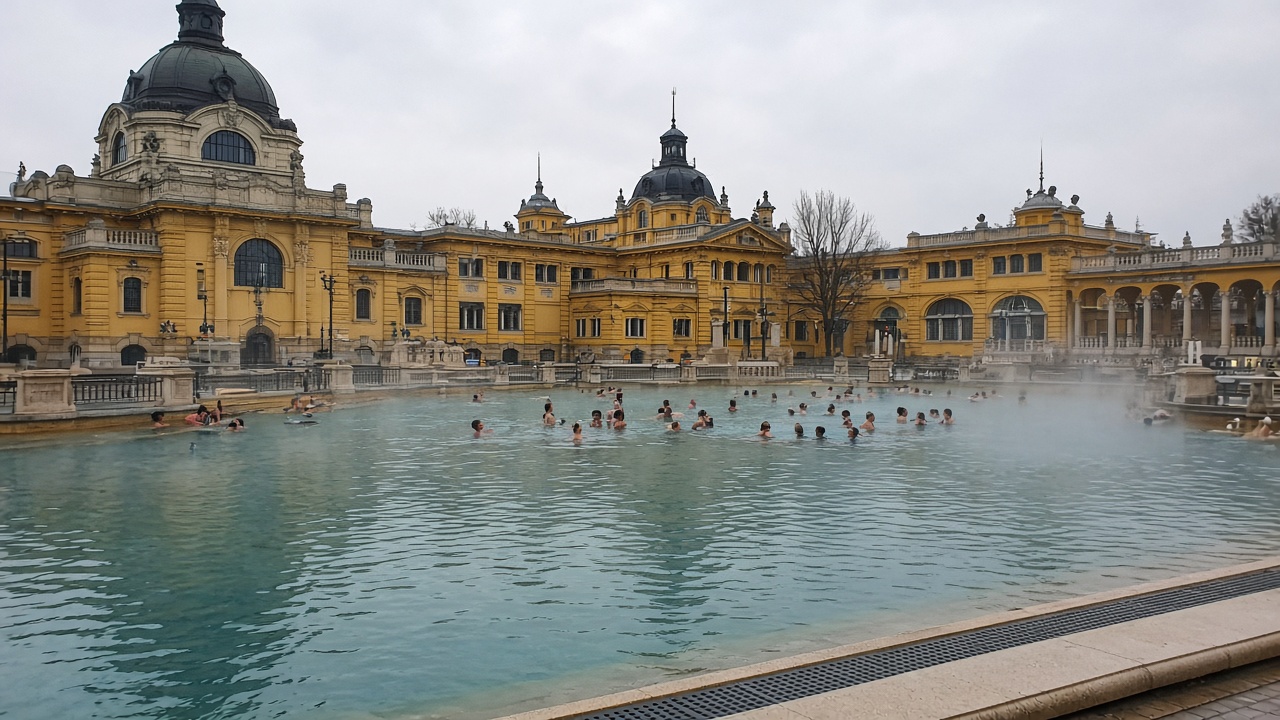
Real bath halls rarely match the pastel dollhouse of The Grand Budapest Hotel: expect steam, tile, mineral scent, and human noise more than Wes Anderson symmetry. You still get cinematic frames—Széchenyi’s yellow façades, Rudas’s dome—just wetter and more honest. In City Park near Széchenyi you may spot Hungarian Vizslas on morning walks while you decide whether to enter the pools first or detour to Vajdahunyad Castle. Couples who want a slower spa pace can drop baths into our 3-day Budapest itinerary for couples.
TOP-7 Budapest baths: which should you choose?
Seven working options by goal. Search official pages with the English country name Hungary and network brands (spabudapest.hu is a common hub) so you avoid stale aggregator prices.
Széchenyi: neo-Baroque classic
The city’s postcard: outdoor pools among yellow courtyards in Városliget, floating chessboards, winter steam. Best first visit and a clear logistics anchor on metro M1 (Hősök tere). Beat crowds by arriving at weekday opening or later on a weekday evening; Saturday noon is peak selfie hour. Pair with the park lake, winter rink, and Vajdahunyad. Sleeping nearby saves the morning—compare hotels near City Park and Széchenyi. Families often prefer outdoor space here or on Margaret Island; see also our 3-day Budapest itinerary with kids.
Gellért: Art Nouveau luxury
The spa attached to the landmark hotel at Gellért Hill’s foot: stained glass, mosaic, early-20th-century palace mood. Choose it when architecture matters more than an outdoor party pool. Tickets skew higher; crowds are usually lighter than Széchenyi but still tourist-heavy. Combine with Liberty Bridge, the hill citadel, and a Danube evening. A guided Buda or city walking tour can frame the hillside; keep the bath block self-paced.
Rudas: Ottoman colour and a Danube panorama
An Ottoman core under a dome plus a modern rooftop pool facing Pest—an unusual mix. Daytime sessions are often gender-separated; evening night spa is typically mixed and livelier. Ideal after Shoes on the Danube Bank: cross the river and you are almost at the door. Do not confuse weekday therapy hours with Friday-night energy—read the slot calendar before you pay.
Lukács: locals’ pick and medicinal water
On the Buda side near Margaret Bridge, Lukács long felt like a neighbourhood cure house: less gloss, more habitual mineral soaks. Historically it gathered intellectuals and political circles across eras—including conversations that sit in the shadow of 1956—without becoming a museum of power. Today it is the calm alternative when City Park queues look brutal. Strong weekday choice.
Király: compact medieval authenticity
A 16th-century Turkish complex without Széchenyi’s palace scale: dome, dim light, hammam mood. Come for Ottoman Buda atmosphere, not a water-park checklist. Service is modest—bring your towel and skip expectations of endless “relaxation zones.” Pair with a separate Castle Hill half-day.
Palatinus: best kids’ option on Margaret Island
Seasonal outdoor complex on Margaret Island: waves, slides, room to run—the family day when heavy mineral water is too much for little kids. Expect sunscreen logistics and summer ticket lines; off-season the site shrinks or closes. Reach it by tram/bus onto the island and combine with a bike loop under the plane trees.
Dagály: the seventh Danube-side pick
North of the centre on the Danube, Dagály offers outdoor pools and a calmer family rhythm than peak-hour Széchenyi. Use it when Palatinus is slammed or you sleep in northern Pest. It is a daytime pool complex—not Rudas night spa under a Turkish dome. On a longer first trip you can rotate baths across days inside our 5-day Budapest itinerary for first-timers.
Practical information: Schengen, prices, and bath rules
Visa and logistics
Hungary is in the Schengen Area. Many travellers enter visa-free for short stays; others need a Schengen visa, commonly filed through Hungarian consulates or VFS Global. Check official pages before buying non-refundable flights. On the ground, a BKK pass or app covers metro and trams. Before you fly, lock in flights, travel insurance, and an eSIM.
Price and service comparison
Figures below are 2026 orientation ranges in forints, not a cashier printout. Totals swing with weekday vs weekend, cabin vs locker, and towel bundles. Treat euro conversions as planning math and reconfirm near travel dates.
| Bath | Ticket (range) | Extras | Note |
|---|---|---|---|
| Széchenyi | ~9,400–12,000 HUF | Towel hire ~2,000–3,000 HUF; cabin costs more than a locker | Full-day orientation; weekends are peak |
| Gellért | ~9,400–14,000 HUF | Towel/robe hire; cabin upgrades | Often priced for the Art Nouveau setting |
| Rudas | ~5,200–7,500 HUF | Night spa is a separate ticket; towel hire available | Daytime gender sessions + mixed evenings |
| Lukács | ~4,500–6,500 HUF | Locker usually in base ticket; cabin extra | Better value, more local rhythm than Széchenyi |
| Király | ~2,800–4,200 HUF | Minimal spa extras—bring your own towel | Compact Ottoman complex, not a mega-spa |
| Palatinus | ~3,500–4,800 HUF | Seasonal outdoor complex; loungers may cost extra | Summer family pick on Margaret Island |
| Dagály | ~3,200–4,800 HUF | Locker/cabin tiers; towel hire | Northern Danube alternative to Palatinus |
Etiquette, swim caps, and Rudas days
Shower before every pool—non-negotiable. Lane pools almost always want a swim cap; hot tubs may not, but posted rules win. Rudas daytime gender splits remain common versus mixed night spa. Phone speakers, picnic food on the deck, and hour-long towel “claims” on loungers annoy staff and locals equally.
Transport to the main spas
Széchenyi — M1 Hősök tere or a park walk. Gellért — trams to Gellért tér. Rudas — Buda embankment by Elizabeth Bridge. Lukács — near Margaret Bridge on Buda buses/trams. Király — Castle District walk. Palatinus — Margaret Island. Dagály — further north along the Danube. A day pass usually beats a pile of singles if you mix spas with downtown.
Medical caution
Hot mineral water is a load, not infinite wellness. Alternate 15–20 minutes in hot pools with cool zones and bottled water. Pregnancy, blood-pressure issues, or acute illness belong in a doctor conversation before the trip—not at the ticket window.
One-day route: from Shoes on the Danube to hot pools
A workable spine without sprinting: Shoes on the Danube → Parliament exterior → Rudas or Gellért → lunch → optional Széchenyi / City Park → evening District VII. Cipők a Duna-parton is a quiet memorial—do not emotionally smash it into a nightclub right after the sauna. District VII courtyards get their own evening plan in our ruin-bars itinerary.
If you only have energy for one spa after the embankment, pick Rudas (closest) or Gellért (architecture). Széchenyi works better as the anchor of a City Park day with Vajdahunyad than as a third soak. AlpacaBag can assemble the same spine: mark baths and the riverfront, and do not force all seven venues into 24 hours.
| Time | Stop | Note |
|---|---|---|
| 09:00 | Shoes on the Danube | Cipők a Duna-parton by Parliament—15–20 quiet minutes |
| 09:30 | Parliament exterior | Embankment photos; interior only with a timed ticket |
| 10:15 | Cross to Buda | Elizabeth or Chain Bridge → Gellért / Rudas slope |
| 11:00 | Rudas or Gellért | 2–3 hours in the baths; swim cap for lane pools |
| 14:00 | Lunch on Buda | Light meal after hot water; hydrate deliberately |
| 16:00 | City Park / Széchenyi | Optional second spa—or park + Vajdahunyad only |
| 19:30 | District VII | Ruin bars as a separate block, not right after saunas |
Packing checklist and day budget
On-site hire burns budget faster than most travellers expect. Pack a minimal kit from home or the hotel so the desk only needs your locker choice.
- Swimsuit (a second set if you plan two baths in one trip)
- Swim cap for lane pools (often mandatory even when thermal tubs do not require one)
- Flip-flops for wet floors
- Your own towel or light robe—cheaper than hire
- Waterproof bag for wet clothes
- Water bottle and a light snack
- Small wallet / card; leave the passport in the hotel safe when you can
- Hair tie and moisturiser after mineral water or chlorine
All-in day budget per person without lodging—one spa, lunch, and city transport:
| Cost | Range | Note |
|---|---|---|
| One mid-range bath ticket | 6,000–12,000 HUF | ~€15–30; Széchenyi/Gellért sit at the top |
| Towel + flip-flop hire | 2,500–4,500 HUF | Packing your own saves real money |
| BKK day travel pass | ~2,500–3,500 HUF | Or singles if you barely ride |
| Lunch (soup + main) | 4,000–7,000 HUF | Café near Gellért or Margaret Island |
| Thermal day total pp | 15,000–27,000 HUF | Without hotel or nightlife; ~€38–68 |
Spas without the spreadsheet spiral
Tell AlpacaBag you want Széchenyi, Rudas, or family Palatinus—it will leave room for the embankment memorial and an evening ruin-bar stroll.
Ready-made routes
Routes for your destination
Day-by-day plans you can adapt to your dates right away.
FAQ: what to know before you soak
Which Budapest bath is best for a first visit?
Choose Széchenyi for the postcard outdoor pools and easy M1 access at Hősök tere. Pick Gellért for Art Nouveau interiors. Lukács suits travellers who want a more local, therapeutic pace. Rudas is the Ottoman-dome + Danube-view option—check daytime gender sessions before you buy.
How much do Budapest thermal baths cost in 2026?
Orientation ranges: Széchenyi and Gellért often land around 9,400–14,000 HUF for a full day; Rudas and Lukács are frequently 4,500–7,500 HUF; Király and seasonal outdoor complexes (Palatinus, Dagály) are usually cheaper. Cabins cost more than lockers; towel and robe hire add thousands of forints. Always reconfirm on spabudapest.hu or the ticket desk.
Do I need a swim cap, and are there gender-separated days?
Lane pools commonly require a swim cap even when hot thermal tubs do not. Rudas still runs gendered daytime sessions (men’s/women’s days) while evening night spa is typically mixed—read the current calendar before payment. Swimwear is required in shared textile zones unless a session is explicitly marked otherwise.
How do I get to Széchenyi, Gellért, and Rudas?
Széchenyi: metro M1 to Hősök tere or walk through City Park from Vajdahunyad. Gellért: trams 19/41/47/49 to Gellért tér at the hill’s foot by Liberty Bridge. Rudas: Buda embankment by Elizabeth Bridge; from Shoes on the Danube, cross the river and walk to the baths.
Are there medical cautions for hot thermal water?
Pools around 36–40°C stress heart rate and blood pressure—limit continuous soaks to about 15–20 minutes, cool down, and drink water. Pregnancy, acute infections, unstable blood pressure, or recent surgery deserve a doctor’s advice before you go. Mineral profiles differ by bath; treat dizziness as a stop signal, not a challenge.
Do I need a Schengen visa for Hungary?
Hungary is in the Schengen Area. Many passports enter visa-free for short stays; others need a Schengen visa via the Hungarian consulate network or VFS Global. Check official rules for your nationality well before booking non-refundable flights and hotels.