
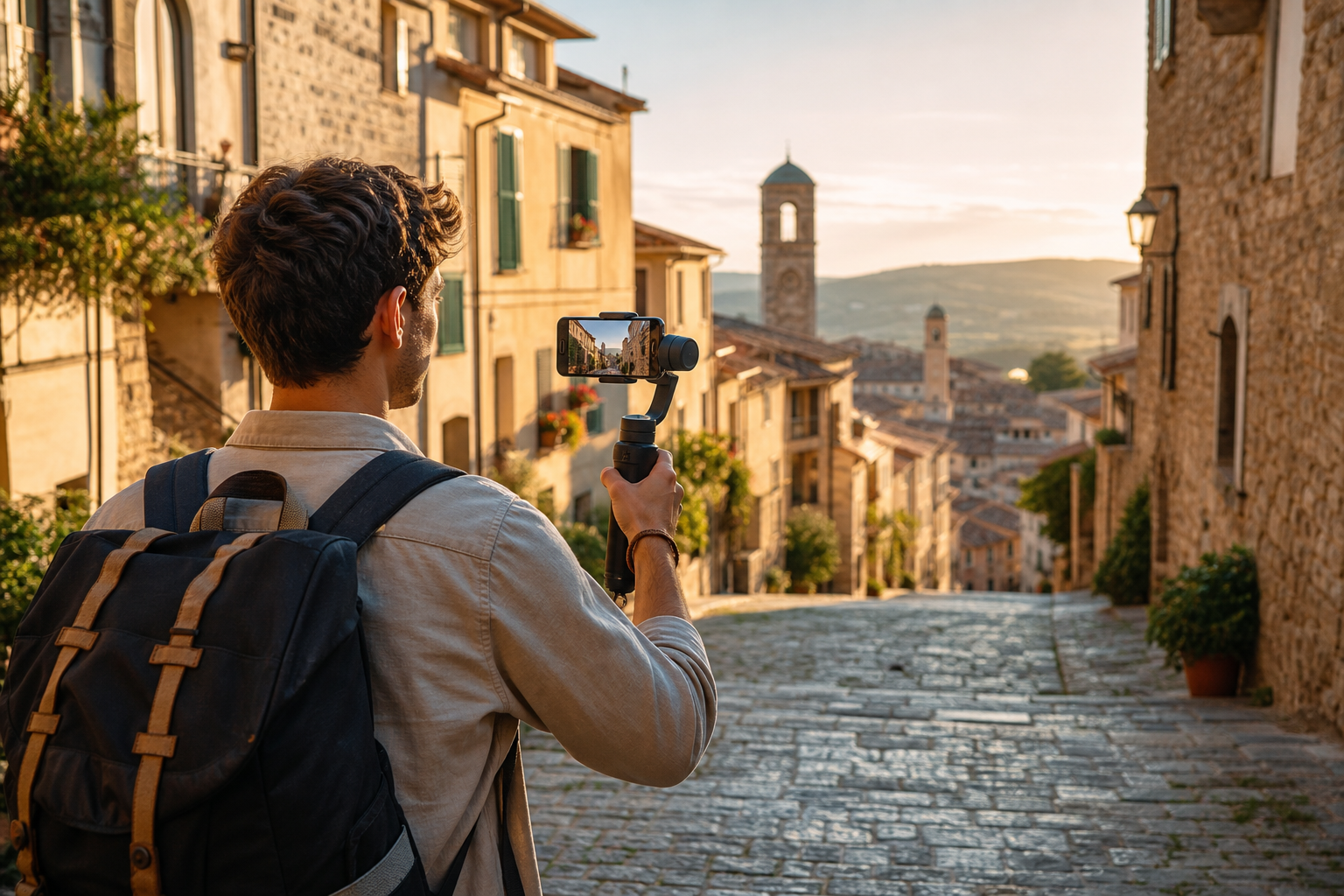
If you are wondering what to film on vacation, do not start with the camera — start with the idea. These trip video ideas give you a clear format for what to capture, why each shot belongs, and how the video should end. That makes filming faster and gives your edit a story instead of a folder of disconnected clips.
Every idea below is ready to adapt to your destination. Replace the example place or activity, keep the sequence, and shoot the six essential shots before you move on.
What is in this guide
25 vacation video ideas
Use each card as a mini production brief. The shot order is a starting point, not a rule: keep only the moments that move your story forward.
Short-form Reels and travel Shorts
Fast, useful formats built around one promise, contrast, ranking, or reveal.
1. The three-second arrival reveal
- Hook
- Open on a closed train door, hotel curtain, or tunnel and reveal the destination on the beat.
- Length
- 12–18 seconds
- Shot list
- • Ticket or map detail
- • Moving window view
- • Hand opening the door or curtain
- • Wide destination reveal
- • Your first reaction
- Ending
- Add the destination name and one short verdict: “Worth the early flight.”
2. One vacation day in 12 clips
- Hook
- Promise a complete day quickly: “Twelve clips from sunrise to midnight in Lisbon.”
- Length
- 20–30 seconds
- Shot list
- • Window view
- • Breakfast close-up
- • Shoes hitting the street
- • Transit
- • Main sight
- • Local detail
- • Lunch
- • Hidden stop
- • Travel companion
- • Sunset
- • Night street
- • Final room view
- Ending
- Finish on the final time stamp and ask which stop viewers would choose.
3. Five things to know before you go
- Hook
- Lead with the consequence: “Five things I wish I knew before visiting this island.”
- Length
- 30–45 seconds
- Shot list
- • Crowd level
- • Payment method
- • Local transport
- • Weather reality
- • Best arrival time
- • Useful map screenshot
- Ending
- Save the most useful tip for last and invite viewers to save the list.
4. A real travel-day budget
- Hook
- Start with the total: “What one full day in Copenhagen actually cost me.”
- Length
- 25–40 seconds
- Shot list
- • Transit ticket
- • Coffee receipt
- • Attraction price
- • Lunch bill
- • Free activity
- • Daily total in notes
- Ending
- Show the final sum beside one thing you would skip next time.
5. Expectation versus reality
- Hook
- Show the postcard image first, then cut immediately to what the place really looked like.
- Length
- 15–25 seconds
- Shot list
- • Saved inspiration photo
- • Approach to the location
- • Crowds or weather
- • Best real angle
- • Honest facial reaction
- Ending
- Give a fair verdict and the time of day you would recommend instead.
6. Rank everything you ate today
- Hook
- Put the strongest reaction first: “I tried five local dishes; only one was a ten.”
- Length
- 30–45 seconds
- Shot list
- • Menu or stall sign
- • Dish arriving
- • Texture close-up
- • First bite
- • Price
- • Score graphic
- Ending
- Reveal the winner and name the place where you found it.
7. A pocket guide to one neighborhood
- Hook
- Make a compact promise: “Coffee, a quiet street, and sunset—all within ten minutes.”
- Length
- 35–50 seconds
- Shot list
- • Street-name sign
- • Walking route
- • Coffee stop
- • Small shop
- • Local detail
- • Viewpoint
- Ending
- End on a simple route map with the three stops pinned.
YouTube travel vlog ideas
Story-led formats with enough room for context, decisions, costs, and honest conclusions.
8. The perfect-day route
- Hook
- Open with the finished itinerary: “Here is how to spend one excellent day without crossing the city twice.”
- Length
- 6–9 minutes
- Shot list
- • Morning map overview
- • Breakfast stop
- • First attraction
- • Walk between stops
- • Lunch
- • Hidden place
- • Golden-hour viewpoint
- • Evening finish
- Ending
- Recap the route, walking time, and one stop to remove if viewers have less time.
Make the route practical before you film: use the AlpacaBag route planner to group stops in a sensible order and avoid spending the story in transit.
9. An honest hotel or apartment review
- Hook
- Answer the booking question immediately: “The location is excellent, but there are two reasons I would not return.”
- Length
- 5–8 minutes
- Shot list
- • Building and street
- • Check-in
- • Full room sweep
- • Bathroom
- • Outlets and storage
- • Window view
- • Night noise test
- • Breakfast
- Ending
- List the ideal guest, the wrong guest, and whether the price felt fair.
Compare hotels and apartments with clear guest reviews before booking, then use the same criteria in your on-camera verdict.
10. My first 24 hours in a new place
- Hook
- Begin with the biggest surprise, then rewind to arrival.
- Length
- 8–12 minutes
- Shot list
- • Airport or station
- • Transfer
- • First neighborhood walk
- • Room drop-off
- • First meal
- • Main sight
- • Unexpected problem
- • Morning after
- Ending
- Share three first impressions and what the next episode will test.
11. Tourist day versus local day
- Hook
- Set up the comparison: “Today I am trying the famous route, then the version a local recommended.”
- Length
- 8–14 minutes
- Shot list
- • Popular breakfast
- • Headline attraction
- • Queue
- • Local transport
- • Neighborhood café
- • Community market
- • Quiet evening spot
- Ending
- Compare cost, travel time, atmosphere, and choose the better day.
12. Travel mistakes I would not repeat
- Hook
- Show the mistake in action: a closed gate, missed train, or hour-long queue.
- Length
- 6–10 minutes
- Shot list
- • What you planned
- • What went wrong
- • Cost or time lost
- • How you fixed it
- • Correct alternative
- • Proof the alternative works
- Ending
- Turn every mistake into one specific rule viewers can copy.
13. Explore a city through one question
- Hook
- Choose a question with a visible answer: “Can you have a great day here for under $50?”
- Length
- 7–11 minutes
- Shot list
- • Rules and budget
- • Transit choice
- • Food stop
- • Paid activity
- • Free activity
- • Running total
- • Final experience
- Ending
- Answer the opening question clearly and show the final numbers.
Cinematic vacation montage ideas
Visual structures that turn separate clips into a cohesive memory rather than a random highlight reel.
14. The moving postcard
- Hook
- Start with your strongest wide shot and a title card naming the place and month.
- Length
- 45–75 seconds
- Shot list
- • Landscape wide
- • Architecture medium
- • Food detail
- • Passing transport
- • Person in motion
- • Sunset closing wide
- Ending
- Hold the final landscape for two beats before fading to the trip dates.
15. A match-cut journey
- Hook
- Cut between similar shapes or movements: a plane window becomes a train window, then a café window.
- Length
- 30–60 seconds
- Shot list
- • Three matching windows
- • Two doors opening
- • Feet crossing different surfaces
- • Circular food detail
- • Sun or lamp match
- Ending
- Return to the first composition in a new location to close the loop.
16. A destination told through one color
- Hook
- Open with a rapid sequence of five details sharing the destination’s signature color.
- Length
- 30–50 seconds
- Shot list
- • Painted doorway
- • Local food
- • Street sign
- • Clothing detail
- • Vehicle
- • Sky or water wide
- Ending
- Pull back from the final color detail to reveal the whole scene.
17. Planes, trains, and streets
- Hook
- Begin with a departure-board flip or suitcase wheel hitting the floor.
- Length
- 35–60 seconds
- Shot list
- • Board or ticket
- • Escalator
- • Window motion blur
- • Station arrival
- • Taxi or tram
- • First street walk
- Ending
- Stop the motion with a still shot of the final destination.
18. Sunrise-to-night time arc
- Hook
- Use the first light entering your room as the visual starting gun.
- Length
- 60–90 seconds
- Shot list
- • Blue-hour window
- • Morning street
- • Bright midday detail
- • Golden-hour portrait
- • City lights
- • Night reflection
- Ending
- Turn off a bedside light or close the curtain to mirror the opening.
19. People who shaped the trip
- Hook
- Open on a quick sequence of smiles, hands, and greetings rather than landmarks.
- Length
- 45–75 seconds
- Shot list
- • Travel companion laughing
- • Vendor serving food
- • Guide pointing
- • Musician performing
- • Shared table
- • Goodbye wave
- Ending
- Close with a group moment and a simple thank-you caption.
No-talking travel video ideas
Natural-sound and visual-first formats for travelers who prefer to stay behind the camera.
20. A slow vacation morning
- Hook
- Let natural sound lead: curtains opening, a kettle clicking, or waves outside.
- Length
- 45–90 seconds
- Shot list
- • Morning light
- • Coffee preparation
- • Getting-ready detail
- • Empty street
- • Bakery counter
- • First view
- Ending
- Set the cup down at the first stop and leave two seconds of ambient sound.
21. A one-minute destination soundwalk
- Hook
- Start with a recognizable local sound before showing its source.
- Length
- 50–70 seconds
- Shot list
- • Footsteps
- • Crossing signal
- • Market call
- • Transit doors
- • Water or trees
- • Street musician
- Ending
- Walk into a quieter space and let the sound naturally fade.
22. Hands-only local food story
- Hook
- Show the final dish for one second, then cut back to how it was made.
- Length
- 30–60 seconds
- Shot list
- • Ingredients
- • Cook’s hands
- • Steam or sizzle
- • Plating
- • Payment
- • First bite from your viewpoint
- Ending
- Show the empty plate and add the dish name, price, and location.
23. Window-seat travel diary
- Hook
- Open with the vehicle beginning to move and scenery sliding into frame.
- Length
- 45–90 seconds
- Shot list
- • Seat and ticket
- • Leaving the station
- • Landscape changes
- • Reflection in glass
- • Passing town
- • Arrival platform
- Ending
- Step onto the platform and reveal the destination sign.
24. Ten details tourists usually miss
- Hook
- Frame the first unusual detail tightly and number it “1/10.”
- Length
- 35–60 seconds
- Shot list
- • Door handle
- • Pavement mark
- • Shop sign
- • Roof ornament
- • Local packaging
- • Tiny garden
- • Public-art detail
- • Transit symbol
- • Window display
- • Street texture
- Ending
- Reveal where all ten details were found on a simple map.
25. A rainy-day travel film
- Hook
- Catch the first drops on glass with clean rain sound and no music.
- Length
- 45–75 seconds
- Shot list
- • Window drops
- • Umbrella opening
- • Shoes through puddles
- • Wet reflections
- • Warm café
- • Steam on glass
- Ending
- Move from the wet street into a warm interior and hold on the contrast.
Turn the video idea into a filmable trip
For a route-led vlog across several destinations, start with the multi-city vacation planning guide. If your story follows real spending, prepare figures with the travel budget calculator and our guide to saving money while traveling.
Need useful stops that cost nothing? Build a scene list from these free things to do in any city.
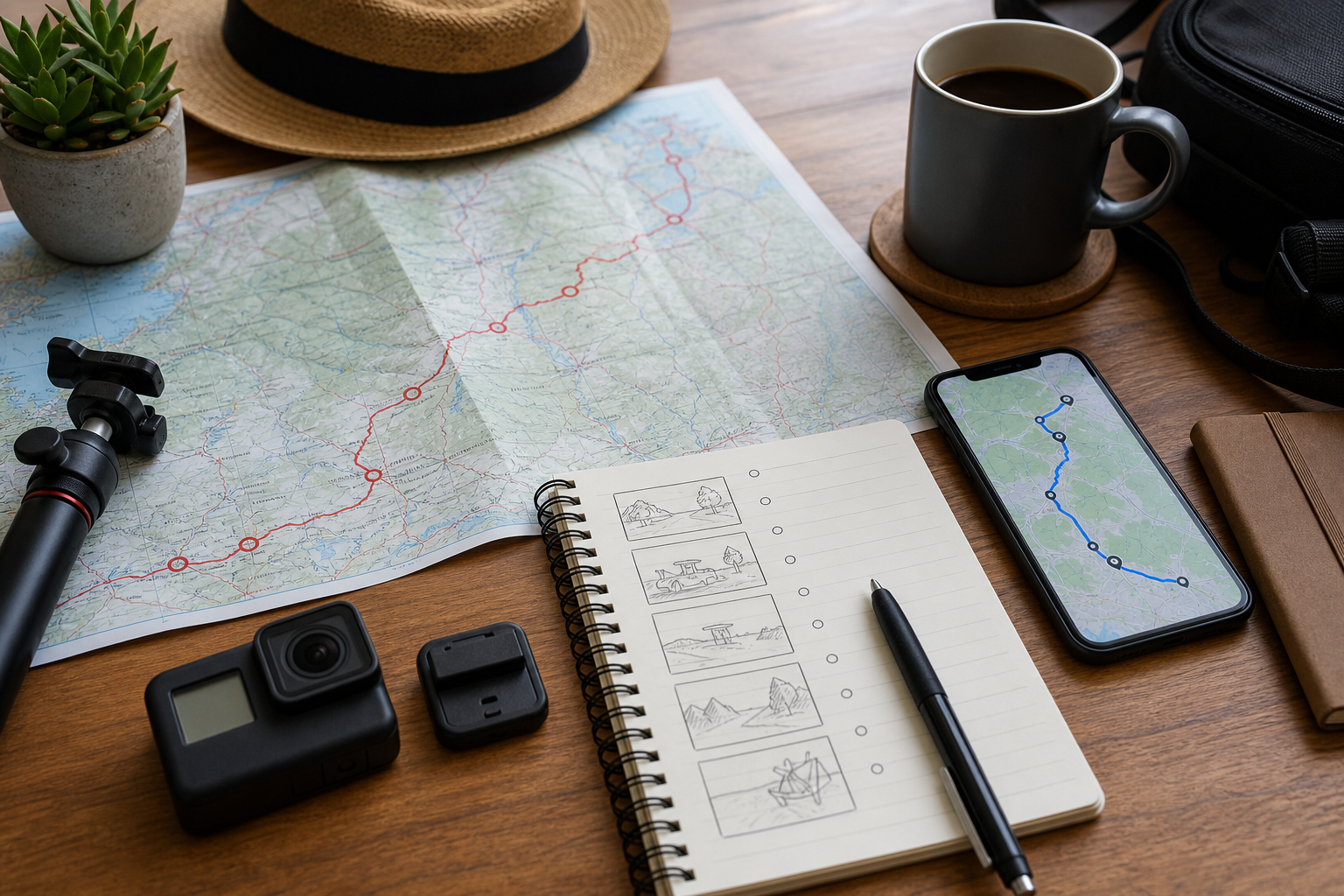
A five-stage storyboard for any travel video
When an idea needs more structure, arrange it into these five beats. A Reel may spend two seconds on each beat; a vlog can give each one a full sequence.
1. Hook
Show the promise, surprise, problem, or final result.
2. Context
Name the place, goal, limit, or decision viewers need.
3. Journey
Use actions and transitions to move through the experience.
4. Payoff
Deliver the view, answer, comparison, cost, or reaction.
5. Close
Give a verdict, useful next step, or visual callback.
Six shots to collect at every important stop
- Wide: Establish where the scene happens.
- Medium: Show a person or action in the place.
- Detail: Capture texture, food, signs, or hands.
- Movement: Walk, pan, pass, open, pour, or arrive.
- Reaction: Record a genuine response or discovery.
- Closing shot: Leave, look back, finish, or change light.
Prepare once, then stay present on the trip
Choose one primary idea for the day and write its hook, six essential shots, and ending in your notes. Record clips for five to ten seconds so you have clean handles for editing, wipe the lens before key scenes, and capture ten seconds of natural sound at each location.
For camera settings, sound, editing, and on-screen confidence, use the complete travel vlog filming guide. Before departure, work through the travel vlog phone checklist and the broader smartphone travel prep checklist so storage, charging, backups, and offline access are ready. Set up an eSIM for maps and backup uploads before departure instead of relying on hotel Wi-Fi.
For remote or active filming days, arrange travel insurance that covers your planned activities. In a new city, an evening tour with a local guide can provide a ready-made sequence of locations and transitions for a route-based story.
Vacation video ideas FAQ
How do I choose the right vacation video idea?
Choose one idea that matches both your platform and the time you can realistically film. Use a short-form format for one clear tip or reveal, a vlog for a full decision or journey, a montage for emotion, and a no-talking format when natural sound can carry the story.
What is a simple structure for a vacation montage?
Use a visible progression: arrival, discovery, peak moment, and close. Repeat a color, movement, or composition across scenes, and let the final shot answer or mirror the opening shot.
Which travel video ideas are best for beginners?
Start with one vacation day in 12 clips, a real travel-day budget, a slow morning, or a hands-only food story. Each has a fixed shot order, needs little presentation, and can be filmed entirely on a phone.
How many clips do I need for a travel video?
A 20–45 second Reel usually needs 8–15 selected clips. A one-minute montage often works with 15–25 clips, while a longer vlog needs sequences rather than a target count. Film wide, medium, detail, movement, reaction, and closing shots for every important stop.
Can I film a good travel video without speaking?
Yes. Record clean ambient sound, make actions easy to follow, and use short captions only when viewers need context such as a place name, price, or time. The no-talking formats above are designed around visual continuity instead of narration.