
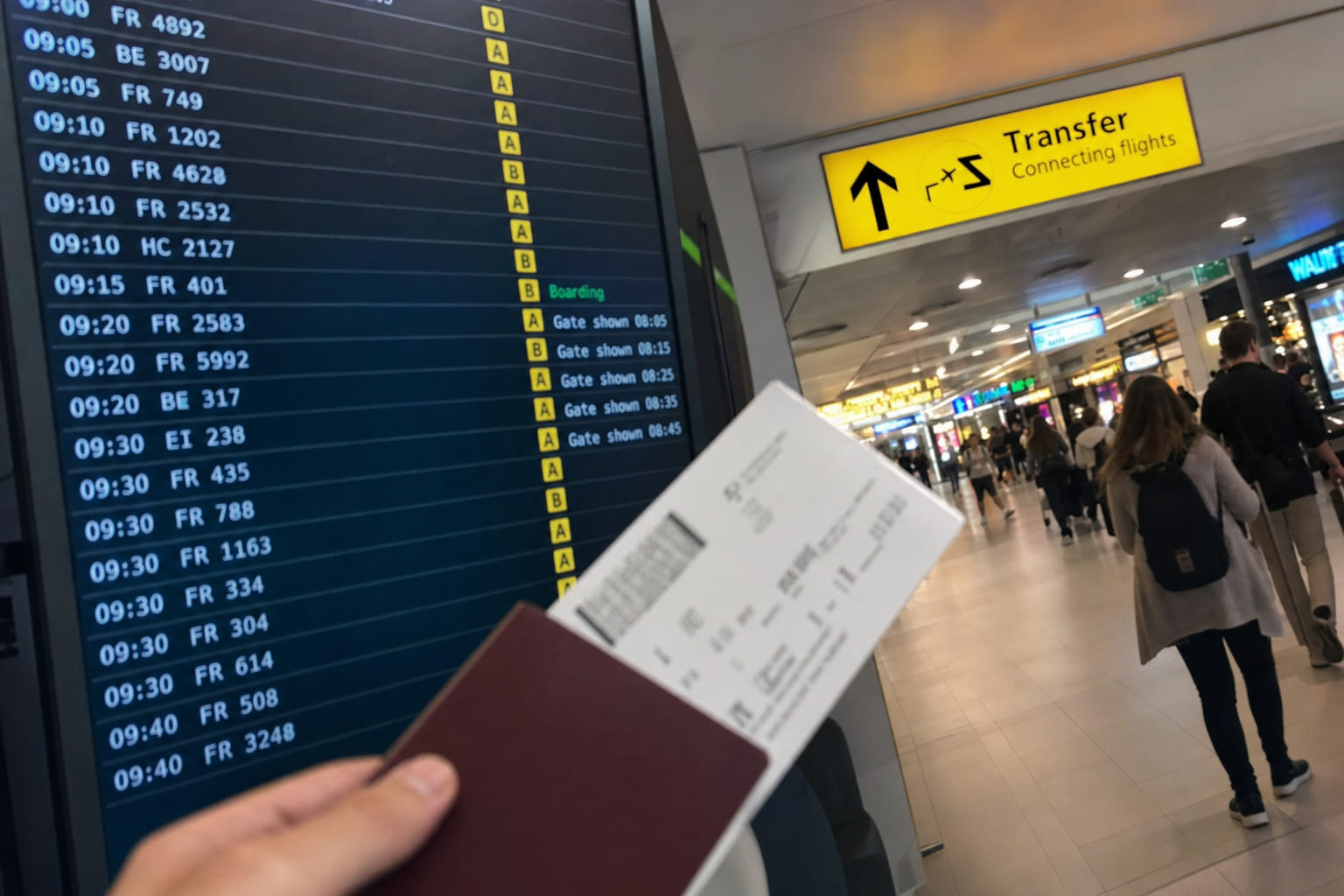
Layovers let you save on flight fares and sometimes add a bonus city — but only if you understand transit types. The core rule: know whether you are on one ticket or stitching separate bookings together. Get that wrong and you risk lost baggage, a voided onward ticket, or an unexpected border crossing.
This guide complements our multi-city vacation planner and carry-on checklist for budget airlines: together they cover tickets, bags, and ground time between flights.
Connecting flight vs self-transfer
The fundamental difference is booking type and who carries the risk. Pick the wrong format and every delay becomes your financial problem.
| Aspect | Connecting flight (single ticket) | Self-transfer (separate tickets) |
|---|---|---|
| Booking | One reservation for the full route | Two or more independent tickets |
| Baggage | Checked through to final destination | Collect and re-check at each stop |
| Transit zone | Usually stay airside — no exit required | Must enter the public landside area |
| Missed connection risk | Airline is responsible for rebooking | Full financial risk on the passenger |
When comparing fares on aggregators, a cheap self-transfer can look identical to a protected connection on the map — read the fine print before you buy travel insurance and assume you are covered for missed connections.
What is a smart connection
A smart connection (also called virtual interlining) is a hybrid route format that fare aggregators assemble artificially. The system combines flights from different airlines that have no official partnership agreements. At checkout it looks like one ticket, but technically and legally you are making a self-transfer.
The main difference between smart transit and simply buying separate tickets is the guarantee from the booking platform itself. If your first flight is delayed and you miss the next one, the aggregator commits to buying you a new ticket at its expense or refunding your money.
How virtual interlining works in practice:
- The booking platform takes on the financial risk if the connection fails.
- You must collect baggage from the carousel and check in again at the next airline's desk.
- You will leave the transit zone, so check visa requirements for the layover country in advance.
- All delay issues are handled exclusively through the aggregator's support — not at the airline counter.
How much time to allow between flights
Minimum connection time (MCT) is set by booking systems, but comfortable transit needs buffer hours — especially at mega-hubs like Istanbul, Dubai, or Bangkok.
- Single ticket, same terminal: 2–3 hours — enough for passport control, re-screening hand luggage, and finding the gate without sprinting.
- Single ticket, terminal change: from 3 hours. Shuttle buses between terminals at large hubs can take up to 40 minutes.
- Self-transfer, same airport: minimum 4–5 hours. You wait for baggage, clear customs, exit landside, and queue for check-in again.
- Different airports (London, Moscow, New York): from 6 hours. Factor traffic, express train schedules, and baggage reclaim.
Traveling with only a carry-on bag shaves 30–60 minutes off a self-transfer — no carousel wait — but you still need immigration time if you leave the transit zone.
Do you need a transit visa?
A transit visa allows legal entry for up to 72 hours in many countries. Whether you need one depends on your passport, route, and — critically — whether you must collect baggage.
Usually no visa if you hold a single ticket, stay in the international transit zone, the layover is under 24 hours, and the airport stays open overnight.
Visa often required if you fly on separate tickets (baggage is only released after passport control), you must change airports, the connecting terminal has no airside corridor, or the hub closes at night and you cannot remain airside.
Cross-check passport, visas, and ticket PDFs with our pre-trip documents checklist before locking in a risky self-transfer fare.
Step-by-step in a transit airport
- Find the departures board immediately — confirm the next flight status and gate; assignments change during immigration.
- Follow Transfer / Connecting flights signs (often yellow or green) instead of Exit unless you are on separate tickets.
- Expect re-screening of hand luggage on international connections before the sterile area.
- Stay near the gate once assigned — do not wander the duty-free wing; listen for boarding calls.
Install flight-tracking apps before departure — our smartphone travel prep checklist covers eSIM, offline maps, and an international data plan for gate changes on the move.
What to do if you miss a connection
Steps and compensation depend entirely on one ticket vs separate bookings.
- Do not panic or leave the transit zone on a single ticket — find the Transfer desk or airline representative.
- Airline fault (single ticket): the carrier must rebook you on the next available flight. After 2 hours you may claim drinks, after 4 hours hot meals, and after 6 hours overnight (night) or 8 hours (day) hotel plus transfer under EU261 and similar rules.
- Passenger fault or separate tickets: the onward ticket may be forfeited with no refund obligation — still ask politely; staff sometimes help at reduced cost.
- Document everything: photos of boards, queues, and boarding passes support insurance and EU261 claims.
Budget for contingency nights near the hub — search airport hotels in advance for Istanbul, Dubai, or Bangkok if your self-transfer window is tight.
Plan without stress with AlpacaBag
Self-organizing complex layovers and offbeat routes can eat dozens of hours on forums. AlpacaBag turns scattered ideas into a realistic day-by-day plan — transfer time, budget, and transport type included. Less counting minutes, more traveling.
Budget for layover risks
Add a contingency line to your trip budget: extra hotel night, taxi between airports, rebooking fee on separate tickets. Use our travel budget calculator and money-saving travel guide so a missed connection does not wipe out the savings from a cheap fare.
Ready-made routes
Routes for your destination
Day-by-day plans you can adapt to your dates right away.




FAQ
How much time do I need for a self-transfer at the airport?
Plan at least 4–5 hours in the same airport when you must collect baggage and check in again. For a terminal change on one ticket, allow 3 hours. Changing airports (e.g. London Heathrow to Gatwick) needs 6+ hours including ground transport.
What is the difference between a connecting flight and a self-transfer?
A connecting flight is booked on one ticket: baggage is through-checked and the airline protects you if the first leg is delayed. A self-transfer uses separate tickets — you exit immigration, collect bags, and re-check in; missing the next flight is your problem.
Do I need a transit visa for a self-transfer?
Often yes. Separate tickets usually require entering the country to collect baggage, which counts as entry — not airside transit. Check visa rules before booking cheap self-transfer fares.
What should I do if I miss my connecting flight?
On one ticket: go to the Transfer desk without leaving the transit zone — the airline must rebook you. On separate tickets: the next flight ticket may be void; ask politely at the counter anyway, document everything for EU261 or insurance claims.
Can I leave the airport during a long layover?
Only if you can legally enter the country (visa or visa-free) and still return with enough time for security and boarding. For a self-transfer you are already landside — use the buffer to reach the next terminal, not sightseeing, unless you have 8+ hours.