
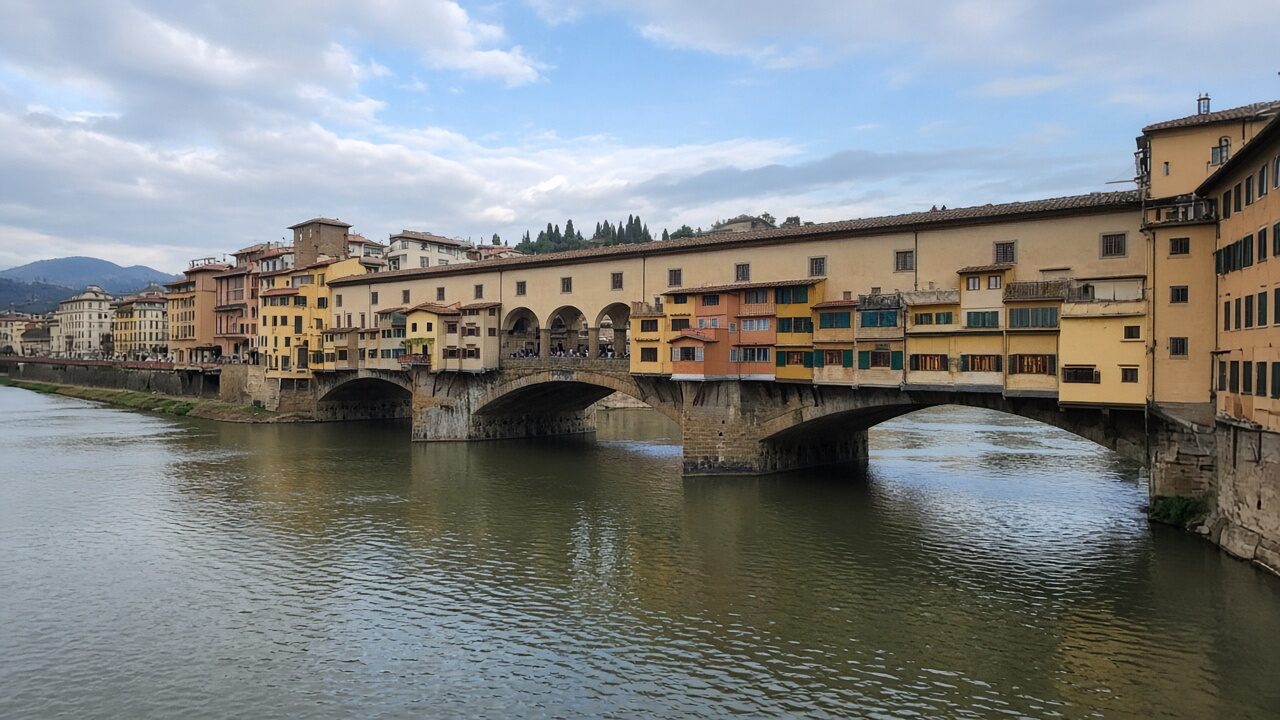
Ponte Vecchio is a working street suspended over water
There is no gate or schedule: Ponte Vecchio is Florence's public crossing between the historic centre and Oltrarno. Three stone arches carry two rows of shops. At the centre, their walls open into small terraces over the Arno, where crowds gather around the bust of goldsmith Benvenuto Cellini.
The current bridge followed the destructive flood of 1333 and is commonly associated with Neri di Fioravanti. It survived the Second World War while Florence's other central bridges were destroyed, though access streets were blocked. Modern danger is more mundane: dense pedestrian traffic rewards pickpockets, so carry valuables in front.
The day goldsmiths replaced the bridge butchers
Medieval butchers, tanners and food sellers valued the river for convenient waste disposal. In 1593 Ferdinando I de' Medici expelled the butchers and assigned the shops to jewellers. The policy cleaned and elevated the private ducal route crossing above them.
Heavy wooden shutters still turn shops into locked chests after business hours. By day, windows hold gold, cameos, watches and contemporary pieces. This is not one regulated market: histories, workmanship and prices vary. See the architecture before opening, then compare several shops if you intend to buy.
The Vasari Corridor passes directly above your head
Giorgio Vasari built the covered route in 1565 for Cosimo I, linking Palazzo Vecchio and the Uffizi to Palazzo Pitti. Its windows form the upper storey over Ponte Vecchio. At the Mannelli tower, the corridor bends around the outside because the family refused to let the ducal passage cut through their property.
You cannot enter from the bridge. Admission begins through the Uffizi on a named, non-refundable timed ticket and exits towards Boboli. In 2026 both standard combined visits and special Friday evenings operated. Use official Uffizi and Vasari Corridor tickets; a bridge tour alone provides no corridor access.
Ponte Santa Trinita and two less obvious angles
The famous silhouette is invisible while you stand on it. Walk to Ponte Santa Trinita for the complete three-arch composition, projecting workshops and Oltrarno hills. Morning light is often gentle; before sunset, arrive early because photographers line both pavements.
Lungarno degli Acciaiuoli near the Uffizi offers a low riverside angle. Ponte alle Grazie gives a more distant view and usually more breathing room. Reflections matter more than perfect symmetry, and no picture is worth stepping into traffic or blocking a narrow pavement.
A one-hour walk from the Uffizi into Oltrarno
Start in the Uffizi courtyard, reach the river and detour west to Ponte Santa Trinita for context. Return, cross Ponte Vecchio and notice the irregular rooms projecting behind shopfronts. On the south bank, Via de' Guicciardini continues to Palazzo Pitti while side streets lead towards artisan workshops.
The bridge circuit needs about an hour without museums or shopping. Pitti and Boboli turn it into half a day. Piazzale Michelangelo can extend the climb above the roofs, but avoid the hottest hour. A well-positioned hotel on either bank of the Arno is useful only if it matches the rest of your route.
How to examine jewellery without buying the story
Decide metal, fineness, stone and budget before entering. Ask for an itemised receipt, documentation for a significant gemstone and return terms before payment. An Italian maker's mark identifies a workshop and province; it does not prove that the tourist-facing price is competitive.
If no purchase was planned, leave the gold in its cases. Watch shutters close, find the corridor windows and enjoy the bridge as an urban machine. Trade, Medici power, private rooms and an ordinary river crossing still occupy the same three arches.
Where to stay
A convenient base can simplify an early start; compare location before price.
Build a route around this visit
A decision-focused guide to Ponte Vecchio: where to enter, what deserves your time, what to do when plans change, and how to avoid treating a famous sight as the whole day.
Ready-made routes
Routes for your destination
Day-by-day plans you can adapt to your dates right away.
FAQ
Do I need a ticket to cross Ponte Vecchio?
No. The bridge is a public street and crossing is free. Tickets apply only to separate attractions such as the Uffizi and Vasari Corridor.
Where is the best complete bridge view?
Ponte Santa Trinita gives the classic view of all three arches and projecting shops. Ponte alle Grazie offers a quieter alternative angle.
Why are the shops mostly jewellers?
In 1593 Ferdinando I de' Medici removed the butchers and assigned the shops to goldsmiths, improving the prestige and cleanliness of the ducal route.
Can I enter the Vasari Corridor from the bridge?
No. It passes above the shops, but admission begins through the Uffizi complex with a named, timed reservation.
When is Ponte Vecchio least crowded?
Early morning, before the shops open, is best for architecture. Late evening becomes calmer after shutters close; watch personal belongings whenever the centre is congested.