
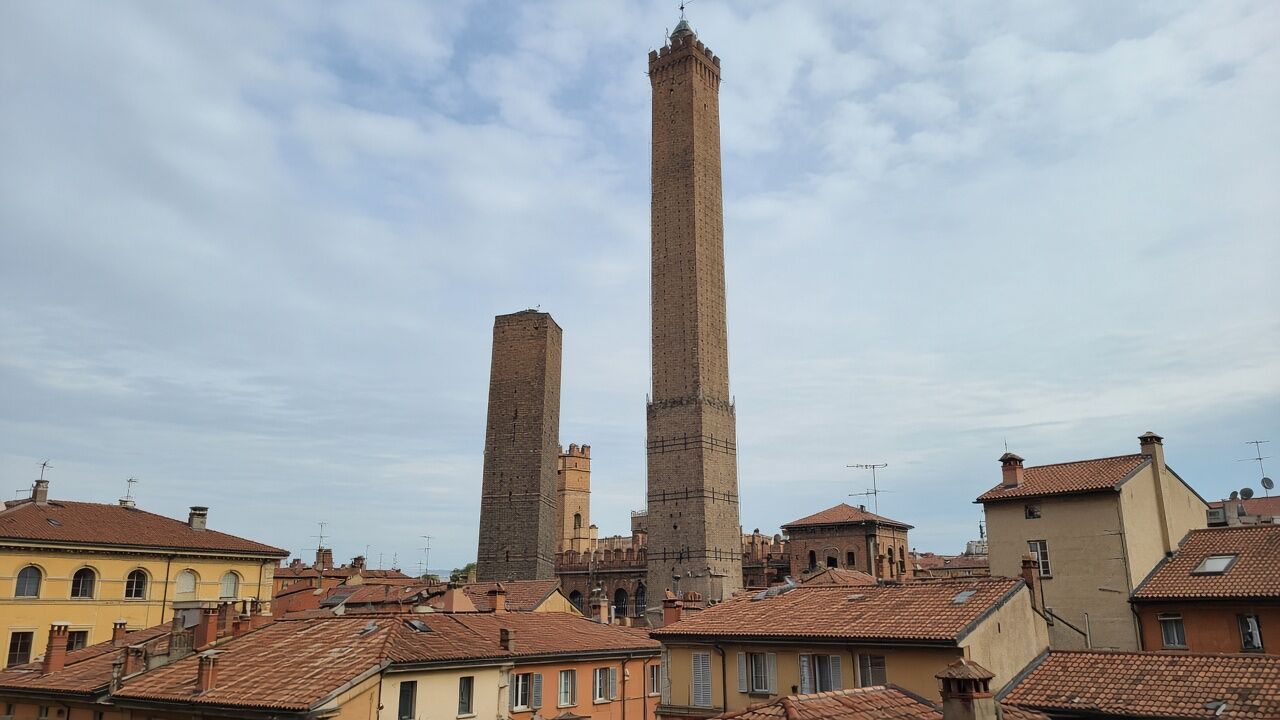
Asinelli is closed: the fact that changes the whole visit
On 1 October 2026, visitors cannot climb Torre degli Asinelli. This is not a seasonal timetable issue. After concerning masonry movement at neighbouring Garisenda in 2023, Bologna restricted the square, installed a protective perimeter and began a complex stabilisation programme.
No reopening date has been published. Work proceeds in monitored stages, with the municipality describing 2028 as the broader project objective rather than a guaranteed tower-opening date. Do not buy an alleged Asinelli admission from an unknown seller. Read the official Garisenda safety project update.
The 498-step Asinelli ascent now preserved in memory
Asinelli rises roughly 97 metres. Before closure, visitors climbed 498 wooden steps: narrow, steep in places, shared by opposing foot traffic and served by no lift. The summit provided a circular view over red roofs, surrounding hills and Bologna's gridded streets beneath their porticoes.
That physical effort made the tower memorable, but presenting it as bookable in 2026 would be misleading. Keep the practical details for a future reopening: secure footwear, empty hands and comfort with confined heights were essential. At present neither staircase nor interior is accessible.
Garisenda leans more dramatically than photographs suggest
Garisenda is shorter than Asinelli but visibly more inclined. Uneven ground settlement began early, and its upper portion was removed in the fourteenth century, reducing it to about 48 metres. Dante compared the leaning tower to the giant Antaeus in the Inferno.
The modern engineering aim is stabilisation, not cosmetic straightening. Plans involve large metal structures, carefully controlled force and reinforcement at the base, with each action governed by sensor readings. That caution explains why barriers and pedestrian routes may change as the site develops.
How to see the Two Towers without obstructing the works
Approach from Piazza Maggiore along Via Rizzoli. The long axis establishes scale while porticoes provide shelter. Near Piazza di Porta Ravegnana, obey temporary signs and never cross a barrier for a photograph. The most useful permitted angle may shift between visits.
Compare Garisenda's edges with the vertical lines of nearby buildings to read the lean. Then circle the block through open streets to see how Asinelli dominates the medieval plan. Morning brings calmer traffic; late light warms the brick but also draws a denser crowd.
Bologna had a forest of towers before it had one icon
During the twelfth and thirteenth centuries, powerful families built towers and fortified tower houses for status, defence and factional competition. The exact total remains debated. The popular claim of one hundred conveys the extraordinary scale better than it provides a reliable census.
Other traces survive around the centre, including Prendiparte and Uguzzoni. Walk towards the Quadrilatero and the famous pair becomes part of an urban pattern rather than an isolated photograph. Ninety minutes allows for street views and a market pause without pretending there is an ascent.
Two Bologna panoramas that do not imitate Asinelli
Torre dell'Orologio beside Piazza Maggiore offers a central rooftop view on its own ticket; verify current access and stair conditions. The longer alternative follows porticoes towards the Sanctuary of San Luca. Instead of a vertical burst, this route rises gradually beneath 666 arches.
Choose the clock tower for roofs and central landmarks, or San Luca for city geography and a substantial walk. Return through the Quadrilatero for food and compare hotels within the historic centre. Neither alternative should be sold or described as entry to closed Asinelli.
Where to stay
A convenient base can simplify an early start; compare location before price.
Build a route around this visit
A decision-focused guide to Bologna's Two Towers: where to enter, what deserves your time, what to do when plans change, and how to avoid treating a famous sight as the whole day.
FAQ
Can I climb Asinelli Tower in October 2026?
No. As checked on 1 October 2026, Asinelli remains closed while the safety project around neighbouring Garisenda continues. No reopening date has been announced.
How many steps did the Asinelli climb have?
The former visitor route used 498 wooden steps inside the 97-metre tower. There is no lift; this describes the historic experience, not a currently bookable visit.
Why does Garisenda lean so sharply?
Uneven ground settlement affected its foundations in the Middle Ages. The upper section was removed in the fourteenth century, and recent masonry changes triggered the current stabilisation project.
Where can I see both towers now?
Use the permitted viewpoints around Piazza di Porta Ravegnana and the long approach along Via Rizzoli. Barriers and pedestrian routes can change with the works.
What replaces the Asinelli panorama?
Try Torre dell'Orologio for a central rooftop view or follow the porticoes towards San Luca for a longer hill walk. Check each attraction separately.