
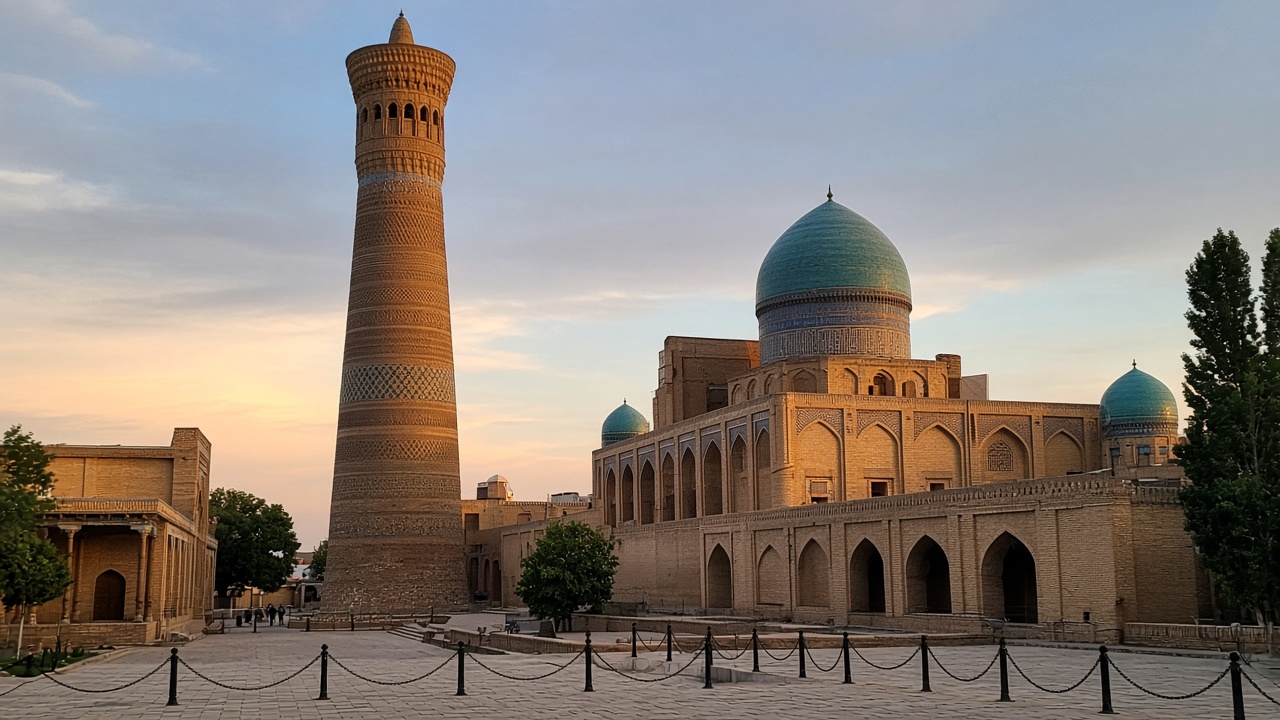
History and architecture of the “Foot of the Great”
Kalyan Minaret
Kalyan Minaret (~46 m) is the square’s vertical anchor. Legend says even Genghis Khan spared it, impressed by the height. Today it is your old-city navigation beacon: if you see the tower, you are close to the trading domes and the Ark.
Kalyan Mosque and Mir-i Arab
Kalyan Mosque opens a wide courtyard and domes; Mir-i Arab opposite still hosts teaching and spiritual life. Together they form Bukhara’s classic mosque / madrasa pair around the minaret — the “foot of the Great.”
| Piece | Ballpark | Note |
|---|---|---|
| Kalyan Minaret | 12th c. core | ~46 m; square landmark |
| Kalyan Mosque | 15th–16th c. | Courtyard, domes, Friday prayers |
| Mir-i Arab Madrasa | 16th c. | Facing façade; active school |
| Ensemble visit | 1.5–2 hours | Plus tea after the walk |
How to get there and when to come
The ensemble sits in historic Bukhara between the Ark citadel and the trading-dome spine — walkable from most old-city hotels. Mornings are quieter for the mosque courtyard; sunset and illumination favour façades and the minaret. For maps and offline navigation, set up an eSIM or Yesim.
Book a hotel in the walkable old city so evening returns to the square stay easy.
Nearby: a one-day old-city walk
Calm order: morning Ark citadel → Poi-Kalyan (1.5–2 h) → trading domes and a teahouse → Chor Minor or a sunset return to the square. Coming from Samarkand, keep yesterday’s Shahi-Zinda / Ulugh Beg Observatory block in mind — do not force both cities into one daylight window.
Need a Bukhara 1–3 day scaffold with tea breaks and minaret sunset built in?
Build itineraryReady SEO scaffolds: Bukhara 3 days independent. Optional extension — Khiva 3 days independent (Itchan Kala) if you still have nights after Bukhara.
Atmosphere: from ancient walls to evening rhythm
The square’s scale and the minaret’s vertical often invite an “epic” headphone playlist — from calm instrumentals to tracks like North Wind Calls or Valhalla Calling. Keep it personal audio; do not blast speakers near the mosque.
Mosaic colour can feel like a studio palette — even a quick notebook sketch helps you slow down. After the dome loop, sit for tea in traditional bowls / cups: talking through what you saw beats racing the next pin.
2026 tips and budget
The square is usually free to cross; ticketed mosque zones cost on the order of tens of thousands of som — confirm at the desk. Skip random “official ticket” sellers at the gate. Documents and Silk Road city order live in the Uzbekistan 2026 trip guide; drivers use the road-trip guide; seasonality is in the autumn guide.
Most travellers reach Bukhara after Samarkand (Samarkand 3 days). International arrival is usually via flights into Tashkent/Samarkand, then train or car. Khiva stays an optional “one more fortress,” not a mandatory tail on every trip.
FAQ
How long do I need at Poi-Kalyan?
Allow 1.5–2 hours for the square, minaret views, mosque courtyard and Mir-i Arab façade. Folded into an old-city day (Ark → trading domes → Chor Minor), budget half a day.
Is there a dress code?
For the active mosque and madrasa: cover shoulders and knees, keep voices low. Follow staff guidance; Friday hours may limit tourist access.
When is the best light for the minaret?
Golden hour and evening illumination change the ensemble completely. By day, try the angle from Amir Alim Khan Madrasa — often fewer people than at the main square entrance.
What does entry cost?
The square is often free to walk; mosque courtyard / ticketed zones are paid (ballpark tens of thousands of som). Confirm at the desk — AlpacaBag does not sell monument tickets.
Is Khiva worth adding?
Yes if you have 2+ spare days after Bukhara: Itchan Kala is a different wall-scale experience. Use the Khiva 3-day independent scaffold after your Bukhara block.