
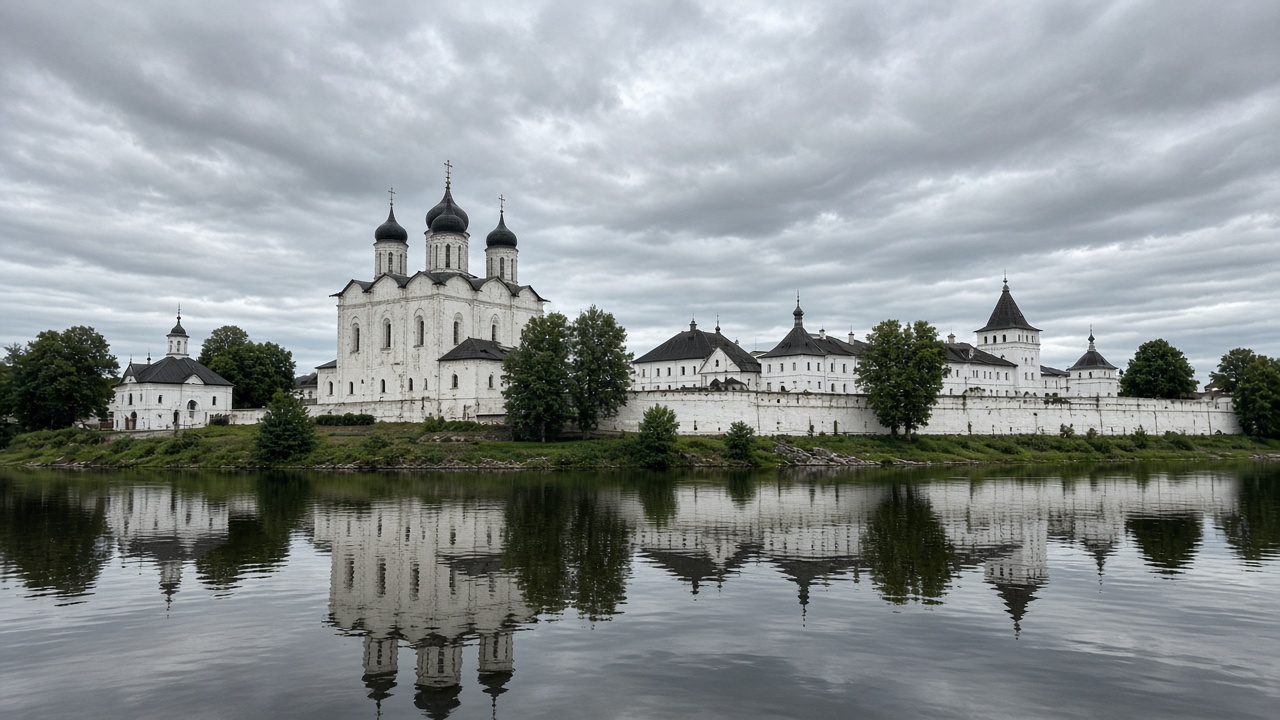
Why Spaso-Preobrazhensky Cathedral is a Pskov must-see
Pskov has strong stops — fortress walls, merchant chambers, legend-heavy towers — but Mirozhsky offers a different scale: inside the cathedral you are not looking at a reconstruction of an era, but at a genuine 12th-century painted ensemble. For travelers it is one of the rarest visual experiences in Russia’s Northwest.
The ensemble is part of the UNESCO World Heritage listing for Pskov’s ancient churches. Practically: if the city has one “museum window” onto Byzantine painting, this is it. Build the rest of the day (fortress, museums, riverside walks) around this slot — not the other way around.
A rescue story: from whitewash to the UNESCO list
Nifont, Byzantine masters, and the long road to a museum
Archbishop Nifont stands behind the commission: in the 12th century Spaso-Preobrazhensky Cathedral and its fresco program took shape under Byzantine workshops. Later layers of whitewash covered the paintings — a common medieval fate when interiors were “updated.”
In the 19th–20th centuries the frescoes were gradually uncovered and conserved; today the cathedral operates as an object of the Pskov Museum-Reserve. UNESCO recognition confirms international value, but for visitors the local rule matters more: access depends on conservation conditions, not only on “normal church opening hours.”
In today’s diocesan life you may hear the name of Metropolitan Matthew of Pskov and Porkhov — useful context for active monasteries and parishes in the region. The Mirozhsky fresco cathedral remains a museum visit: ticket, house rules, and possible humidity closures.
What to look at: key scenes and Nifont’s lapis blues
Do not try to “read everything.” Pick three anchors and let your eyes adjust to the dome scale and light:
- Deesis — the intercession composition; a clear theological “center” of the interior program.
- Transfiguration — the title scene of the cathedral; watch the rhythm of figures and color accents.
- Lamentation — the emotional hinge of the cycle; here medieval plasticity feels least like a flat illustration.
A separate visual marker is the saturated blue (“lapis”) palette linked to expensive pigments in Nifont’s commission. Even without an art-history background, that color helps lock a memory frame: not the exterior walls, but the painted interior.
Practical visitor information
Hours and the weather factor
The core rule: the cathedral may close in rain or high humidity. This is standard fresco protection, not a rare glitch. AlpacaBag tip — check the forecast an hour before you leave; if the sky is wet, do not wait at a closed door — switch to an indoor museum immediately.
Weather and humidity
The cathedral often closes in rain or high humidity to protect 12th-century paint. Check the forecast an hour before you leave.
Site status
Spaso-Preobrazhensky Cathedral is a museum object of the Pskov Museum-Reserve — not an active parish church for fresco services.
Timing
Budget 40–60 minutes inside plus ~30 minutes for the grounds and the dam photo at the Mirozhka–Velikaya confluence.
Plan B
If the cathedral is closed, switch to Pogankiny Chambers or other indoor museums; save Pechory Lavra for a separate transfer day.
Getting there and ticket costs
- Location: Zavelichye, at the Mirozhka river mouth into the Velikaya; the dam and opposite bank give the best panoramas.
- Walk from the Krom: Olga Embankment → bridge → monastery, about 25–40 minutes.
- Tickets: adult orientation ~200–400 RUB for the museum cathedral — confirm only via museums.pskov.ru.
We do not sell official museum tickets. After the practical block — a city base: hotels in central Pskov work well if you want a morning walk to the Krom and Mirozhsky without transfers; eSIM helps with offline maps when rain forces a plan change.
| Item | Solo | Note |
|---|---|---|
| Spaso-Preobrazhensky Cathedral (museum ticket) | ~200–400 RUB | Confirm live prices only on museums.pskov.ru; ask about concessions at the desk |
| Monastery grounds / exterior walk | free | The fresco church is a separate museum ticket |
| Coffee in Zavelichye | ~250–450 RUB | Typical café check near the embankment after the visit |
One-day Pskov route: from the Krom to Mirozhsky
AlpacaBag day thread: start at the Pskov Krom, walk the embankment into Zavelichye for Mirozhsky Monastery, then catch Pokrovskaya Tower / a return view of the centre. If weather turns by midday — after the Krom go straight to Pogankiny Chambers and save Mirozhsky for a clearer slot.
| Slot | Plan |
|---|---|
| 09:30–11:00 | Pskov Krom and Trinity Cathedral — fortress start to the day |
| 11:00–11:40 | Olga Embankment → crossing into Zavelichye (~25–40 min walk) |
| 11:40–13:00 | Mirozhsky Monastery: cathedral 40–60 min + grounds ~30 min |
| After Mirozh | Pokrovskaya Tower / Krom from the far bank — or Pogankiny if it rains |
No English Pskov SEO hub routes yet — stitch the day with the wizard and sibling guides, then compare another Russian fortress scale with our Tobolsk Kremlin guide.
Need timed slots with a weather-closure buffer — not a chaotic “five more stops”?
Build itineraryWhat else nearby: lavra day trip and city siblings
Within walking distance after Mirozhsky, a return toward the Krom and an evening accent on Gremyachaya Tower give another face of Pskov — legends on the Pskova bank. In rain, keep Pogankiny first.
A separate out-of-town trip is Pskovo-Pechersky Lavra: confirm hours and visit rules on the lavra’s official site, and do not fold it into Mirozhsky’s two-hour slot.
Prefer a guided Zavelichye walk — browse excursions as a complement to your own museum ticket, never as a substitute for the official cathedral entrance.
FAQ
Why does Mirozhsky Monastery close because of weather?
The 12th-century frescoes are sensitive to humidity. In rain or damp conditions the museum-reserve may close Spaso-Preobrazhensky Cathedral to protect the painting. It is a conservation rule, not a random schedule quirk.
How much time do you need at Mirozhsky Monastery?
Plan 40–60 minutes for the cathedral itself and about 30 minutes for the grounds and the dam viewpoint. Linked with a walk from the Krom along the embankment, it fills a half-day block.
How do you get from the Krom to Mirozhsky?
Walk along Olga Embankment and across the bridge into Zavelichye — usually 25–40 minutes at an easy pace. A taxi helps in rain or with kids if you need to arrive before a possible weather closure.
What should you look at first inside the cathedral?
Start with the Deesis, the Transfiguration, and the Lamentation — plus the distinctive lapis-rich blues tied to Archbishop Nifont’s commission and Byzantine workshops.
Where should you go if rain closes the fresco church?
The best indoor Plan B in the city is Pogankiny Chambers. Outdoors you can shift to the Krom or Gremyachaya Tower; keep Pskovo-Pechersky Lavra as a separate out-of-town trip.