
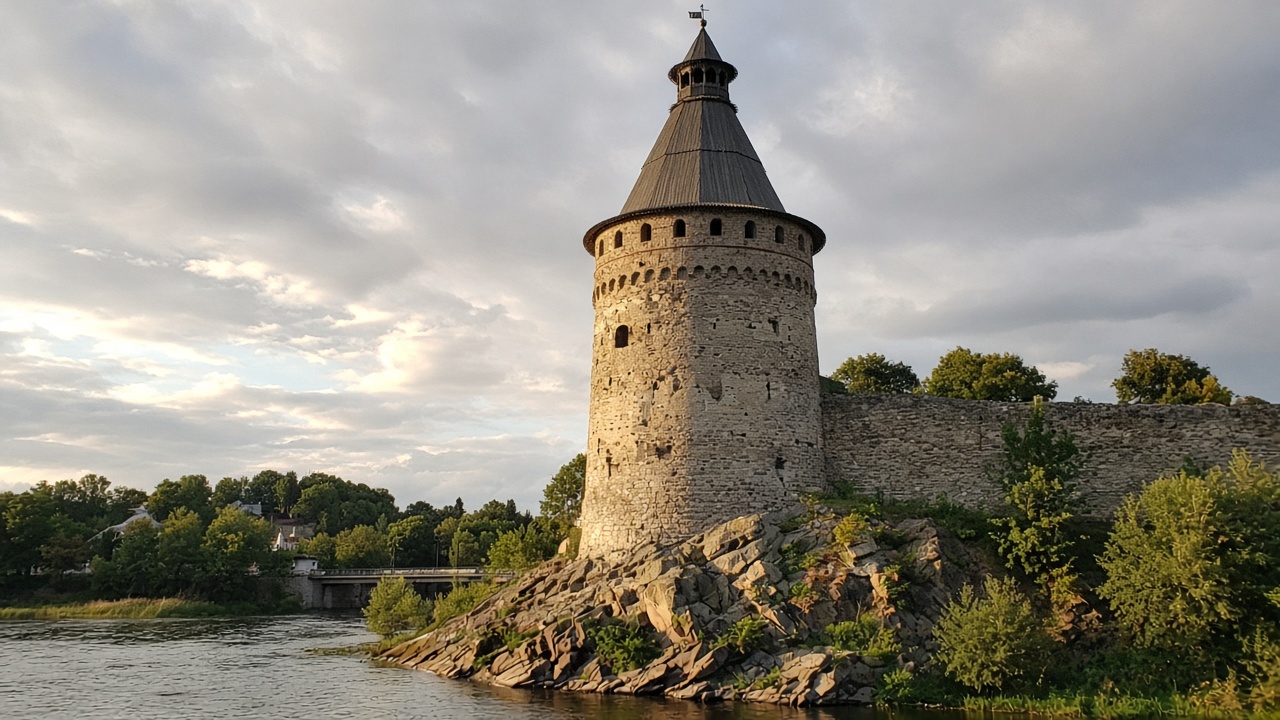
History and architecture: why “Gremyachaya”?
Gremyachaya or Kosmodamianskaya: the name confusion
The chronicle pins an exact year: in 1525 (year 7033) Grand Prince Vasily III ordered clerk Misyur Munekhin to raise a stone gun tower on Gremyachaya Hill above the Pskova “on the steep bank” and to dig a secret passage. The new tower was first called Kosmodamianskaya (Kozmodemyanskaya) — after the nearby church of Cosmas and Damian. A smaller tower once stood at the Gremyachie Gates; when it disappeared, the popular name “Gremyachaya” migrated onto the surviving round tower. Guidebooks still mix both labels for one place.
Some historians allow that an Italian master (sources say a “fryazin”) may have taken part in Pskov fortification works of that era. For visitors, the practical fact matters more: the tower sits on limestone rock at Lapina / Gremyachaya Hill, without a conventional foundation, and still reads as a node in the Okolny Town ring.
Place in the Pskov fortress system
Gremyachaya guarded the river approach and linked to the Upper Grilles — the point where the Pskova entered the urban defence. About 19–20 m high, ~14–15 m across at the base, six tiers of embrasures: not a decorative ruin, but a serious Zapskovye strong point. Nearby sit chamber ruins and the hilltop church; the silhouette “locks” best from the water and the opposite bank.
A natural same-day pair is the Pskov Krom— the starting hub for most fortress and embankment walks.
Top 3 Gremyachaya Tower legends
The sleeping princess and barrels of gold
The best-known tale is the “enchanted princess.” Deep under the tower, behind heavy doors, a gilt coffin supposedly holds a young princess under her mother’s curse; barrels of gold crowd the vault, and unclean spirits guard the entrance. The “disenchantment” rule is harsh: find a brave soul who can recite the Psalter for twelve days and nights without sleep or fear. Then the spell lifts, and the hero wins both the bride and the treasure.
Local retellings usually end with failure on the final days — fear, deceptive visions, flight — and the hoard “closes” again. It is folklore, not chronicle fact; yet it explains why the tower still appears in city tours and “urban legends” shows as the place where fortress history and fairy tale braid together.
The prince’s shadow and underground ghosts
Another story ties the name to a captive prince: invaders locked him in the stone tower, and in a decisive battle his shadow supposedly flickered on the wall — enemies faltered, Pskovians retook the town. The same cycle includes a “quiet clang of chains” on the anniversary night and whispers of shapes in the lower tier. For a walk, remember the practical layer: the lower niches and descents to water were real fortress “secret” works, with ghost stories layered on top.
The craftsman and unclean spirits
A third durable plot follows a mason (or apprentice) who tried to finish work on the hill and met “helpers” from the unclean realm at night — either the masonry finished too fast, or tools vanished into the undercroft. Tellers diverge on the moral: don’t boast before sundown, or don’t poke underground without need. For travellers it is a soft stop sign: see the ruins by daylight, in sensible shoes, without testing the legend in closed niches.
Mystical Pskov: folklore without the spam
Pop culture vs. the tower you actually visit
Search results sometimes surface phrases like “necromancer of Pskov province” — that is a book / fanfic pop-culture layer, not the key to visiting the tower. If that motif interests you, keep it as background chatter about regional mystique; on the ground the 1525 chronicle, the River Pskova, and the three classic legends above matter more. Soft folklore fits better here than dark clickbait.
Nearby: Krom, Finnish Park, Mirozh, Pogankiny
The same day pairs well with the Krom, a walk through Finnish Park / the Pskova embankment, then Mirozhsky Monastery (12th-century frescoes) or a rainy-day backup at the Pogankiny Chambers. For another Russian kremlin vertical, see our Tobolsk Kremlin guide.
Walking route: from the Krom to Gremyachaya Hill
Classic track: Krom → Pskova embankment → Finnish Park / riverside path → Gremyachaya Hill. Allow 15–25 minutes at an easy pace; reserve 40–60 minutes for the tower and chamber ruins. Best light is early morning or the pre-sunset hour — stone and water give an atmospheric frame without flash.
| Slot | Plan |
|---|---|
| Start | Pskov Krom → embankment of the River Pskova |
| 15–25 min | Walk along the Pskova / through Finnish Park to Gremyachaya Hill |
| 40–60 min | Tower, chamber ruins, descend to the water for sunrise or golden-hour photos |
AlpacaBag tip: walk down to the water at the foot of the tower — from there the masonry looks as if it grows out of the rock. No English Pskov SEO hubs yet — stitch the day with the wizard and sibling guides, starting from the Krom link above.
Need timed slots for Krom → Gremyachaya → Mirozh / chambers — not a chaotic “five more stops”?
Build itineraryGetting there and visitor tips
- Start: ~15–25 min walk from the Pskov Krom along the Pskova / through Finnish Park
- Entry: free; no separate museum ticket
- Time on site: 40–60 minutes for tower and ruins
- Checklist: sensible shoes for the hill; a small torch only if you carefully check niches in daylight; water and a light layer for river wind
We do not sell “tickets” to the ruins — there aren’t any. After the walk, stay near the centre: hotels in Pskov near the Krom, eSIM for offline maps on the hill.
Budget (2026 orientation)
| Item | Solo | Note |
|---|---|---|
| Tower and ruins visit | Free | Open grounds; no ticket desk |
| Walk from the Krom | Free | ~15–25 min along the Pskova / through Finnish Park |
| Coffee after the walk | 200–400 ₽ | Centre orientation; optional |
Next day: Izborsk, Pechory, and the region
If Gremyachaya’s legends spark interest in the wider land, day two and three fit Izborsk Fortress and the Pechory (Pskovo-Pechersky) monastery as separate regional outings — don’t cram them into the same evening after the Krom. By car you can stretch further to Gdov, Opochka, or Pushkinskiye Gory as a bonus for fortress fans, not as a mandatory first-day checklist.
Prefer a guided regional day — browse excursions as a complement if you would rather not drive yourself.
FAQ
Where is Gremyachaya Tower in Pskov?
On Gremyachaya Hill above the River Pskova, in the Okolny Town fortifications (Zapskovye). A practical start is a 15–25 minute walk from the Pskov Krom.
Do you need a ticket?
No — visiting the grounds is free. The tower is a ruin without a museum ticketing desk; mind slippery stone and steep descents.
How long do you need?
Plan 40–60 minutes for the tower and nearby ruins. With the walk from the Krom along the Pskova, the whole block takes about 1.5–2 hours.
Why is it called both Gremyachaya and Kosmodamianskaya?
The 1525 gun tower was first named Kosmodamianskaya (Kozmodemyanskaya) after the nearby church of Cosmas and Damian. The popular name “Gremyachaya” later migrated from another, long-vanished tower at the Gremyachie Gates.
What else fits the same day?
The Pskov Krom, Mirozhsky Monastery, and Pogankiny Chambers are natural city companions. Keep Izborsk Fortress and the Pechory monastery for a separate day trip in the region.