
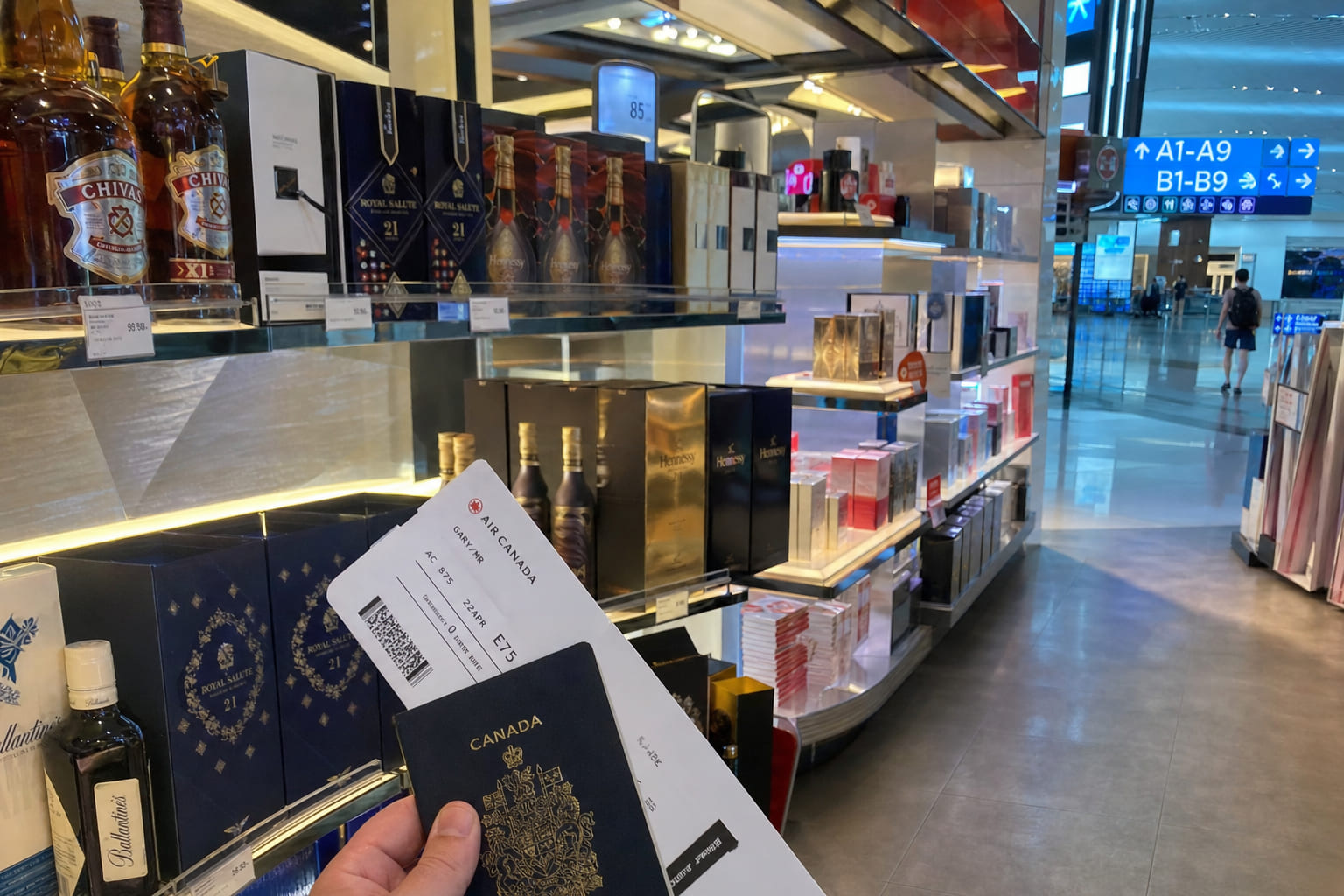
What does duty free mean?
Duty is a tax governments charge on goods that cross a border — import duty, and often related VAT or excise. Duty free means those local taxes are not added (or are removed) at the till because the purchase is treated as an export: you are a traveler taking the item out of the territory, not a resident shopping downtown.
That is why duty-free shops cluster in international airport terminals, cruise ports, and some border crossings. The product categories people associate with the format — spirits, tobacco, fragrance, cosmetics, chocolate, luxury accessories — are the ones where tax normally makes up a large share of the shelf price.
Duty free is not a promise that every SKU is cheaper than Amazon, a city pharmacy, or a supermarket. It only changes the tax line. Rent, logistics, FX, and brand price floors still sit on the receipt.
How does duty free work at airports?
The shopper flow is the same in most hubs: clear security (and sometimes passport control), enter the sterile zone, browse, then pay. At checkout staff usually scan or photograph your boarding pass — and often check a passport — so the system knows you are leaving and which tax regime applies.
- International departure — you are eligible for duty-free pricing on qualifying goods.
- EU / customs-union nuance — on some European hubs the same bottle shows two prices: one for flights inside the customs area, one for flights leaving it.
- Pickup options — some airports let you order online and collect airside; others deliver sealed bags to the gate.
Pair this with your carry-on checklist if liquids or bag size are tight, and keep an eSIM ready so you can compare the city price before you pay.
Who can buy duty free — and what about domestic flights?
In practice, duty free is for people whose itinerary takes them out of the local tax territory. Airport staff, meeters-and-greeters landside, and most domestic-only passengers cannot complete a true duty-free sale — or they are offered duty-paid prices instead.
If your trip is domestic end-to-end, do not count on tax-free alcohol or fragrance. If you connect from a domestic leg onto an international flight, eligibility usually follows the international sector and the airport’s own till rules — bring the boarding pass for the departing long-haul or cross-border flight.
What is the point of duty free?
The legal idea is simple: goods that leave the country with a traveler are exports, so local consumption tax should not stick to them the way it does for residents. Airports get retail revenue from a captive audience; travelers get a chance at tax-relieved prices on high-tax categories; brands get a travel-retail channel for exclusives and travel sets.
That also explains the common frustration — “what’s the point if it isn’t cheaper?” Tax relief is only one cost lever. When airport rent and brand floors are high, a “duty free” chocolate bar or gadget can cost more than downtown. The point of the system is tax treatment for departing travelers, not a guarantee of bargains.
Is duty free worth it — and is it always cheaper?
Sometimes yes, often no. Heavily taxed categories (spirits, tobacco in high-tax countries) are the usual winners. Souvenirs, sweets, and many electronics are the usual losers. Fragrance and cosmetics sit in the middle: exclusives and travel sets can beat the city; full-size luxury lines often do not.
| Category | Verdict | Why |
|---|---|---|
| Spirits | Often buy | High excise at home → duty free frequently wins if you compare the same bottle. |
| Tobacco | Often buy | Strong in high-tax countries; authenticity matters as much as the price gap. |
| Fragrance / cosmetics | Compare | Travel sets and exclusives can win; many luxury SKUs match or beat city prices. |
| Souvenirs & sweets | Usually skip | Airport rent shows up here — magnets and chocolate are rarely a deal. |
| Electronics / gadgets | Usually skip | Warranty, voltage, and city promotions often beat the sterile-zone shelf. |
Prices also differ by hub — the same bottle can vary widely between airports. For a broader trip budget, see our guide to saving money while traveling.
What can you buy — and what is usually worth it?
Typical duty-free shelves: alcohol, tobacco, perfume and cosmetics, confectionery, fashion accessories, and some electronics. What is worth buying is narrower.
- Check the identical SKU — size, concentration, and set contents, not just the brand name.
- Watch promotions in town — department-store gifts-with-purchase can erase an airport “deal”.
- Buy for uniqueness last — limited local editions are fine souvenirs, not automatic bargains.
Duty free shopping rules and purchase limits
Two layers of rules apply. First, the store / airport may cap how many identical items you can buy (travellers often hear “around ten units”) and may refuse sales that look commercial. Second, destination customs still apply on arrival: alcohol, tobacco, and total value allowances differ by country, and a sealed till receipt does not override them.
Before you stock up, check your destination’s personal exemption (for example, many US returnees use an $800 baseline within a rolling period — confirm current CBP figures for your trip). Over-allowance goods can mean duty on arrival even if departure duty free was legal.
Can you take duty free through a layover?
Liquids over 100 ml bought airside usually travel in a tamper-evident STEB bag with the receipt visible. Keep the bag sealed until you clear your last security checkpoint. A self-transfer or terminal change can force a re-screen — if staff will not accept the STEB, you may need to check the bag or leave the liquids behind.
Buffer time matters: our airport self-transfer guide covers how much connection slack to leave when you change tickets yourself.
Duty free vs VAT refund: what's the difference?
Duty free is usually airside: qualifying taxes are removed (or never added) at the till after you show your itinerary. City tax-free / VAT refund is different — you pay the full shelf price downtown, then reclaim part of the VAT when you leave, minus the refund operator’s fee.
Use the calculator for city purchases. Great Britain (England, Scotland, Wales) no longer runs a general tourist VAT refund scheme; EU minima and rates still vary by country (for example Spain has no statutory minimum, France typically needs just over €100 per store per day).
VAT refund calculator (city tax-free)
Estimate how much of a city purchase you might reclaim after a typical refund-operator fee. Duty free at the airport is different: tax is usually removed at the till.
VAT in the price: €17.36 (21%)
Estimated net refund: €14.76
Of purchase price: 14.76%
No statutory minimum (confirm with the store)
Estimate only. Rates, minima, and operator fees change; eligibility depends on residency and export rules. Not legal or tax advice. Rate snapshot: 2026-08.
Plan the trip, not just the shopping
Duty free is one stop on the way. AlpacaBag builds a day-by-day route with budget and layover time in mind — especially useful on multi-city trips (see the multi-city vacation guide). Compare flights and lock travel insurance before you chase till deals.
Ready-made routes
Routes for your destination
Day-by-day plans you can adapt to your dates right away.




FAQ
What does duty free mean?
Duty free means goods sold without certain local taxes — typically import duty and often VAT or excise — because you are taking them out of the country as a departing traveler. The till price still includes airport rent, brand markup, and FX.
How does duty free work at airports?
Shops sit past security in the sterile zone. You pick a product, show a boarding pass (and often a passport), and the till applies the tax regime for your itinerary. On some EU hubs the same SKU has different prices for EU vs non-EU flights.
What is the point of duty free?
Governments waive local taxes on goods treated as exports for international travelers. Airports and brands use that to sell alcohol, tobacco, fragrance, and travel retail — but “tax off” is not the same as “cheapest everywhere.”
Do I need a boarding pass to buy in duty free?
In most airports yes. The till checks that you are leaving on an eligible international (or qualifying) flight, because the tax exemption depends on your destination.
Can you buy duty free on a domestic flight?
Usually no for true duty-free pricing. Domestic passengers stay inside the same tax territory, so shops either refuse the sale or sell at duty-paid prices. Rules vary by country and terminal layout.
Is duty free always cheaper than a regular store?
No. Spirits and tobacco are often better value, but souvenirs, many cosmetics, and gadgets can cost more than city retail once rent and markup are included. Compare the identical SKU on your phone.
Is duty free the same as a VAT refund (tax-free shopping)?
No. Duty free is airside and usually tax-off at the till. City tax-free is a post-purchase VAT refund for non-residents, minus operator fees — use the calculator above for that path.
Can you take duty free liquids through a layover?
Usually yes if the bag stays sealed (STEB) with the receipt, but a transit security re-check can still force you to check the bag or abandon oversized liquids.