
From Santa Reparata to Brunelleschi: why this church matters
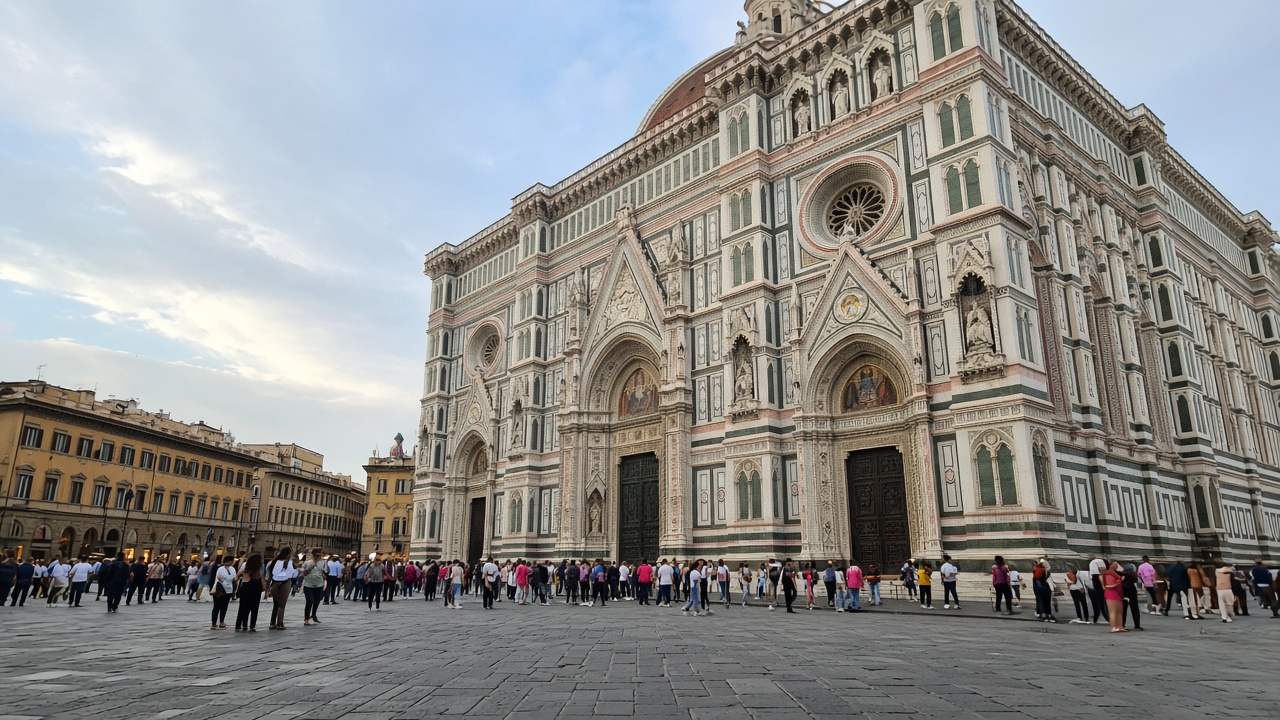
Long before the striped marble you see today, early-medieval Florence worshipped in Santa Reparata, a Romanesque basilica whose foundations still lie under the nave. Excavations in the crypt let you walk among those walls while the Gothic cathedral soars above—a literal stack of city ambition. Arnolfo di Cambio began the new cathedral in 1296; Giotto’s campanile followed; the oversized dome gap waited decades until Filippo Brunelleschi won the commission with a double-shell, herringbone-brick solution that needed no external buttress forest.
The facade you photograph is 19th-century Neo-Gothic polish on a Renaissance core—do not mistake it for a medieval original. Context helps: the 1439 Council of Florence (Ferrara–Florence Union talks) briefly made the city the diplomatic centre of Latin and Greek churches; the unfinished cathedral was the backdrop to that moment of intellectual prestige, even if the political union did not last.
For itinerary wiring, treat the Duomo as day-one anchor on a 2-day first-time Florence route, a gentler pacing option in our 3-day Florence plan with kids, or the art-heavy 5-day first-time itinerary.
Inside and around Santa Maria del Fiore
Nave, clock, and crypt
The cathedral interior is surprisingly spare—vast whitewashed walls and a floor of marble inlay panels (some sections roped off). Look for Paolo Uccello’s clock face above the west entrance: it keeps Italian ecclesiastical time. Descend to Santa Reparata when open: it grounds the “Duomo as layer cake” story better than any guidebook paragraph.
Vasari’s Last Judgment under the dome
The inner shell of Brunelleschi’s dome carries Giorgio Vasari’s Last Judgment, finished with help from Federico Zuccari—a Mannerist thunder of angels and damned souls that reads best when you tilt your head from the crossing or climb the dome gallery. It is not Michelangelo’s Sistine palette; it is Florentine civic theatre at cathedral scale.
Dome, Baptistery, and campanile—sibling guides
The cathedral is only one tile in the Opera del Duomo complex. The dome climb, mosaic Baptistery, and Giotto’s bell tower each have their own queues and Pass rules—see our dedicated Brunelleschi’s Dome guide and Baptistery of San Giovanni guide for step counts, photo angles, and Gates of Paradise context.
Practical information for visitors in 2026
Official tickets and Pass matrix
Buy only through duomo.firenze.it (Opera di Santa Maria del Fiore). Third-party sellers in Piazza del Duomo are unreliable. Free cathedral slots still need a reservation; paid Passes bundle timed entries. Names and bundles change—use the matrix below as orientation, then confirm live prices on the official site (checked 2026-09-29).
| Product | Typical inclusions | When to choose it |
|---|---|---|
| Cathedral only (free entry + timed slot) | Nave, floor, crypt (Santa Reparata) | Book a free slot on the official Opera del Duomo site; dress code enforced |
| Brunelleschi Pass | Dome climb, Baptistery, Giotto’s campanile, Opera museum, Santa Reparata | Best if the dome is your priority; dome time is fixed once booked |
| Giotto Pass | Campanile, Baptistery, Opera museum, Santa Reparata | Skip the dome climb; strong for façades + bell-tower views of the cupola |
| Ghiberti Pass | Baptistery focus + Opera museum + Santa Reparata | Lean option if you already have a separate dome ticket or plan only exteriors |
Dress code and security
Shoulders, upper arms, and knees must be covered; large backpacks may be refused or sent to a cloakroom. Skimpy summer outfits are the main reason travellers lose a timed slot at the door—carry a scarf or light wrap. Security lines merge with ticket checks at peak hours; arrive early for dome climbs especially.
Sleep in the historic centre or near Santa Maria Novella station for easy morning access—compare hotels near Piazza del Duomo. A local Florence walking or museum tour can narrate the Pass maze; self-guided works if you pre-book slots. Before flying, lock in flights, travel insurance, and an eSIM for mobile tickets at the gate.
Style check: Florence vs Milan Duomo vs Sagrada Família
These three churches get compared in every “Italy + Barcelona” trip forum—they are not interchangeable destinations, but the architecture story rhymes.
Milan Duomo is Late Gothic bristling with spires and forest-of-marble verticality; Florence’s Duomo is Renaissance engineering pride with a mathematician’s dome and a relatively calm nave. Milan rewards roof-walk lovers; Florence rewards anyone obsessed with how Brunelleschi solved a span without centring scaffolding.
Sagrada Família in Barcelona is Modernisme / Art Nouveau organic stone—Gaudí’s nature metaphors and ongoing construction. Florence is quattrocento rationalism and civic republic bravado. Visit both if you can, but pack different expectations: Sagrada is sculptural fantasy; Santa Maria del Fiore is measured geometry crowned by Vasari’s dramatic fresco cycle.
Sample morning: beat the square’s heat and queues
Piazza del Duomo compresses tour groups by mid-morning. If you hold a dome slot, treat it as the spine; fill gaps with nave and museum while clocks align.
| Time | Stop | Note |
|---|---|---|
| 08:15 | Piazza del Duomo | Coffee away from the square kiosks; check dome slot on your phone |
| 08:45 | Dome climb (if booked) | 463 steps; arrive 15 minutes before your timed entry |
| 10:15 | Cathedral nave | Free timed entry or included on your Pass; Vasari Last Judgment under the dome |
| 11:00 | Baptistery or campanile | Use remaining Pass inclusions; see our Baptistery guide for mosaic timing |
| 12:00 | Opera del Duomo Museum | Original Gates of Paradise panels and dome models—often quieter before lunch |
AlpacaBag tip: photograph the marble patterns from the south side of the baptistery before the facade glare turns harsh—then climb either the dome or campanile while your legs are fresh. Families on the 3-day with-kids route may split dome and museum across two mornings instead of one marathon block.
Duomo square without ticket stress
Tell AlpacaBag your Pass choice and dome slot—we will slot Baptistery, museums, and slow afternoons around the climb.
Ready-made routes
Routes for your destination
Day-by-day plans you can adapt to your dates right away.
FAQ
Is Florence Duomo free to enter?
The cathedral nave is free but requires a timed reservation on the official Opera del Duomo ticket site. The dome climb, campanile, Baptistery interiors, and Opera museum are paid and usually sold as Pass bundles. Never buy from unofficial touts in the square.
What is the dress code for Santa Maria del Fiore?
Shoulders and knees must be covered; hats off inside. Sheer fabric, crop tops, and very short shorts are often refused at the door even with a valid ticket. Carry a light scarf in summer—air conditioning is minimal and the nave can feel warm after the dome climb.
How long should I plan for the Duomo complex?
A cathedral-only visit is about 30–45 minutes. Add 45–60 minutes for the dome, 30–45 for the campanile, and 30–40 for the Baptistery mosaics. A full Pass morning is realistically 3–4 hours before lunch; split across two half-days if you are travelling with kids.
Which Pass should I buy?
Choose Brunelleschi if climbing the dome is non-negotiable. Pick Giotto if you want bell-tower views without the stair spiral. Ghiberti suits mosaic and Gates of Paradise fans who skip the dome. Compare inclusions on duomo.firenze.it and book dome slots weeks ahead in peak season.
Can I see the Vasari Last Judgment fresco?
Yes—the enormous Giorgio Vasari and Federico Zuccari fresco covers the interior of Brunelleschi’s double-shell dome, visible from the nave (and up close on the climb). Bring binoculars if you stay on the floor; the detail of the Last Judgment reads better from the upper gallery on the dome route.
How does the Duomo fit a first-time Florence itinerary?
Book an early dome or campanile slot, then walk to the Uffizi or Accademia on separate days. Our 2-day first-time route, 3-day with-kids plan, and 5-day deep dive all treat Piazza del Duomo as the anchor—link below in the article tail.