
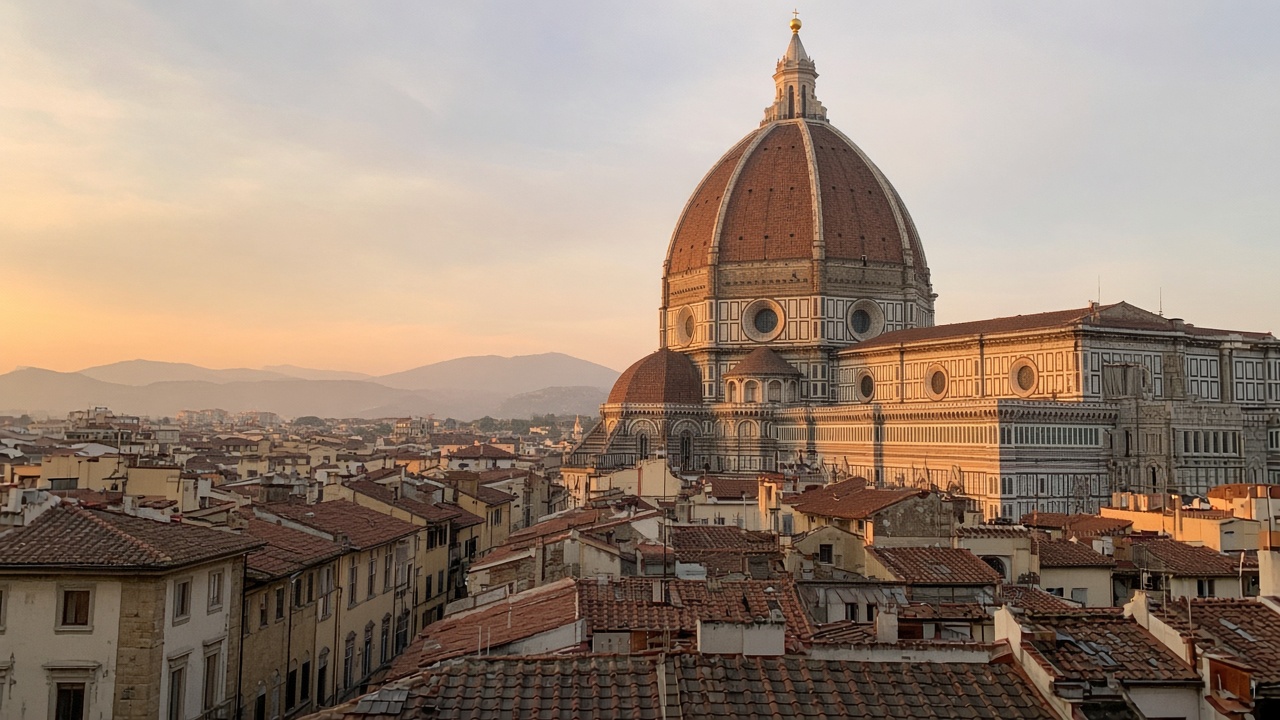
History: herringbone brick and a dome without centering
When Florence’s cathedral needed a roof over an enormous octagonal crossing, the city held a competition in 1418. Filippo Brunelleschi’s winning idea was not a single thick mass but two shells—inner and outer—linked by ribs and horizontal rings. Workers laid bricks in a herringbone (spina pesce) pattern so each course partly supported the next as the curvature grew. That made the cupola largely self-supporting: no temporary wooden scaffold filled the void beneath, a feat that still reads as engineering audacity six centuries later.
The finished dome spans roughly 45.5 metres across the inner shell and rises about 114 metres from ground to lantern—numbers worth knowing because they explain why the climb feels long yet never boring. Brunelleschi also designed machines to hoist materials; the white marble lantern he planned was finished after his death. Today the dome belongs to the Opera di Santa Maria del Fiore complex together with the cathedral nave, Giotto’s campanile, the Baptistery, and the museum—each covered in sibling guides, not repeated here in full.
If you are sequencing a first trip, slot the timed dome early, then fold the rest into our 3-day Florence itinerary for first-timers or the tighter 2-day first-time plan. Couples who want slow mornings and long dinners often prefer the pacing in our 3-day Florence itinerary for couples.
Climb logistics: 463 steps, timed slots, 45–60 minutes
The dome climb uses a dedicated entrance on the cathedral’s north side—not through the main nave doors. Your ticket shows a fixed time; staff check it at the gate. Inside, a one-way spiral route climbs between the shells, passes close to Vasari’s frescoes, and ends at the outdoor walkway around the lantern. Count on 463 steps, narrow passages, and brief waits when groups overlap at the tightest turns.
Budget 45–60 minutes door to door for a typical visit, plus 10–15 minutes of security and queue buffer in peak season. Large bags, strollers, and heels are poor choices; a small cross-body bag and trainers behave better on the stone treads. There is no lift—if knees or balance are uncertain, the campanile (included on Giotto Pass) trades stairs for a different panorama.
Checked 29 September 2026: pass names, prices, and slot release patterns change on the official Opera del Duomo channels—confirm your window the week you travel. We do not sell cathedral tickets as affiliate products.
Sleep within walking distance of the centro storico so an 08:30 dome slot stays painless— compare hotels near Piazza del Duomo and Santa Maria Novella. Want a guided context on Renaissance Florence before you climb? A half-day Florence walking or Duomo complex tour can frame the story; the stairs themselves you always walk alone. Before flying in, line up flights, travel insurance, and an eSIM for mobile tickets and maps.
Passes: Brunelleschi vs Giotto (and when to skip the stairs)
The Opera sells bundled passes rather than a lone “dome only” walk-up ticket in most seasons. Names shift slightly year to year, but the logic holds: anything with “Brunelleschi” in the title includes the cupola climb; “Giotto” bundles the bell tower instead. Baptistery and museum access often appear in both—read the current matrix before checkout so you are not paying twice for the same site.
Still deciding between cathedral details and the climb? Our Florence Duomo (Santa Maria del Fiore) guide covers nave etiquette, dress code, and interior highlights. For octagonal mosaics and the Gates of Paradise story, see the Baptistery of San Giovanni guide—the three articles share one square but three different “main events.”
| Pass (orientation) | Typical inclusions | Best if… |
|---|---|---|
| Brunelleschi Pass | Dome climb + cathedral + Baptistery + museum + bell tower | First visit when the dome is non‑negotiable |
| Giotto Pass | Cathedral + Baptistery + museum + bell tower (no dome) | Skip the stairs but still want campanile views of the cupola |
| Ghiberti Pass | Baptistery + museum + Santa Reparata (lighter bundle) | Museum and Gates focus; add dome only if you change your mind |
AlpacaBag tip: buy the Brunelleschi tier when dome slots sell out days ahead in spring and autumn; switch to Giotto only if you know you will not climb—regret at the ticket desk is common.
Photo angles: campanile, Boboli, and the square
The most detailed shots of ribbing and tile come from Giotto’s campanile, looking across at the cupola—book that climb on a different time slot so you are not racing two staircases back to back unless you enjoy suffering. At ground level, walk to the east side of Piazza del Duomo and use the Baptistery’s marble geometry as a foreground frame; early morning light keeps the red tiles saturated before the square fills.
For the postcard silhouette, take the bus or a long walk up to Piazzale Michelangelo, or enter the Boboli Gardens and climb toward the terrace above the amphitheatre—the dome floats above terracotta rooftops with the Apennines behind. Tripods are restricted in many ticketed interiors; a phone with a wide lens handles the lantern walk better than a heavy zoom in tight stairs.
Drone flights over the historic centre are effectively off limits for tourists—stick to legal viewpoints. After exterior shots, reward yourself with art indoors: pair this page with the Duomo and Baptistery guides so you know which Pass already covers each stop.
Micro day loop: Uffizi area → Duomo → Ponte Vecchio
Think of Florence’s core as a triangle: museums and Medici power along the Arno’s north bank, the religious heart at Piazza del Duomo, and the river crossing at Ponte Vecchio. The table below assumes a morning dome slot; swap museum blocks if you hold a late Uffizi reservation instead.
| Time | Stop | Note |
|---|---|---|
| 08:45 | Piazza del Duomo | Check in for your timed dome slot; separate entrance on the north side |
| 09:00–10:15 | Dome climb | 463 steps, ~45–60 minutes including the lantern lookout |
| 10:30 | Cathedral nave | Vasari’s Last Judgment under the cupola—quick interior pass if Pass allows |
| 11:15 | Baptistery & Opera del Duomo Museum | Gates copies outside; originals inside the museum |
| 13:00 | Lunch (San Lorenzo / Mercato Centrale) | Eat north of the tourist ring around the square |
| 15:00 | Uffizi area → Ponte Vecchio | River walk and goldsmith windows—no need to shop to enjoy the view |
Do not stack a dawn dome climb, a three-hour Uffizi visit, and a sunset campanile on one calendar unless you are training for a marathon. Spread heavy sights across our multi-day routes linked above; use this loop as the “Day 1 greatest hits” spine.
Lunch nearby: eat well without the square’s traps
Within 500 metres of the Duomo, menus multiply and quality thins—avoid anyone tugging you by the elbow toward a “special today” board. Better bets sit north and west: around Mercato Centrale and San Lorenzo, traders and office workers still eat lunch at counters with posted prices. Order a simple pasta or lampredotto if you want a Florentine staple; sit-down trattorie on side streets off Via de’ Cerretani often beat the piazza fronts on value.
After lunch, walk off the carbs toward Via Roma or the Oltrarno if you have energy— Ponte Vecchio is prettier when you are not hangry. Save gelato for after the Baptistery loop so sugar does not meet 463 steps on an empty stomach. Water fountains (nasoni) are free; refill before the climb.
When you are ready to automate timing—dome slot, museum entry, and a sane dinner window— open AlpacaBag on Florence or jump into the 2-day first-time route.
Dome slot + city loop, without spreadsheet chaos
Tell AlpacaBag you want the Brunelleschi climb, Baptistery, and an afternoon toward Ponte Vecchio—it will keep buffer time for stairs and lunch.
Ready-made routes
Routes for your destination
Day-by-day plans you can adapt to your dates right away.
FAQ
How many steps are there to the top of Brunelleschi’s Dome?
The official climb is 463 steps. There is no elevator—the route follows narrow corridors between the inner and outer shells, then opens at the lantern for a 360° view over Florence. Plan 45–60 minutes from the timed entry to exit, not counting security.
Do I need a timed reservation for the dome?
Yes. The cupola uses a separate entrance and strict time slots sold through the Opera di Santa Maria del Fiore ticket system (Brunelleschi Pass or equivalent dome add-on). Arrive early for bag check; late arrivals may lose the slot with no refund.
Brunelleschi Pass or Giotto Pass—which should I buy?
Choose Brunelleschi if climbing the dome is the reason you came. Choose Giotto if you prefer the bell tower view of the cupola and want to skip 463 stairs. Both include the cathedral and Baptistery in typical bundles—compare current names and inclusions on the official site before paying.
Is the dome climb suitable for children or anyone with vertigo?
Kids who can walk steadily for an hour often manage it; strollers and large backpacks are not allowed. The final lantern platform is exposed and windy—skip it if you are uncomfortable with heights or tight spiral stairs. There is no “step out” shortcut mid-climb.
Where is the best free photo of the dome?
From Giotto’s campanile (ticketed) you look across at Brunelleschi’s ribs; from Piazzale Michelangelo or the Boboli Gardens terrace you get the classic city silhouette at sunset. In Piazza del Duomo itself, stand back toward Via dei Servi for the full octagonal base.
Do I need a Schengen visa for Italy?
Italy is in the Schengen Area. Many passports enter visa-free for short stays; others need a Schengen visa through the Italian consulate or a visa service. Check your nationality’s rules before booking non-refundable dome tickets and flights.