
Three places, and only one of them is this trip
Checked 17 November 2026 against the museum's hours page, access page, and visiting rules. The address on those pages is 3-7-1 Sakuracho, Koganei-shi, Tokyo, inside Koganei Park. Phone 042-388-3300. Hours, closures, and the fare move. Read them again the morning you go.
The English name is the Edo-Tokyo Open Air Architectural Museum. In Japanese it is Edo-Tokyo Tatemono-en. Search that, or "Koganei open air museum." A search for "Edo-Tokyo Museum" alone often drops the pin on the indoor museum in Ryogoku. That is a different building, in Sumida, with its own ticket. The museum's outline calls the Koganei grounds an annex of that institution, opened in 1993 on about seven hectares. Related on paper. Not the same afternoon.
The Studio Ghibli Museum is a third place: Inokashira Park in Mitaka, one stop cluster east of Koganei on the same Chuo Line, and a dated ticket that sells out. How those tickets actually go on sale is the Ghibli Museum ticket guide. Nothing you buy in Koganei gets you through the Mitaka gate. Visitors still recommend this park when that date is gone, because the East Zone is a relocated Shitamachi street and the 1929 bathhouse Kodakara-yu is the building people compare with the bathhouse in Spirited Away. The museum's own pages do not call the site a Ghibli museum. Do not book it as one.
| Place | Where | What you came for |
|---|---|---|
| Ghibli Museum | Mitaka, Inokashira Park | A dated ticket, often already gone |
| Open-air architectural museum | Koganei Park, Sakuracho | Wooden houses you walk through |
| Edo-Tokyo Museum | Ryogoku, Sumida | The indoor downtown museum |
Hours, Mondays, and 17 November 2026
April through September the posted hours are 9:30–17:30. October through March they are 9:30–16:30. Last admission is 30 minutes before closing, so 16:00 while the winter hours are the ones on the board. 17 November 2026 falls in that October-to-March window.
The standing closure is every Monday. When Monday is a national holiday, the museum closes the following day instead. New Year holidays are closed as well. The FY2026 event schedule says the museum is closed from 25 December 2026 through 1 January 2027 and reopens on 2 January 2027. That note can change. It is not a reason to skip the hours page.
17 November 2026 is a Tuesday. The day before is an ordinary Monday, not Labour Thanksgiving Day (23 November). The Monday rule closes the 16th, not the 17th, unless the calendar has a special closure that is not on the pages checked today. There is no evening opening on the 17th. The illuminated evening on that same schedule is 6 and 7 November 2026, with last admission at 20:00 on those two nights only.
Admission is the museum's own ticket. The number is on the admission page. This guide does not repeat it. You can buy a same-day ticket at the counter. The site also sells a ticket for a chosen date, with no entry time. That is not the Ghibli Museum lottery, and a quiet Tuesday is not the day the museum tells you to reserve first. On the November evening dates it does.
From Shinjuku or Tokyo Station
The straightforward ride is the JR Chuo Line to Musashi-Koganei, then a Seibu bus. Use a train whose board lists Musashi-Koganei. Faster Chuo services can skip the stop. The JR East timetable for Musashi-Koganei is the board that matters, not a minute copied from October.
Two rapids on the JR East pages for late October 2026 are enough to size the ride. One left Shinjuku at 22:30 and reached Musashi-Koganei at 22:54. Another left Shinjuku at 17:41 and arrived at 18:12. The same trains left Tokyo Station at 22:16 and 17:27. On those two trains that is 24 and 31 minutes from Shinjuku, and 38 and 45 minutes from Tokyo Station. Check the morning you travel. An IC card pays the train. The amount is on the gate.
At Musashi-Koganei use the north exit. Seibu bus stop 2 is 武12 and 武13. Stop 3 is 武21 and 武15. Get off at Koganei-koen Nishi-guchi and walk about 5 minutes. The museum describes the bus itself as about 5 minutes. Pay with the same IC card. Do not copy a fare from a blog.
If you get off one stop early, Higashi-Koganei has the CoCo bus to Tatemono-en Iriguchi, then about a 10-minute walk. From Hana-Koganei on the Seibu Shinjuku Line, a Seibu bus also stops at Koganei-koen Nishi-guchi. Both are on the access page. Neither is simpler than the Chuo Line from Shinjuku when you are starting in central Tokyo. A car can use Koganei Park's parking, and the museum warns that weekend roads clog. The train is the plan.
What you actually walk through
You enter at the Visitor Center, the old Kokaden hall. It was built in 1940 in front of the Imperial Palace as a temporary ceremony building, moved to what is now Koganei Park in 1942, and rebuilt as the museum entrance. Lockers there are free. Leave the suitcase and the umbrella. Umbrellas stay out of the houses. The desk, a short introductory exhibit, a library, and a shop and cafe are in this building before you go outside.
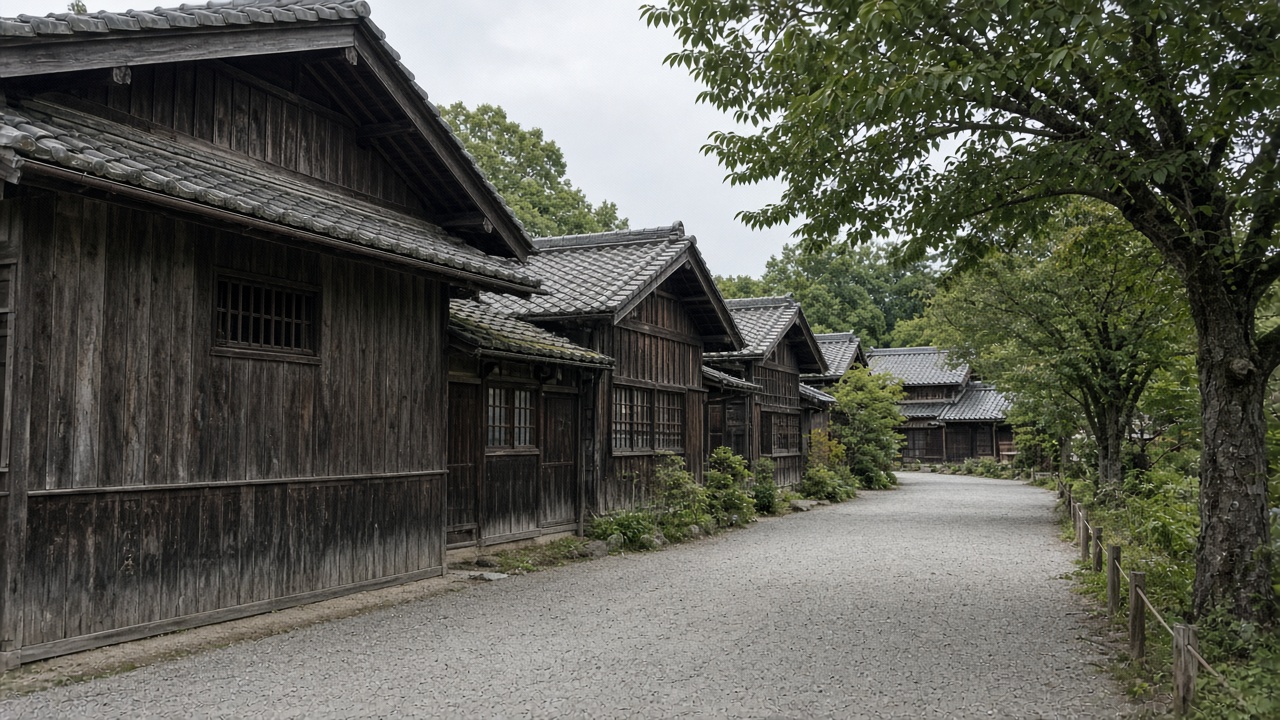
The East Zone is the Shitamachi street. Shops moved from around Tokyo line a lane: the Kodera soy-sauce shop, the Takei Sanshodo stationery store, the Maruni Shoten kitchenware shop, the Kagiya bar, a flower shop, a grocery, a tailor, and the brick police box from Mansei Bridge. Kodakara-yu, built in 1929 in Senju-motomachi, Adachi, is the public bath. You can go inside. The tubs are empty exhibits, not a working bath, and not a film set with a ticket. Food and drink belong at the old warehouse-style rest house in this zone, including the Kura noodles upstairs, not inside the historic rooms.
The West Zone is the quieter lane of houses, the one the museum calls its Yamanote street, plus thatched farmhouses farther on. The Tsunashima family farmhouse is a mid-Edo thatched house from Setagaya. The Koide house (1925) and Kunio Mayekawa's own house (1942) are the modern houses. The House of Georg de Lalande, extended around 1910, has the Musashino Sabo cafe. The Center Zone, around the entrance, holds the Korekiyo Takahashi house from Akasaka (1902) and the Jisho-in mausoleum (1652). The museum does not hand out slippers. Follow the shoe notice on each building.
Seven hectares is an afternoon, not a twenty-minute add-on between Shinjuku and a sunset deck. Do not pair it with Mitaka on the same morning unless you already hold a Ghibli Museum ticket for a time that still fits. If the west-of-Tokyo train is more than you want, the separate choice among Kamakura, Nikko, and Mount Takao is the quieter one-day trips from Tokyo. Those are different days. They are not a second stop after Koganei.
What the photo rule actually says
Snapshots of the reconstructed buildings and the exhibits are the ordinary visit. The visiting page asks you not to stay in one place so long that other people cannot see the room. Staff can stop you if you block a doorway, monopolize a corner, or get in the way of the houses.
Tripods, monopods, selfie sticks, and flash are prohibited inside the buildings, including the preserved city train, and on the grounds. Reflectors, extra lights, and props stay outside. A shoot with a model, or anything commercial, is something the museum can question and stop. Marked exhibits are off limits even for a phone. The page also starts a rule about photographing other visitors. Read that line before you point a camera at a stranger. Do not touch the objects. The houses are wood, smoking is only in the posted area near the noon cannon in the Center Zone, and open flame is banned.
Where to sleep, and what not to bolt on
Sleep near the station you will leave from. Shinjuku is the simple Chuo Line platform. Tokyo Station works if you are already there and you check that the train stops at Musashi-Koganei. A hotel by that station is the 9:30 opening, not a cross-town transfer that lands you at the gate after lunch. The park is a day trip from central Tokyo. It is a poor reason to move the whole stay to Koganei unless you want a quiet suburban night.
A travel eSIM is how you open the JR East board and the bus-stop numbers at Musashi-Koganei without hunting for wifi. It is not a ticket, and it does not pay the bus by itself. Keep the IC card for the fare.
Put the houses on a Tokyo day you can actually finish, such as a Tokyo day for architecture or a Tokyo day for history. Come back on the same Chuo Line. Do not add Ryogoku, Mitaka, and Koganei to one date because the names look related.
Want Koganei on a Tokyo plan, and Mitaka only if a Ghibli Museum date is actually in hand?
Build an itineraryReady-made routes
Routes for your destination
Day-by-day plans you can adapt to your dates right away.


FAQ
Is the Edo-Tokyo Open Air Architectural Museum the Ghibli Museum?
No. The Studio Ghibli Museum is in Inokashira Park in Mitaka and sells its own dated tickets. The open-air museum is in Koganei Park, at 3-7-1 Sakuracho, Koganei. A ticket there does not admit you to Mitaka. People go when the Mitaka date is gone because the grounds are relocated Tokyo buildings, including the 1929 public bath Kodakara-yu.
Is this the Edo-Tokyo Museum in Ryogoku?
No. The Edo-Tokyo Museum in Ryogoku is the large museum in Sumida. The open-air museum is the annex in Koganei: houses moved onto about seven hectares inside Koganei Park. The museum’s own outline, checked 17 November 2026, calls the Koganei site the Tokyo Metropolitan Government Edo-Tokyo Museum Annex, opened in 1993. Different station, different ticket, different day. Do not follow a pin that lands in Ryogoku.
What are the hours, and is 17 November 2026 open?
On the hours page checked 17 November 2026: April to September 9:30–17:30, October to March 9:30–16:30, last admission 30 minutes before closing. Closed every Monday, or the following day when Monday is a national holiday, plus New Year holidays. 17 November 2026 is a Tuesday, so the Monday rule does not close it, and the October-to-March hours apply. The FY2026 event note says the museum is closed 25 December 2026 through 1 January 2027 and reopens 2 January 2027. Read the calendar again the day you go.
How do I get there from central Tokyo?
Take a JR Chuo Line train that lists Musashi-Koganei. From the north exit, Seibu bus stop 2 (武12 or 武13) or stop 3 (武21 or 武15) to Koganei-koen Nishi-guchi, then a 5-minute walk. The museum calls the bus ride about 5 minutes. On JR East samples from late October 2026, one rapid left Shinjuku at 22:30 and reached Musashi-Koganei at 22:54, and another left at 17:41 and arrived at 18:12. Tokyo Station on those same trains was 22:16–22:54 and 17:27–18:12. Those are examples, not the 17 November timetable.
Can I take photos?
Ordinary snapshots of the buildings and exhibits are allowed. Do not block a doorway or stay in one spot. Tripods, monopods, selfie sticks, and flash are prohibited in the buildings, including the preserved city train, and on the grounds. Extra lights, reflectors, and props are not allowed. Some marked exhibits are off limits for photos. Staff can ask you to stop. Read the museum’s visiting rules the week you go.
How much is admission?
The price is on the museum’s admission page. This guide does not copy it. Same-day tickets are sold at the counter, and the site also sells a ticket for a chosen date. That is a date, not a timed entry like the Ghibli Museum. Read the page the week you go. Busy days, including the November evening opening on 6 and 7 November 2026, are when the museum itself tells you to buy ahead.