
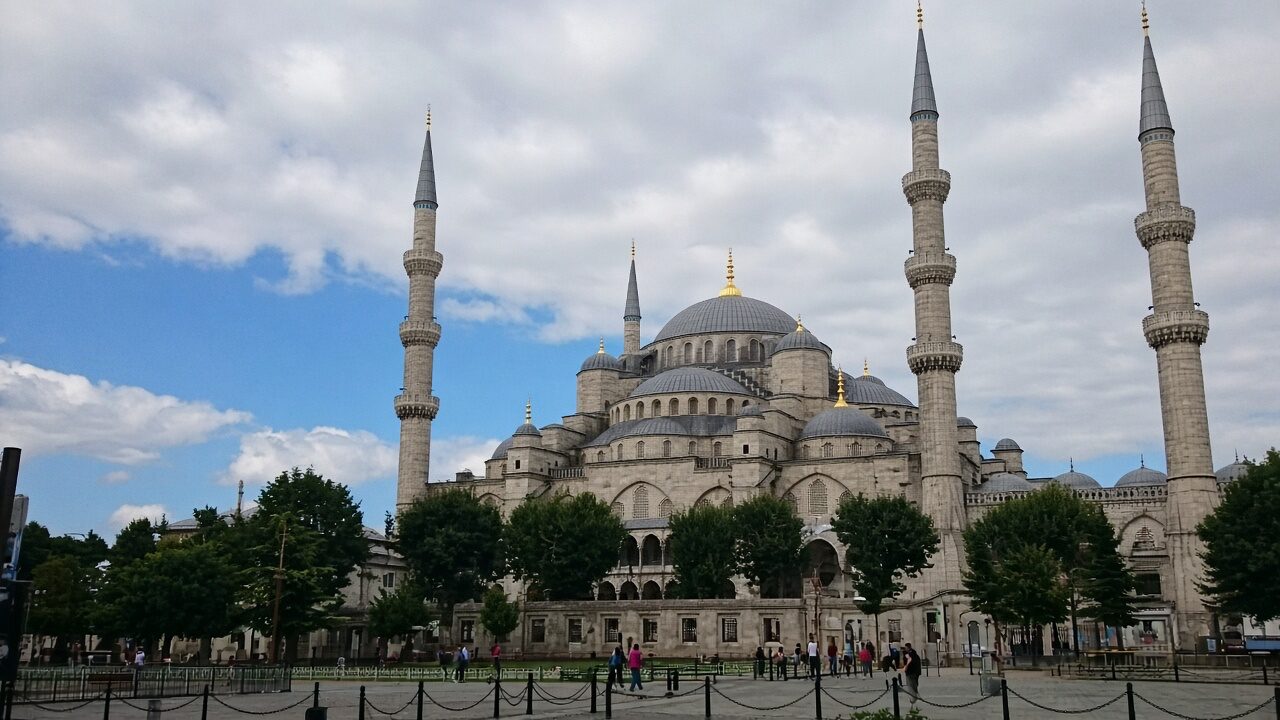
The Blue Mosque on Sultanahmet Square
Its formal name is Sultan Ahmed Mosque, or Sultanahmet Camii. European travellers supplied the blue nickname after seeing the Iznik tiles inside. From the square it appears to answer Hagia Sophia, yet architect Sedefkar Mehmed Agha was not making a copy. He arranged a classical Ottoman mosque around one central dome supported by a cascade of semi-domes.
Take tram T1 to Sultanahmet and approach along the former Hippodrome. The German Fountain, Egyptian Obelisk and Serpent Column show that this open ground was important long before the mosque. Signs direct cultural visitors toward the current entrance, while staff keep the sightseeing and worship flows separate.
The building functions first as a place of prayer. That determines the visit: you do not race for a ticket office, but arrive in a window between prayers. Checked on 1 October 2026, independent admission remained free and daily worship continued to take priority over sightseeing.
Courtyard, cascading domes and six minarets
Do not hurry straight into the prayer hall. The courtyard is the clearest place to understand the architecture. A domed arcade frames the open space and a fountain marks its centre. Move toward a corner to see the semi-domes stepping upward until they meet the main dome, the composition that makes the building seem to rise naturally from the square.
Six minarets were an emphatic statement in the early seventeenth century. A popular story blames confusion between the Turkish words for gold and six, but it is safer to enjoy that as folklore. The young Sultan Ahmed I intended an imperial complex that would stand confidently beside the older monuments of Constantinople.
On the western approach, look for the chain above the entrance once used by the mounted sultan. Tradition says it obliged him to lower his head before entering sacred ground. Even when the queue moves quickly, reserve ten minutes for the courtyard; tour groups obscure the interior, while the geometry outside remains legible.
Where to find the blue in the Iznik tiles
The dome and low chandeliers command attention when you enter, but the nickname comes from ceramics higher on the walls. Iznik tiles carry tulips, carnations, rosettes and cypress forms. Blue and turquoise dominate, joined by red and green, while daylight from many windows softens the entire pattern.
The lower visitor area may look less blue than postcards suggest. Raise your eyes around the windows and galleries. Step back from the barrier so individual motifs merge into broad bands. Phone cameras often intensify blue, so look beyond the screen before deciding whether the name feels deserved.
The carved marble mihrab indicates the direction of Mecca, and the minbar beside it is used for the Friday sermon. Calligraphy, light and ceramic pattern are not separate museum displays; together they shape a room built for worship. Put the camera down for a moment and notice how the atmosphere changes when a group leaves.
Free admission, paid guides and the carpet underfoot
There is no Blue Mosque admission ticket. If a website sells one, inspect the contents: it is normally a guide, audio commentary or a package including another paid attraction. Interpretation can be worth buying, but it does not bypass security and cannot keep the mosque open through prayer.
Everyone removes shoes before the hall because the floor is a prayer carpet. Bags for footwear are normally supplied; carry yours or place it where staff instruct. Walking on the carpet is not a paid tier. Donations are voluntary. Anyone demanding payment specifically for independent entry or carpet access is not describing the mosque's free admission system.
The carpet is a working surface on which people prostrate in prayer, not an exhibit or photo set. Do not place a street-soiled bag on it or lie down for a picture. Wear clean socks and shoes that come off easily; a small practical choice prevents a bottleneck for everyone behind you.
Five daily prayers, Friday and the dress code
Prayer times shift slightly every day because they follow the sun. Cultural visitors wait outside or leave the hall while worship takes place. Friday midday prayer creates a longer pause and a larger congregation. A fixed timetable copied from an old travel blog is less useful than the notice posted at the entrance for that date.
Everyone covers shoulders and knees, and women cover their hair. Loan garments are often available, but your own scarf and long clothing are more comfortable. Transparent fabric, a deep neckline or short shorts do not become suitable simply because one loose wrap has been added.
Speak quietly, disable the flash and never take close photographs of people praying without permission. The visitor area may be marked by a barrier; stepping beyond it for an unobstructed picture is disrespectful. Children are welcome, but explain before entry why running across the carpet is not appropriate.
One hour from the Hippodrome to the prayer hall
Start at the German Fountain, walk the Hippodrome and inspect the exterior silhouette. Give the courtyard ten minutes, the interior around half an hour and keep ten minutes for security and shoes. If a prayer pause begins, visit Arasta Bazaar behind the southern wall rather than crowding the gate, then return for the next window.
Hagia Sophia faces the mosque but follows a different system: cultural visitors use its paid upper gallery. Read the details in our Hagia Sophia guide. A tea break between the two interiors helps their mosaics, tiles and domes remain distinct memories.
After Sultanahmet, descend toward Eminonu for a fish sandwich or choose a slower meal with the Istanbul food guide. Save Suleymaniye for another walk if you want a second imperial mosque and a broad city view; squeezing it into the same hour does neither building justice.
Where to stay
A convenient base can simplify an early start; compare location before price.
Build a Sultanahmet walk
Allow for worship windows, courtyard time and Hagia Sophia's separate rules without buying a ticket that the Blue Mosque does not require.
Ready-made routes
Routes for your destination
Day-by-day plans you can adapt to your dates right away.
FAQ
Do you need a ticket for the Blue Mosque?
No. Independent entry to the working mosque is free and requires no reservation. A paid online product covers a guide, audio commentary or a combination tour; it is not an admission ticket and cannot bypass security.
When is the Blue Mosque closed to tourists?
Sightseeing pauses for the five daily prayers, with a longer interruption around Friday midday prayer. Prayer times move with the sun, so use the schedule for your exact date rather than fixed year-round opening hours.
Why do visitors remove their shoes?
The prayer hall is covered wall to wall with carpet used for worship. Remove shoes before entering and carry them in the supplied bag or place them where staff direct. Clean socks and simple footwear make the process easier.
Where are the famous blue tiles?
Look above the lower walls, around windows and across the galleries. The Iznik designs include tulips, carnations and cypress motifs in blue, turquoise, red and green; daylight brings out their softer colour.
How long do the courtyard and interior take?
Allow 45 to 60 minutes when no prayer pause intervenes. That leaves time for security, the courtyard, shoe removal and a quiet look at the interior rather than only a quick photograph.