
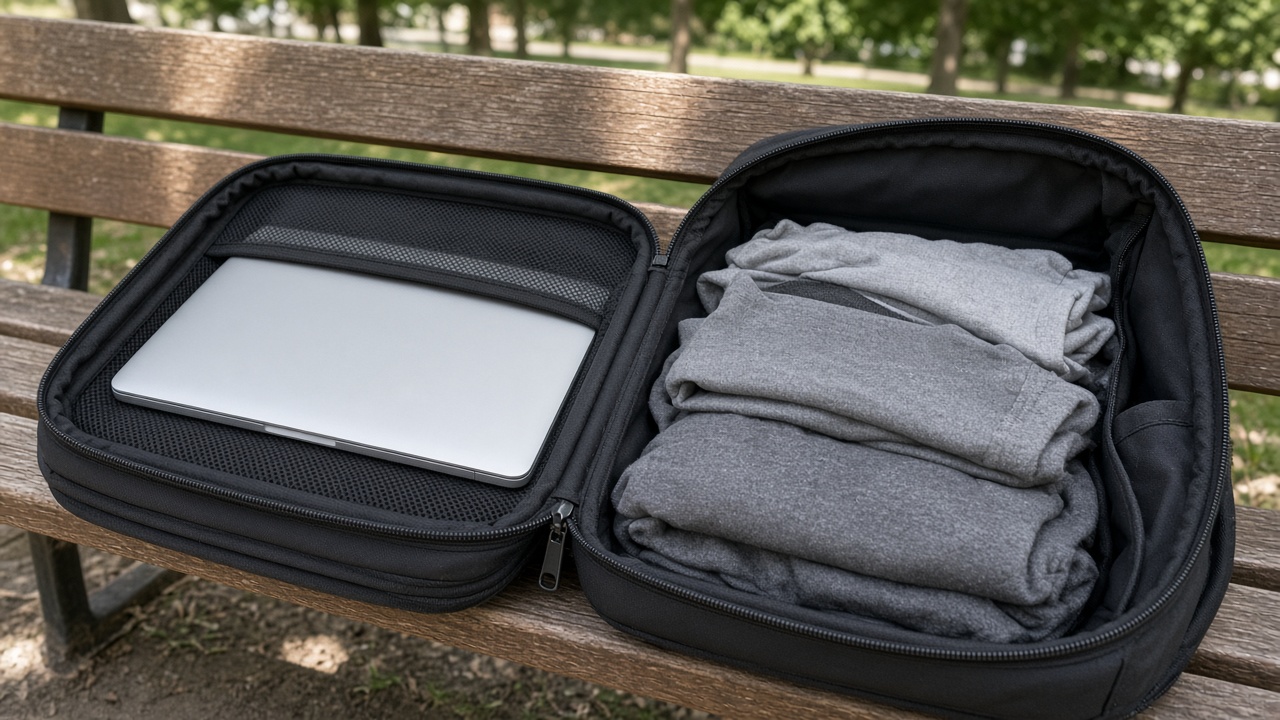
The tray still wants the laptop
People shop for a “TSA-friendly” laptop backpack because the belt is slow and the laptop is at the bottom. The bag can fix the second problem. It does not cancel the first rule.
TSA’s laptop page, last updated 15 July 2026, allows a laptop in carry-on and in checked bags, then says: please remove the laptop from your bag and place it in a separate bin for X-ray screening. The same page says TSA PreCheck travelers do not need to remove shoes, laptops, 3-1-1 liquids, belts, or light jackets. The final decision rests with the TSA officer.
The security screening page widens that to personal electronic devices larger than a cell phone. The examples on that page are laptops, tablets, e-readers, and handheld game consoles. They go in a bin with nothing placed on or under them. Hair dryers, electric shavers, and electric toothbrushes are named as items that are not in that group. TSA also says it uses unpredictable measures and that no one is guaranteed expedited screening.
So the honest product claim is speed. If the lane wants the laptop out, a bag that opens flat saves the dig. If the lane wants it in, you leave the bag closed. Either way the hangtag is not the instruction.
Clamshell versus top-load
A clamshell backpack unzips like a book. The laptop sleeve is usually on the back panel. One open, and the computer is a lift, not a search. Clothes stay in the other half. A top-loader opens at the mouth. The laptop sits under the clothes. You move shirts, pull the computer, then rebuild the bag on the far side of the belt while the next person waits.
| Opening | Sign says: laptop out | Sign says: leave it in |
|---|---|---|
| Clamshell | Lay it open, lift the closed laptop into its own bin. Clothes stay put. | Leave it zipped. If an officer points, it still comes out in one motion. |
| Top-load | Pull the clothes aside, fish the laptop out, repack after the scanner. | Leave it zipped. If an officer points, you dig while the belt waits. |
An open clamshell with the laptop still in the sleeve is not “removed.” The screening page wants the device in a bin with nothing on it or under it. Take the bare laptop. A sleeve, a mouse, and a coil of cable on top of the computer are how a bag comes back for a second look.
Pack the clamshell so that motion stays short. Laptop in the sleeve, closed, not in a thick case plus the sleeve. Cables in a side pocket. Clothes in the other half. On a top-loader, put the sleeve against the back and one layer of clothes over it, so the pull is one handful, not a full unpack. That is still slower. It is the same rule.
“TSA approved” is marketing
“TSA approved” and “TSA friendly” on a backpack product page are sales language. They usually mean the main compartment lies flat, or that a laptop panel folds out toward the belt. They are not a certificate that this bag may stay closed in a standard lane.
TSA publishes the screening rule. It does not publish a list of backpack shapes that skip the bin. If a shop says the bag is approved, read that as a description of the zipper, then check the laptop page for the lane you will actually stand in. A fold-out panel does not override an officer who points at the tray.
The useful test in a shop is physical. Can you get a closed laptop out with one hand while the bag is on a bench? If you have to unbury it, the security line will feel the same. Litres on the hangtag do not answer that.
When the laptop stays in the bag
Three situations, and none of them is “because the bag is a clamshell.”
TSA PreCheck. The laptop page says those travelers do not need to remove the laptop. Look for the indicator on the boarding pass and the PreCheck lane. The screening page says expedited screening is not guaranteed. If the officer asks, the laptop comes out. A clamshell is then the bag that does not stall the lane.
A CT scanner lane. Some checkpoints have replaced the older X-ray with a computed tomography scanner and posted that liquids and large electronics stay in the bag. Aviation Week, on 23 June 2026, reported that TSA confirmed passengers screened in lanes with CT units do not need to remove their travel-size liquids bag or electronics, and that a nationwide rollout is not in place. TSA’s laptop page was updated later, on 15 July 2026, and it still tells you to remove the laptop. Treat the laptop page as the default and the sign in front of you as the exception. Do not unpack “just in case” when that sign says leave it in. Do not assume the next airport has the same machine.
A European airport is not a TSA checkpoint. Heathrow’s security page says the airport has upgraded its scanners and that you can keep laptops, tablets, and other large electronics in the cabin bag, with liquids in containers of up to 2 litres. The same page says not every airport uses the same equipment, and that you should check the local rules when you fly from somewhere else. Zurich Airport told Aviation Week that from 26 June 2026 liquids and electronics would stay in the bag at every lane for passengers who start their trip there. The same article reports that the European Commission describes this as a progressive lifting, tied to approved CT scanners at that airport. Brussels, in that report, was still planning scanners for 2028. Rules change. Read the airport on the boarding pass.
What else comes out
If the lane is a standard “larger than a cell phone” lane, the tablet, the e-reader, and the handheld game console follow the laptop. They each want a clear view, with nothing on them or under them. A second laptop is a second bin, not a reason the backpack is special.
A phone is not in that example list. The screening page draws the line at devices larger than a cell phone. Empty your pockets when the officer says so. Do not invent a second rule that the phone must ride in the laptop bin.
The laptop page also allows a laptop in checked baggage. That does not make the hold the plan for the computer you want at the tray. The bag in your hand is the one this page is about. Take medicine, documents, and the laptop out before a bag is taken away from you at a gate for any other reason.
The airline box is a different test
Security and the airline sizer do not grade the same thing. A clamshell that opens fast can still be too deep for the free under-seat bag. The laptop against the back panel is the bulge. Measure the bag after that laptop is in the sleeve, not the empty hangtag.
The personal-item backpack guide puts published pack sizes next to the under-seat box. None of those packs is a promise at the gate. The Wizz, Ryanair, and easyJet page is the three boxes those help centres printed on 17 November 2026, and they do not measure the box the same way. A bag built only for a US checkpoint can fail a European sizer the next morning. The opening style does not change the centimetres.
If the flight is this week
Read the security page for the airport on the ticket. A US standard lane: laptop out, alone in the bin, nothing on it or under it. A PreCheck indicator on the pass: the laptop page says you do not need to remove it, and an officer can still ask. Heathrow, as of this check: leave the laptop in, and do not assume the airport you fly home from has copied that. Anywhere else: the sign at the lane wins over the hangtag.
Then choose the opening for the lane you are most likely to meet. If you often stand in a “laptop out” line, a clamshell is the faster pair of hands. If every airport on this ticket already says leave it in, a top-loader is not a mistake. Either bag still has to fit the airline. The city comes after the bag, not from it.
Plan the cities first. Pack the laptop where one hand can reach it.
Build an itineraryReady-made routes
Routes for your destination
Day-by-day plans you can adapt to your dates right away.
FAQ
Do I still take the laptop out of a clamshell backpack?
In a standard TSA lane, yes. The laptop page, updated 15 July 2026, says to remove the laptop and place it in a separate bin for X-ray screening. A clamshell only makes that faster. TSA PreCheck travelers are told they do not need to remove it, and the officer can still ask. Checked 17 November 2026.
Does “TSA approved” on a backpack let me leave the laptop in?
No. That phrase on a product page is marketing. TSA does not certify a backpack shape as a pass to skip the bin. The laptop page is the default rule. The sign at your lane, and the officer, can make an exception. The zipper does not.
When can the laptop stay in the bag?
TSA PreCheck travelers do not need to remove laptops, and TSA says no one is guaranteed expedited screening. Some lanes with CT scanners tell you to leave electronics in the bag. Aviation Week reported on 23 June 2026 that TSA confirmed passengers in lanes with CT units do not need to remove the travel-size liquids bag or electronics. Follow the sign at that lane.
Is a European airport a TSA lane?
No. TSA is a US agency. Heathrow’s security page says you can keep laptops, tablets, and other large electronics in the cabin bag. Heathrow also says other airports differ. Zurich Airport told Aviation Week the same leave-it-in rule would start on 26 June 2026 for passengers who begin their trip there. The European Commission has described the change as progressive, airport by airport.
Does the opening change the under-seat size?
No. A clamshell and a top-loader face the same box. A laptop against the back panel is what makes the bag bulge. Measure the packed bag. The personal-item backpack guide compares published pack sizes with the under-seat box. The Wizz, Ryanair, and easyJet page is the three boxes. A bag that opens quickly and then fails the sizer still fails.