
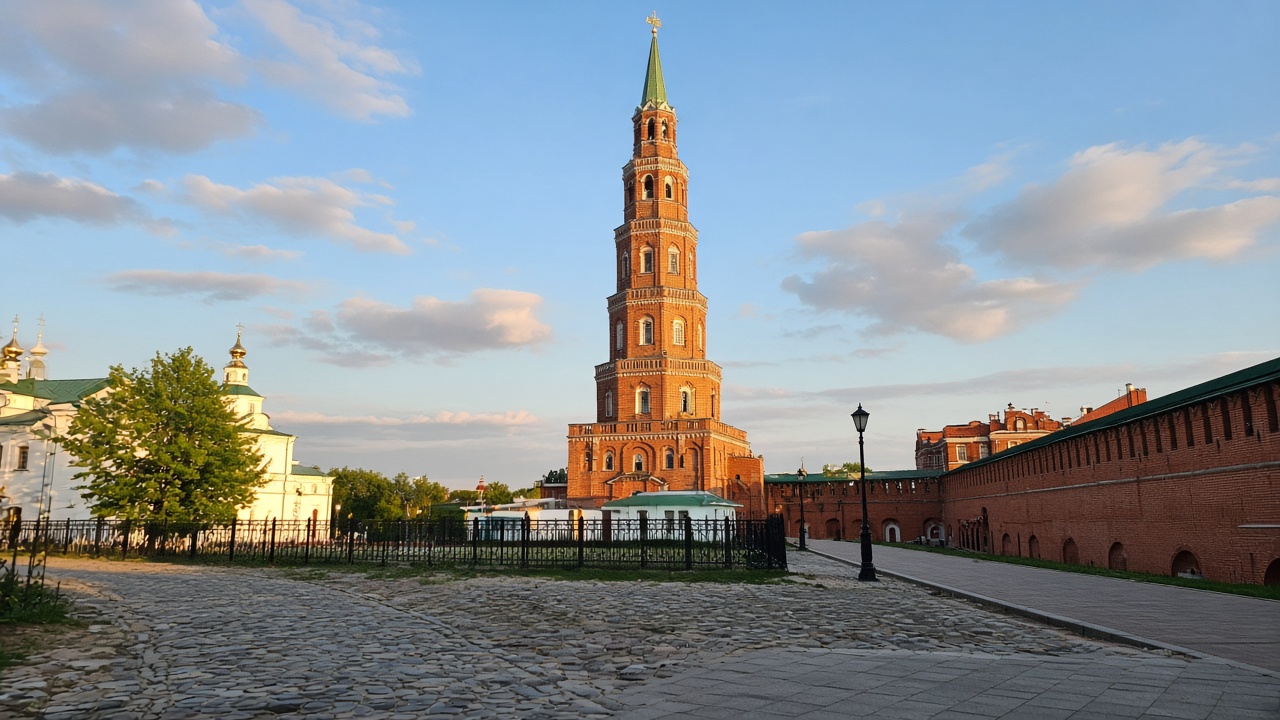
Who built the tower, and when?
Syuyumbike stands inside the Kazan Kremlin, a UNESCO site and the city’s historical core. Museum texts usually point to the mid-1700s, while tours still mention Ivan the Terrible—worth treating as story vs. archive.
| Version | Attribution | Note |
|---|---|---|
| Mid-18th century (1767–1775) | Linked to Catherine II’s era | The date most museum handouts use |
| “Ivan the Terrible” tale | Folk tradition | Historians treat it as an anachronism |
| Watchtower role | Military / administrative | Narrow windows and tiers fit a lookout more than a palace |
A few minutes away, the Tatarstan Museum of Natural History adds geological and ethnographic context after you see the tower.
The Syuyumbike legend: fact or fiction?
The famous plot involves a queen forced to marry, golden gates promised as a condition, and a tragic fall from the height. It anchors many tours but is not an 18th-century document.
A gentle local habit is touching the brick and making a wish—do it respectfully; the monument is protected and photo queues get long in season. For Tatar culture after the Kremlin, continue to Tugan Avylym or grab kystybyi at Tyubetey on Kremlevskaya.
The “leaning tower”: architecture and tilt
Roughly 58 m high, seven tiers, brick and stone. References often cite about 1.98 m of top offset—hence the Pisa comparisons in brochures. Geologists and restorers discuss soil layers, foundation movement, earthquakes, and drainage over centuries.
- Sundial on the south face
- Zodiac motifs on the tiers
- Axis shift vs. the foundation (the “leaning” effect)
- Brickwork at the base without heavy cosmetic overlays
Open platforms behind the tower can be windy—pack a light layer even in summer.
What to see nearby: a Kremlin route
A straight line without extra loops: Spasskaya Tower → Kul Sharif → Syuyumbike → Farmers’ Palace terrace and fountain.
| Stop | Time | Note |
|---|---|---|
| Spasskaya Tower (entry) | 10–15 min | Security, Kremlin map |
| Kul Sharif Mosque | 40–60 min | Separate visitor rules |
| Syuyumbike Tower | 30–40 min | Facade, sundial, lean angle |
| Farmers’ Palace | 20–30 min | Terrace and fountain shot |
Add urban contrast later: the Kaban Lake embankment, the National Library viewpoint, or a family day in Kazan.
Compare flights to Kazan, a hotel near the Kremlin or Kremlevskaya metro, and a guided Kremlin tour for context and queue savings.
Make Syuyumbike the anchor of your day
Tell AlpacaBag your pace—it links the Kremlin, embankment, and viewpoints without extra transfers.
Getting there, hours, and budget
Nearest metro: Kremlevskaya. Strolling open Kremlin squares is traditionally free; mosques and museums charge separately (often from ~250–350 RUB—check kazan-kremlin.ru). Hours shift by season and events.
On a second day consider Kamskoye Ustye for a quiet historic outing. Add travel insurance for longer trips.
FAQ
Can you go inside Syuyumbike Tower?
Climbing the tower is usually not open to tourists—it is a monument on Kremlin grounds. Exterior viewing from surrounding squares is free during Kremlin opening hours.
How much does it lean?
Museum references often cite about 1.98 m of top offset from vertical. Stand to one side and compare the silhouette with neighboring walls to see it clearly.
How long for the Kremlin including Syuyumbike?
Plan at least half a day: 2–3 hours for walls and squares plus 1–2 hours for Kul Sharif or the natural history museum. AlpacaBag can chain this with the embankment or library viewpoint.
How do you reach the Kremlin?
Metro Kremlevskaya, then walk into the historic core. Taxis work well from the station or airport; inside the Kremlin you walk only.
Is the queen’s leap legend true?
It is a romantic 19th-century story, not a documented fact. Enjoy it as city folklore, but rely on museum texts for dates and architecture.