
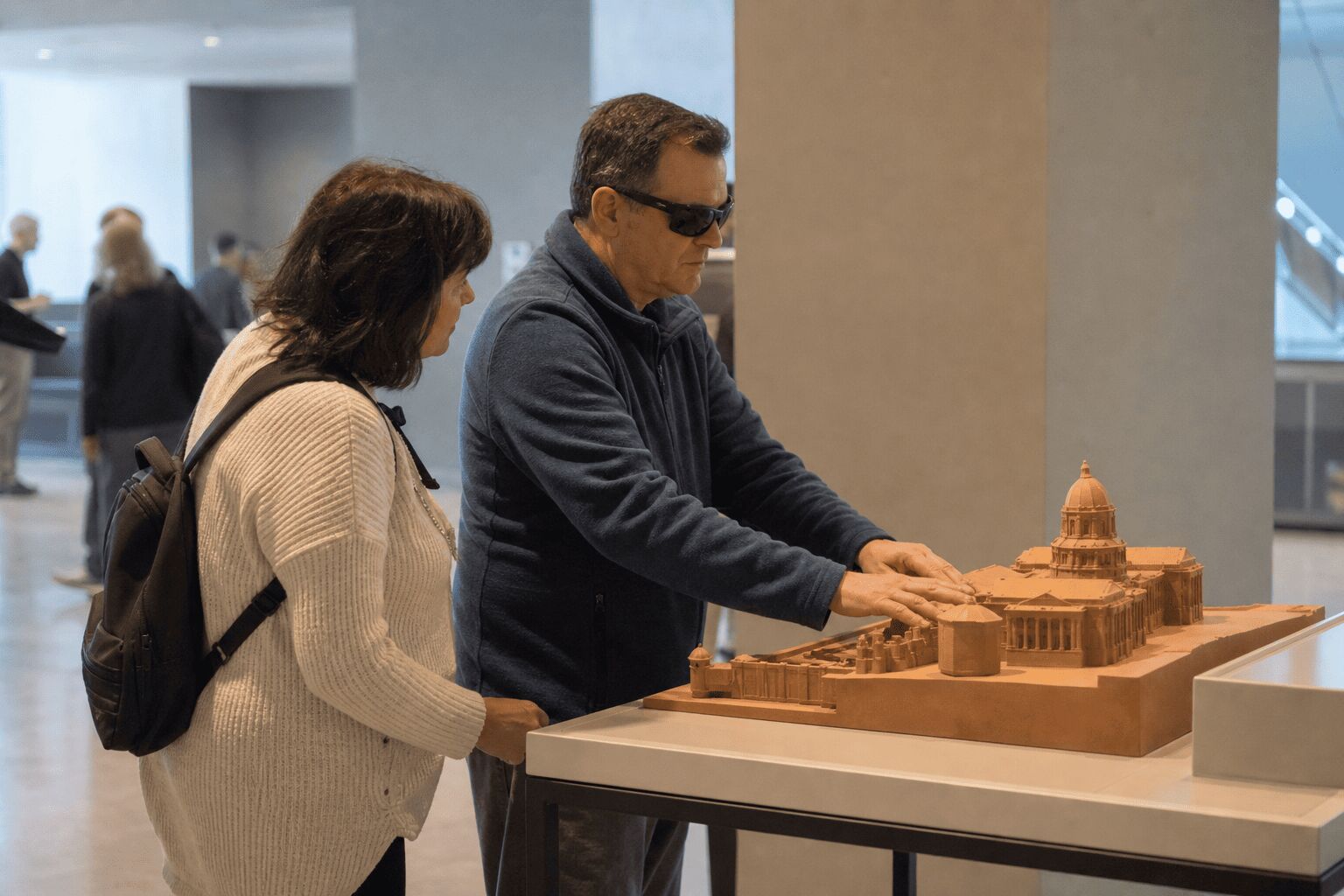
Which Russian cities are most accessible?
Moscow has the widest range: the State Historical Museum, Garage, VDNKh, Tsaritsyno, Museum of Russian Impressionism and Museum of Architecture combine tactile interpretation and spoken description in different ways.
St Petersburg stands out for permanent resources at the Hermitage and Russian Museum. Kazan Kremlin publishes regular inclusive programs, and Kaliningrad's Amber Museum maintains multisensory tactile stations.
Irkutsk and Oryol are useful examples of NFC interpretation. Technology alone does not make a whole building accessible: evaluate the entrance, stairs, navigation, toilets and format of each event separately.
How blind visitors experience museum collections
| Format | What it provides | Examples |
|---|---|---|
| Tactile models and 3D copies | Communicate shape, scale, architecture and surface details. | Hermitage, Russian Museum, Historical Museum, Tsaritsyno |
| Relief interpretations of paintings | Clarify composition, outlines and the position of key subjects. | Russian Museum, Museum of Russian Impressionism |
| Audio description | Translates visual information into structured spoken language. | Garage, Museum of Architecture, Kazan Kremlin |
| Scent elements | Add an olfactory layer to a work or historical object. | Museum of Russian Impressionism, Amber Museum |
| NFC tags | Launch audio on a compatible phone without locating a QR code. | Decembrist Museum in Irkutsk, Rusanov House Museum in Oryol |
| Braille and tactile navigation | Explain gallery content and support independent orientation. | Hermitage, Historical Museum, Russian Museum |
How to visit an accessible museum in Russia
- Choose a specific program. Look for an accessibility or inclusion section rather than relying on the general ticket page.
- Contact the museum early. Confirm the date, group size, language, audio description and whether tactile stations work independently.
- Ask about the entrance. Request the nearest transport stop, exact door, steps and a contact for the front-of-house team.
- Confirm touch rules. Ask which models may be handled and whether you need your own smartphone or headphones.
- Check concession evidence. Bring relevant documents but do not assume admission is free without checking the event rules.
- Plan a calm pace. One large museum or two smaller spaces usually make a more comfortable day than a long checklist.
Build an accessible route without overloading the day
Add the museum, a comfortable lunch stop and a short walk. AlpacaBag will distribute the places across your available days.
Build my itinerary10 accessible museums and programs in Russia
This is a practical list, not a best-to-worst ranking. A permanent tactile station may be easier for an independent visit, while a temporary audio-described tour can provide more context but requires a reservation.
1. St Petersburg
State Hermitage Museum
The Main Museum Complex has tactile models in the Ancient World and Ancient China rooms, while the General Staff Building has models in its Empire-style galleries.
Formats: Tactile models, audio description and braille labels
Planning: Start with the museum page for blind visitors and confirm which building and route are available on your chosen date.
Check the current program on the official website2. St Petersburg
State Russian Museum
The Stroganov Palace offers adapted sculpture copies for tactile exploration. Architectural models are also available at the Mikhailovsky Palace and Mikhailovsky Castle.
Formats: Tactile gallery, 3D copies, relief images and audio guides
Planning: Check accessibility for the specific palace and look for adapted-tour announcements on the Accessible Museum page.
Check the current program on the official website3. Moscow
State Historical Museum
The first floor includes models of key objects from the Stone Age to Peter the Great, presented on stands with integrated audio description.
Formats: Tactile models, audio description and braille
Planning: Contact the accessibility team in advance for details about specialist tours and workshops.
Check the current program on the official website4. Moscow
Garage Museum of Contemporary Art
Garage regularly runs tours, one-work discussions, workshops and film screenings designed for blind and partially sighted visitors.
Formats: Tactile models, audio description and adapted events
Planning: Choose a current event and email blind@garagemca.org before your visit.
Check the current program on the official website5. Moscow
VDNKh Museum City
Architectural models are located at the Cosmonautics and Aviation Center, VDNKh Museum and the information center inside the Main Entrance arch.
Formats: Tactile models and tours with audio-description elements
Planning: Check the current VDNKh schedule for group tours at the Cosmonautics and Aviation Center and Slovo Museum.
Check the current program on the official website6. Moscow
Tsaritsyno Museum-Reserve
The Grand Palace presents tactile interpretations of architecture, portraits, sculpture and decorative objects.
Formats: Architectural models, tactile copies and specialist tours
Planning: Follow the Accessible Collection project and register for a scheduled adapted tour when one matches your dates.
Check the current program on the official website7. Moscow
Museum of Russian Impressionism
Multisensory stations combine tactile interpretations of paintings with selected scents, while temporary exhibitions receive adapted programming.
Formats: Relief models, scents and audio-described tours
Planning: Request an audio-described tour by emailing inclusion@rusimp.org.
Check the current program on the official website8. Moscow
Shchusev State Museum of Architecture
The main-building foyer has a tactile model of the museum estate and object copies. Selected exhibitions offer tours with architectural reliefs.
Formats: Models, reliefs, braille and audio description
Planning: Notify the museum in advance if you need assistance or an audio-described tour.
Check the current program on the official website9. Kazan
Kazan Kremlin Museum-Reserve
Programs take place around the Kremlin, at the Natural History Museum of Tatarstan and during selected Hermitage–Kazan exhibitions.
Formats: Tactile stations, audio description and video tours
Planning: Check the monthly inclusive-program schedule and arrange group visits with the accessibility team.
Check the current program on the official website10. Kaliningrad
Kaliningrad Amber Museum
Stations interpret an amber casket and the Rus mosaic through models, textures and scents; audio is available through a museum device and IZI.travel.
Formats: Tactile stations, scents and audio description
Planning: Confirm station availability and the current status of the Touch of Light audio-described tour.
Check the current program on the official websiteNFC museum guides in Irkutsk and Oryol
The Volkonsky and Trubetskoy estates of the Irkutsk Decembrist Museum use raised NFC tags with audio descriptions. A comparable system of 50 tags operates at the Vladimir Rusanov House Museum in Oryol. A compatible phone opens the audio without a dedicated app, but NFC must be enabled.
Confirm current visitor conditions with the Irkutsk Decembrist Museum and the Rusanov House Museum.
Useful city routes for museum trips
A museum works best as part of a realistic city day. AlpacaBag currently has published Russian-language history routes for Moscow, St Petersburg, Kazan and Kaliningrad. Use one as a framework and replace unsuitable stops with your chosen museum.
For a longer journey, continue with our Russia trip-planning guide. You can also compare the best automotive museums in Russia and explore our guide to unusual museums around the world.
For an overnight visit, compare hotels near the museum, consider an individual city tour and check domestic flights. An eSIM helps when contacting accessibility coordinators, and travel insurance belongs on the practical preparation list.
FAQ
Are there museums only for blind people in Russia?
Large museums exclusively for blind visitors are not the usual model. Accessibility is generally integrated into mainstream museums through tactile models, audio description, braille and specialist programs.
Can blind visitors touch museum exhibits?
Only objects explicitly identified as tactile: models, copies, reliefs and materials at dedicated stations. Original objects in standard galleries must not be touched unless museum staff clearly permit it.
Do accessible museum tours require advance booking?
Permanent tactile stations may be available during a regular visit, but specialist tours usually follow a schedule and have small groups. Contact the museum before traveling.
Is museum admission free for blind visitors in Russia?
Concessions vary by institution, event type and required documents. Check the official ticket rules: a free adapted event does not automatically make every exhibition free.
How can a blind visitor navigate a large museum?
Ask for a description of the entrance and accessible route, tactile maps and meeting assistance. On arrival, speak to the administrator rather than relying only on a general audio guide.
Which technologies do accessible museums use?
Common tools include tactile models, raised graphics, audio description, braille, scent elements and NFC tags with spoken descriptions. The available mix can differ between branches of the same museum.